How to Qualify for a Mortgage in Canada
Before you apply, it helps to understand what lenders actually look at and where you might fit. Every lender sets its own guidelines, so a turndown from one does not mean the door is closed everywhere.
At LendToday, we help homeowners across Canada compare bank, alternative, and private mortgage options. This guide walks you through the main things that shape approval, so you can see your likely path before you ever fill out an application.
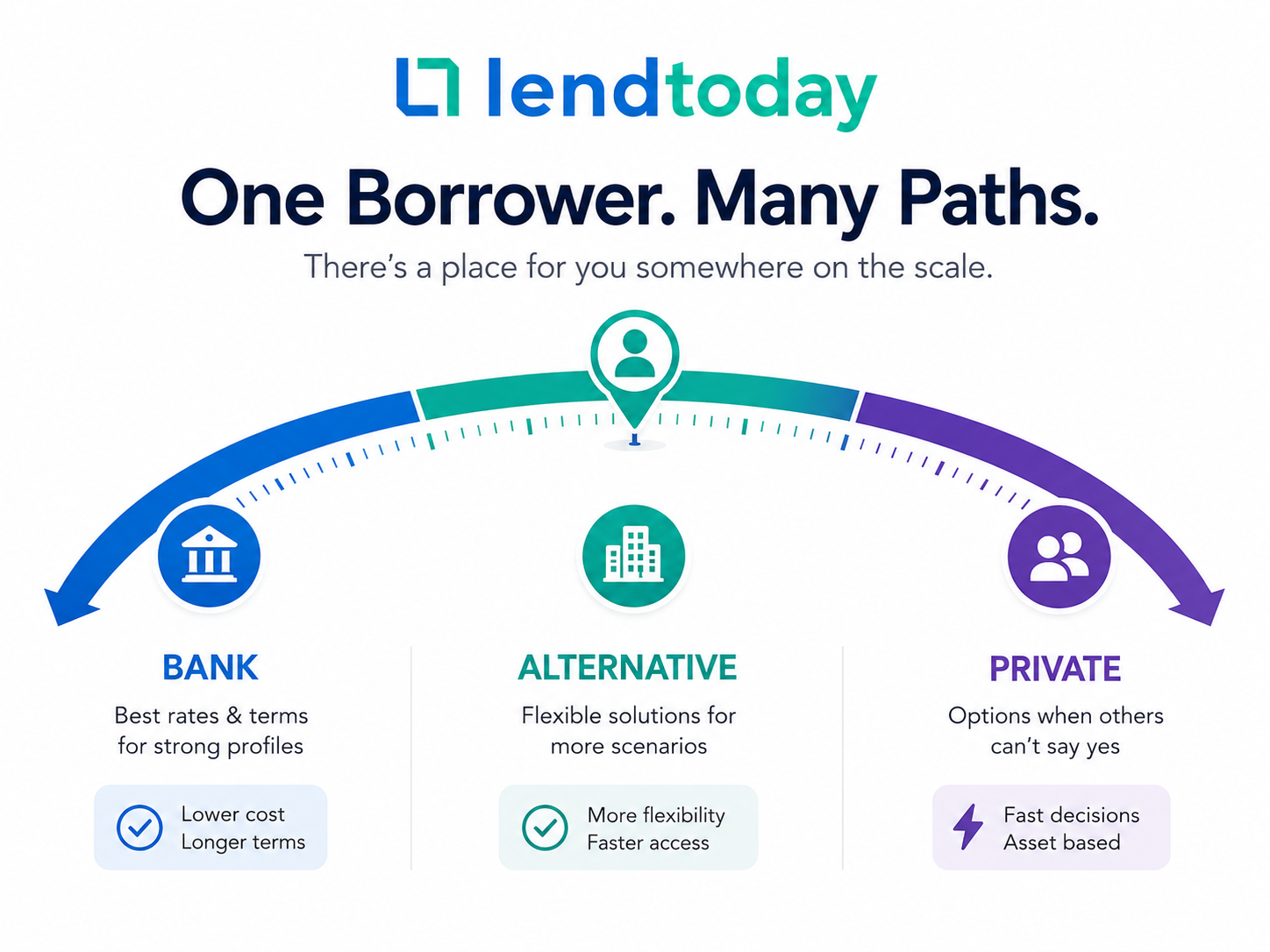
The Mortgage Approval Path
Every application follows a similar path. Lenders review the same core areas, then match you to a product that fits. Here is the journey at a glance.
What Lenders Look At
Mortgage qualification comes down to a simple question in the lender's mind: can you comfortably repay this loan, and is the property good security if something goes wrong? To answer that, they review a handful of core areas.
No single factor decides your application on its own. A strength in one area can offset a weakness in another, which is why two people with the same credit score can get very different answers. Understanding each piece helps you see where you stand and where a specialist can help.
The five pillars below are what nearly every lender weighs, from the big banks to alternative and private lenders. What changes between them is how strict they are on each one.
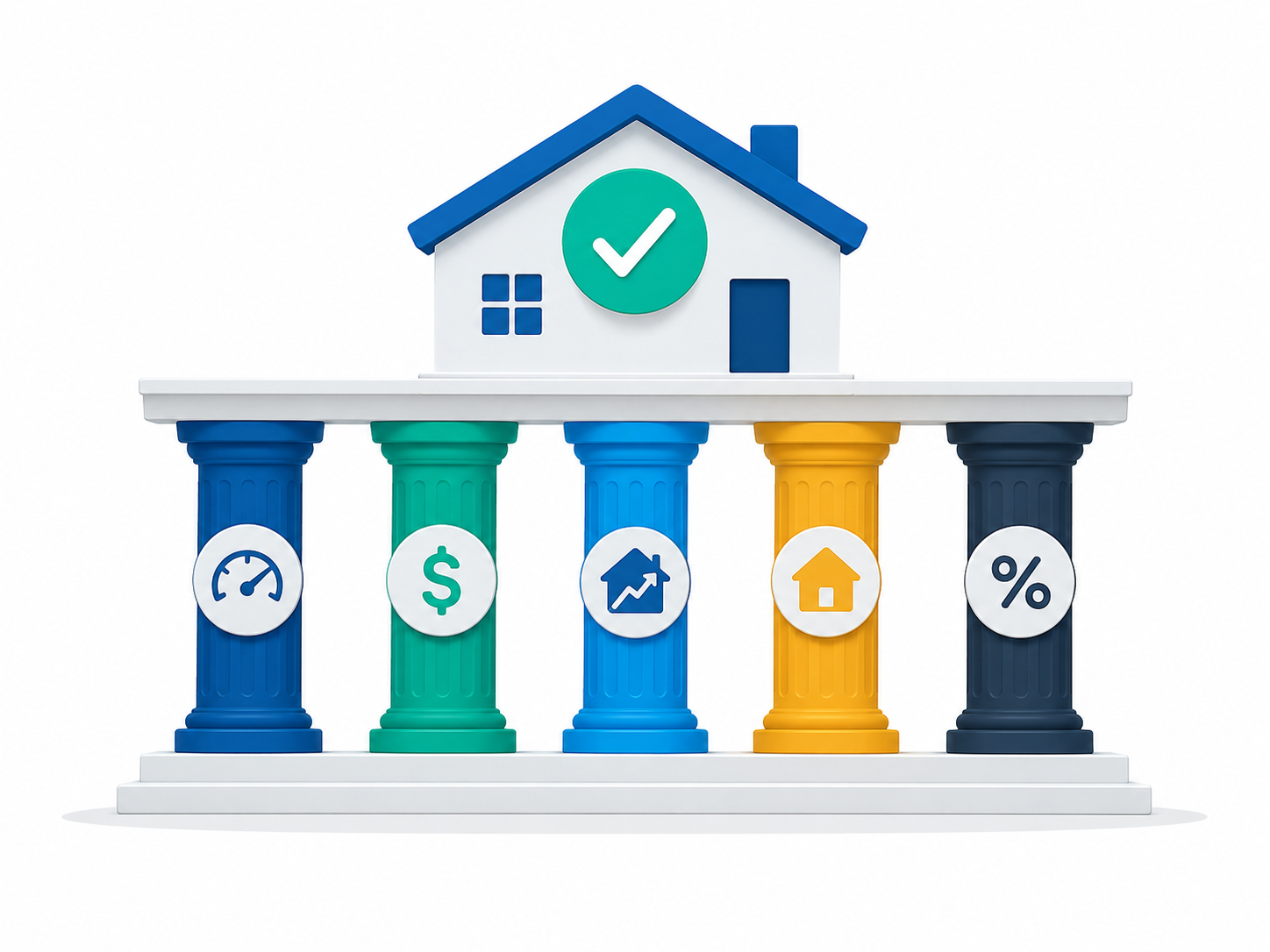
The 5 Pillars of Mortgage Approval
These are the areas lenders review on almost every application. Alternative and private lenders take a more flexible view of each one, which is why options exist when a bank says no.
1. Credit History
Your credit report shows how reliably you pay your bills and manage debt. Banks want strong, clean credit. A lower score is not the end of the road, it simply points you toward a different type of lender.
Where flexibility exists: alternative lenders often consider lower scores.2. Income & Employment
Lenders want to see that you can afford the payments. Salaried income is easiest to prove, while self-employed, commission, and contract income can take more documentation.
Where flexibility exists: alternative lenders accept non-traditional income.3. Down Payment or Equity
Buying a home requires a down payment. Refinancing relies on the equity already built up in your property. The more you have, the more options open to you.
Where flexibility exists: strong equity can offset weaker credit.4. The Property Itself
Your home is the lender's security. They review its value, condition, and location, usually with an appraisal, to confirm it is a sound property to lend against.
Where flexibility exists: private lenders focus heavily on the property.5. Debt Service Ratios
Lenders measure your housing costs and total debt against your income using two ratios, GDS and TDS. These help confirm the payment fits your budget.
Where flexibility exists: some lenders work with higher ratios.The Full Picture
A good lender weighs all five pillars together, not in isolation. That is exactly how a mortgage broker approaches your file, matching your full situation to the lender most likely to approve it.
This is where working with a broker pays off.Debt Service Ratios: GDS and TDS
Two ratios sit at the heart of mortgage qualification in Canada. They measure how much of your income goes toward housing and total debt. Understanding them helps you see how much room you have.
What the Numbers Mean
Gross Debt Service (GDS) is the share of your gross income that goes toward housing costs, including your mortgage payment, property taxes, heating, and half of any condo fees. As a general guideline, this should not be more than 39% of your gross household income.
Total Debt Service (TDS) adds all your other monthly debts, such as car loans, credit cards, and lines of credit. As a guideline, your total debt load should not be more than 44% of your gross income.
These are guidelines, not hard walls. You may still qualify even if your ratios are slightly higher, and alternative lenders often work with more flexible limits. A specialist can tell you what is realistic for your situation.
A Simple GDS Example
Say your household earns $8,000 a month before taxes. Here is how a lender would estimate your housing costs against the 39% GDS guideline. These are round sample numbers for illustration only.
| Gross monthly income | $8,000 |
| Mortgage payment | $2,100 |
| Property taxes | $350 |
| Heating | $150 |
| GDS ratio | ~32% |
At about 32%, this example sits comfortably under the 39% guideline, leaving room for the lender to also check the TDS ratio once other debts are added.
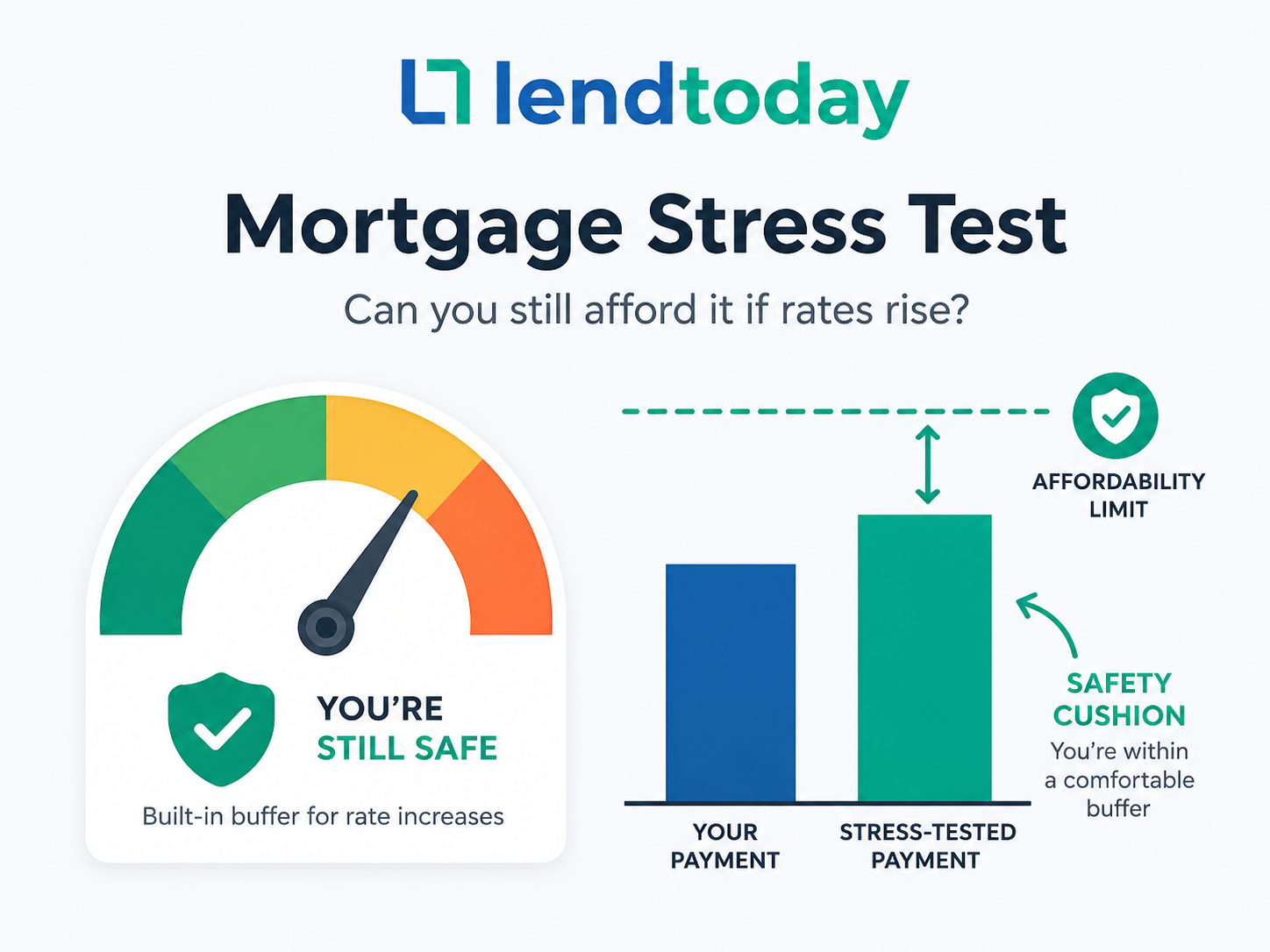
The Mortgage Stress Test
Federally regulated lenders, including the big banks, must run a stress test. Instead of qualifying you at your actual rate, they check whether you could still afford the payment at a higher qualifying rate.
That qualifying rate is the greater of your contract rate plus two percentage points, or 5.25%. The idea is simple: if rates rise by the time you renew, can you still handle the payment?
The stress test is a common reason a capable borrower is turned down by a bank. Lenders that are not federally regulated, along with many alternative lenders, are not required to apply it in the same way, which can open up options.
Different Lenders, Different Guidelines
There is no single, universal approval standard in Canada. Each lender sets its own lending guidelines and policies, and a lender can even decline an application after a preapproval. That is the single most important thing to understand about qualifying.
It means one bank may say no while another says yes. It means a decline from a big bank does not rule out an alternative lender. And it means the right question is rarely "do I qualify" in general, but "which lender is the right fit for my situation."
This is exactly where a mortgage brokerage adds value. Rather than trying your luck with one lender at a time, we compare bank, alternative, and private options to find the one most likely to approve you, before you apply.
Bank, Alternative, and Private Lenders
Mortgage lenders in Canada generally fall into three tiers. Each one weighs the five pillars differently. Seeing them side by side makes it clear why a turndown is rarely the end of the road.
| Factor | Bank (A Lender) | Alternative (B Lender) | Private Lender |
|---|---|---|---|
| Rates | Lowest | Moderate | Highest |
| Credit | Strong credit required | Bruised credit accepted | Credit less important |
| Income | Strong, fully documented | Some flexibility | Equity focused |
| Approach | Strict guidelines | Common-sense underwriting | Customized approvals |
| Best for | Prime borrowers | Just miss bank criteria | Short-term, equity-rich |
Explore the tiers in more detail through our bad credit mortgage and private mortgages pages.
Where Do You Fit?
Use this as a rough guide. Find the description that sounds most like you in each row, then look at which tier it points toward. Most people land across more than one tier, and that is exactly what a specialist helps sort out.
Credit Score
- Strong (higher range)Bank
- Fair (mid range)BankAltPrivate
- Bruised (lower range)AltPrivate
- Serious credit issuesPrivate
Employment
- Salaried, long tenureBank
- Commission or contractBankAltPrivate
- Self-employedBankAltPrivate
- Hard to documentPrivate
Home Equity or Down Payment
- High (35% or more)Bank
- Moderate (around 20%)Bank
- Lower, but some equityBankAltPrivate
- Equity-driven requestPrivate
Income Stability
- Stable and predictableBank
- Variable but steadyBankAltPrivate
- Recently changedBankAlt
- IrregularPrivate
Existing Debt
- LowBank
- ModerateBankAltPrivate
- HighBankAltPrivate
- Very high or in collectionsPrivate
Reading Your Results
Mostly Bank means you are likely a fit for a traditional lender. A mix that leans Alternative is very common and completely workable. Any Private answers simply mean a specialist review will help most. This is general guidance, not an approval, and your real options are confirmed after a full review.
Every situation is different, both in its story and its finances. Two people with the same numbers can get very different answers once the full picture is understood. That is why it helps to share as much as you can with your lender or mortgage broker. A clear explanation of your circumstances can make all the difference in securing the best approval options.
What This Looks Like in Practice
Here are three illustrative examples to show how the pieces come together. These are hypothetical scenarios created to explain the concept, not real clients, and every real situation is reviewed individually.
Example: A Salaried Buyer
- Strong credit
- Salaried, T4 income
- Large down payment
- Low existing debt
Example: A Self-Employed Owner
- Fair credit
- Self-employed income
- Solid home equity
- Some existing debt
Example: Rebuilding After a Setback
- Past credit event, now discharged
- Strong home equity
- Working to rebuild credit
- Clear plan forward
Why Strong Borrowers Get Declined
Plenty of capable people are turned down by a bank for reasons that have little to do with whether they can afford the payment. When a bank says no, it is usually a guideline you did not fit, not a judgment on you.
Common reasons an otherwise strong applicant is declined include:
- Probationary or recently started employment
- Self-employed or commission-based income
- Variable income that is hard to average
- How rental income is treated by the lender
- A recent job or industry change
- Not quite enough down payment or equity
- The property type, condition, or location
- A high level of unsecured debt
- A recent consumer proposal or credit event
Most of these are workable with the right lender. This is often the path forward for people with self-employed income or a bruised credit history.

What Can Improve Your Approval Chances
If you are close but not quite there, small changes can make a real difference. Here are practical steps that often strengthen an application.
- Lower your credit utilization by paying down card balances
- Pay off or reduce revolving debt before you apply
- Increase your down payment or use available home equity
- Add a co-borrower with strong income or credit
- Wait until a probationary period ends, if you recently started a job
- Correct any errors on your credit bureau report
- Consolidate high-interest debt to improve your ratios
- Consider an alternative lender while you rebuild
Several of these tie directly into solutions we offer, such as refinancing to consolidate debt or tapping a home equity line of credit. A specialist can help you decide which move fits your situation.
Explore Your Options
Depending on where you fit, one of these solutions may be the right next step. Choose any option to learn more.
Not Sure Which Lender Fits Your Situation?
Every lender has different approval guidelines. We compare bank, alternative, and private mortgage options to help you find the best fit, before you apply.
Apply online today and we will typically get back to you within 24 hours with a clear, no-obligation picture of your options.
Mortgage Qualification FAQs
How do I qualify for a mortgage in Canada?
Lenders review five main areas: your credit, income and employment, down payment or equity, the property, and your debt service ratios. Each lender sets its own guidelines, so a strong file in one area can offset a weaker one in another. A specialist can review your full situation and point you to the right lender.
What are GDS and TDS ratios?
Gross Debt Service (GDS) is the share of your gross income that goes toward housing costs, generally kept to no more than 39%. Total Debt Service (TDS) adds all your other debts and is generally kept to no more than 44%. These are guidelines, and you may still qualify if you are slightly higher.
What is the mortgage stress test?
Federally regulated lenders must confirm you could afford your payment at a qualifying rate, which is the greater of your contract rate plus two percentage points or 5.25%. It is a common reason a capable borrower is declined by a bank, and some lenders are not required to apply it the same way.
Can I qualify with bad credit?
Often, yes. Lower credit scores usually point you toward an alternative or private lender rather than a bank. Learn more about a bad credit mortgage.
Can I qualify if I am self-employed?
Yes. Self-employed and hard-to-document income does not rule you out, though it can take more paperwork with a bank. Alternative lenders take a more flexible view. Explore self-employed mortgage options.
Can I qualify after a bankruptcy or consumer proposal?
It is often possible, especially once the event is discharged and you have some equity or a plan to rebuild. An alternative or private lender is usually the starting point, as a short-term bridge back to a bank.
Do private lenders use GDS and TDS?
Private lenders focus far more on the property and your equity than on strict ratios. They are the most flexible tier, which is why they suit short-term and equity-driven situations. Explore private mortgages.
What documents do lenders need?
Expect to provide identification, proof of income, and details of the property and your down payment or equity. Self-employed applicants usually provide two years of income history. Requirements vary by lender, and a specialist will tell you exactly what applies to you.
How much down payment do I need?
To purchase, the minimum starts at 5% for insured buyers, and 20% is common with alternative lenders. For a refinance, it is the equity in your home that matters rather than a cash down payment.
Does home equity help me qualify?
Yes. Strong equity gives lenders more security and can offset a weaker credit or income picture. It also opens up options like a home equity line of credit or a second mortgage.
Can I qualify with tax debt or collections?
It depends on the situation, but it is often workable through an alternative or private lender, particularly if you have equity. These are exactly the cases a specialist review is built for.
Can I qualify if I am retired?
Yes. Retirement income, including pensions and government benefits, can count toward qualification. What matters is that the income is stable and documented.
Does rental or support income count?
It often does. Many lenders include a portion of rental income and can consider spousal or child support. How much counts varies by lender, which is one more reason comparing options helps.
What if my mortgage renewal is coming up?
A renewal is a good time to review your options, especially if your situation has changed. If your current lender will not renew, an alternative lender may still approve you. Reach out for a no-obligation review.
What if I do not fit bank guidelines?
You still have options. A decline from one bank does not rule out another lender, and alternative and private lenders exist for exactly this reason. Contact us to find out what fits your situation.
Sources: Financial Consumer Agency of Canada, Preparing to get a mortgage and Getting preapproved for a mortgage; Canada Mortgage and Housing Corporation, Calculating GDS / TDS.