Private Mortgages in Ontario
A private mortgage can be the difference between staying in your home and losing it. When the bank says no, a private mortgage looks at the equity in your property and the strength of your plan, not just a credit score on a page.
At LendToday, we help homeowners across Ontario access private mortgages, from the Greater Toronto Area and Durham Region to Ottawa, Hamilton, and London. Whether you are dealing with bruised credit, debt that has built up, or income that is hard to document, we work to find a solution that fits.
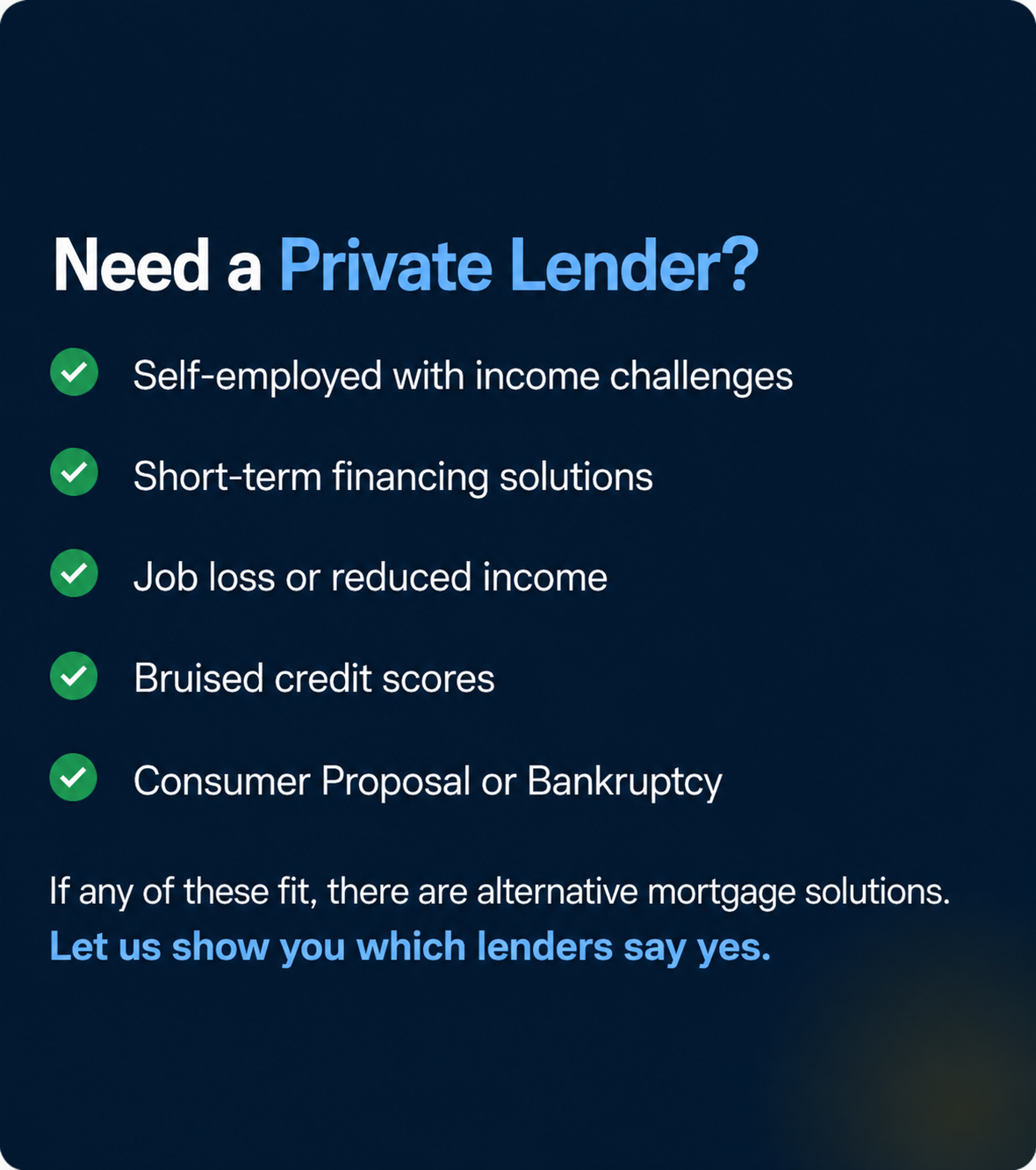
What Is a Private Mortgage?
A private mortgage is a loan secured against your home that comes from a private lender rather than a traditional bank. Private lenders can be individuals, groups of investors, or lending companies that fund mortgages outside the strict rules the big banks follow.
Because the loan is secured by your property, a private lender focuses first on your home equity and the strength of your exit plan. Your credit score and income still matter, but they do not carry the same weight they would at a bank. This is why a private mortgage is often possible even when a bank has already turned you down.
Private mortgages are usually meant as a short-term bridge. They give you room to solve a pressing problem, stabilize your finances, and then move back to more traditional financing when you qualify again. Ontario's regulator, the Financial Services Regulatory Authority of Ontario (FSRA), similarly stresses that homeowners using private lenders should understand the risks and have a clear exit strategy to return to a traditional mortgage. Learn more about a bad credit mortgage and how equity-based approval works.

Types of Private Mortgages in Canada
A private mortgage is not one single product. The right structure depends on what you already owe, how much equity you have, and what you are trying to solve. Here are the common ways homeowners use one.
First Mortgage
A private first mortgage sits in first position on your home. Homeowners often use one when a bank will not renew or approve a new mortgage, but the equity is there to support the loan.
Second Mortgage
A private second mortgage sits behind your existing first mortgage. It lets you tap equity without touching a low-rate first mortgage you want to keep in place.
Bridge Financing
Private bridge financing covers a short gap, such as the time between buying a new home and selling your current one, when timing does not line up with a bank's schedule.
Debt Consolidation
A private mortgage can roll several high-interest debts into one payment secured by your home, often clearing collections or arrears that a bank will not work around.
Home Equity Access
If you have built equity but cannot qualify for a traditional home equity loan, a private mortgage can turn that value into funds you can use.
Refinancing
A private mortgage can refinance an existing loan to stop a pressing problem, such as arrears or a looming power of sale, and give you time to get back on track.
When a Private Mortgage Makes Sense
A private mortgage is not the right fit for everyone, but for many homeowners it is the most direct way to solve a problem the bank cannot help with. It is often worth considering when:
- You have equity in your home but the bank has declined you
- Your credit has taken a hit and you need a solution now
- You are self-employed or have income that is hard to document
- You are behind on your mortgage, property taxes, or CRA payments
- You need funds quickly for a time-sensitive situation
- You want to consolidate high-interest debt into one payment
Why Homeowners Choose LendToday
Experience that works for you. Our team brings more than 30 years of combined experience helping Canadians access financing when the bank has said no.
We work where banks won't. We base our decisions on your equity, so a bruised credit history, a high debt load, or income that is hard to document does not automatically rule you out.
Access to private and alternative lenders. Through our network, we connect you with private lenders who base their decision on your equity and your plan, not just a credit score.
Guidance beyond the mortgage. A private mortgage is usually a bridge, so we help you map a path back to traditional financing and, where useful, rebuild your credit over time.
An honest answer, fast. Apply online today and we will typically get back to you within 24 hours with a clear, no-obligation picture of your options.
How a Private Mortgage Works
The idea is simple. A private lender advances funds secured by the equity in your home, with a focus on your plan to repay or refinance later. Here is the plain-language version of how it usually comes together.
A Simple Example
Say a homeowner has built solid equity in their property, but has fallen behind after a job loss and now has bruised credit and a balance owing. The bank will not renew their mortgage, and the pressure is mounting.
A private lender looks at the equity in the home and a realistic plan to get back on track. They advance a private mortgage that clears the arrears and the high-interest debt, replacing them with one manageable payment secured by the property.
This is a simplified illustration. The amount available to you, your payment, and your term all depend on your property value, your current mortgage balance, your equity, and the plan you qualify for. A specialist can walk you through the exact numbers for your situation.
See how this has worked for real homeowners in our client case studies.
Private Mortgage vs Bank Mortgage
A private mortgage and a bank mortgage both use your home as security, but they work very differently. Here is a general comparison to help you see where a private mortgage fits.
| Factor | Private Mortgage | Bank Mortgage |
|---|---|---|
| Approval based on | Home equity and your exit plan | Credit score, income, and strict ratios |
| Credit requirements | Flexible, equity-driven | Strong credit usually required |
| Income documentation | Flexible, works for self-employed | Full, traditional proof of income |
| Typical term | Short-term, often a one to three year bridge | Longer-term, multi-year |
| Best for | Solving a pressing problem the bank cannot help with | Standard financing when you meet bank criteria |
| Speed of process | Often faster once equity is confirmed | Slower, rigid approval process |
A private mortgage is usually a stepping stone, not a permanent solution. You may also want to explore refinancing to consolidate debt or a home equity line of credit.
What You Can Use a Private Mortgage For
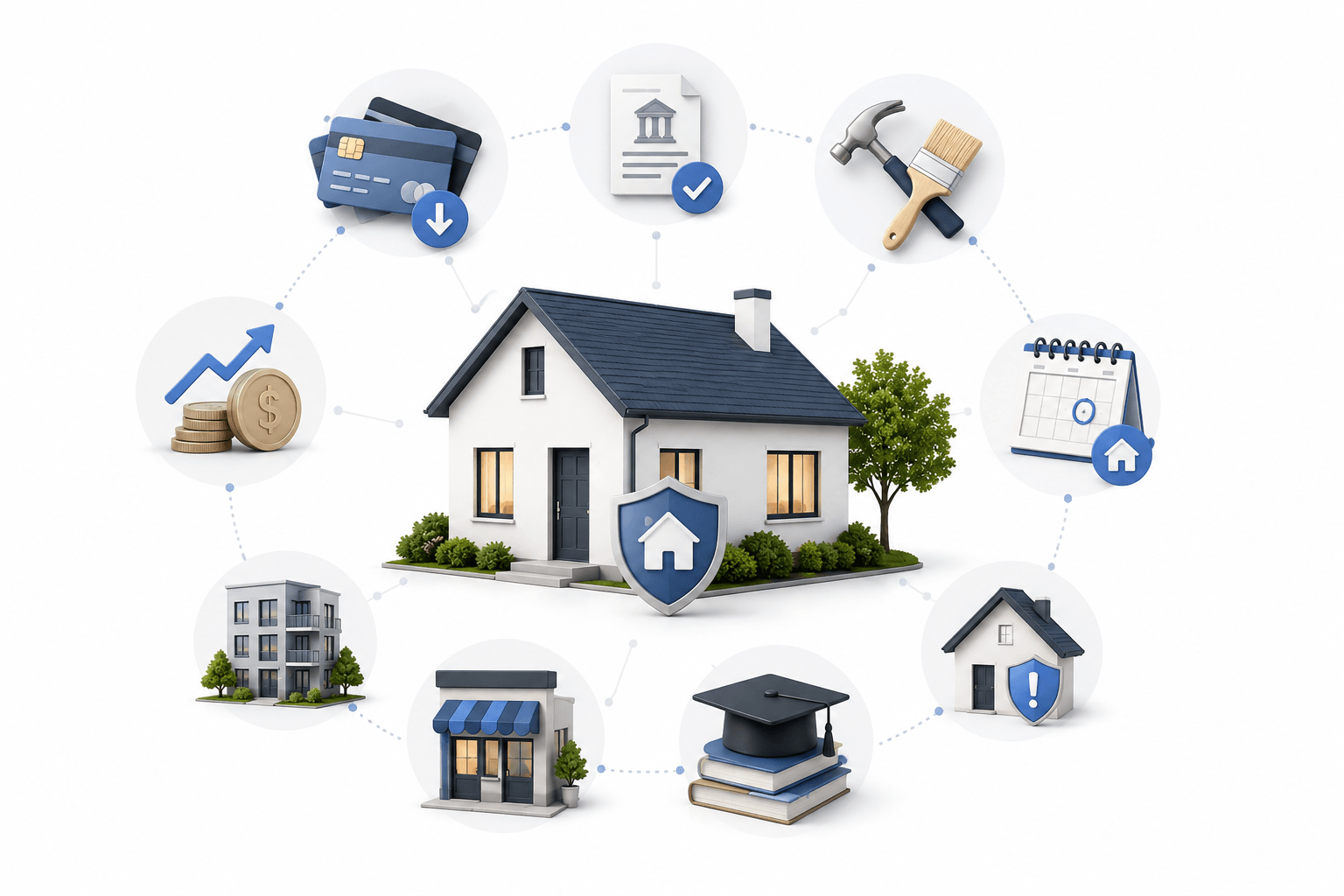
Homeowners turn to private mortgages to solve a wide range of problems that banks will not touch. The funds you access can be put toward many goals. Choose any option to get started.
Why Your Bank May Say No
Traditional banks follow rigid lending rules, and a strong homeowner can still be turned down for reasons that have little to do with whether they can afford the payment. When the bank says no, it is rarely about your character. It is about a checklist you did not fit.
Common reasons a bank declines an otherwise capable homeowner include:
- A low or bruised credit score
- Too much existing debt relative to income
- Failing the federal mortgage stress test, which requires you to requalify at a higher rate
- Self-employed or hard-to-document income
- A history of missed or late payments
- A current or past consumer proposal or bankruptcy
- Mortgage arrears or falling behind on payments
A private lender weighs your equity and your plan far more heavily, and is not bound by the federal stress test that banks must apply. A challenge that stops a bank cold is frequently workable through a private mortgage. This is often the path forward for homeowners dealing with mortgage arrears, property tax arrears, or CRA tax debt.

Do You Qualify for a Private Mortgage?
Qualifying for a private mortgage is less about a perfect credit file and more about the equity in your home and a workable plan. You may be a strong candidate if the following are true.
- You own a home in Ontario with equity built up in it
- You have a clear reason for the funds and a plan to move forward
- You can support a manageable monthly payment
- You are willing to treat the private mortgage as a short-term bridge
Even if you are behind on payments, self-employed, or carrying bruised credit, a private mortgage may still be within reach. The best way to know is a quick, no-obligation review. Learn more about a bad credit mortgage or self-employed mortgage options.
How to Get a Private Mortgage With LendToday
Getting started is simple, and there is no obligation to proceed. Here is what the process looks like from your first step to a clear answer.
Fill out our short, secure application. It takes only a few minutes and there is no obligation.
We look at your home equity and your goals, not just your credit score, to understand what is possible.
Drawing on our network of private and alternative lenders, we find the private mortgage that fits your situation.
Apply today and we will typically get back to you within 24 hours with a clear picture of what is possible.
Ready to Explore a Private Mortgage?
If the bank has said no, a private mortgage may be the solution that keeps you in your home and back in control. At LendToday, we lay out your options clearly, with no obligation to proceed.
Apply online today and we will typically get back to you within 24 hours.
Private Mortgage FAQs
What is a private mortgage?
A private mortgage is a loan secured against your home from a private lender rather than a bank. Private lenders focus on your home equity and your plan to repay, so a private mortgage is often possible even when a bank has declined you.
How is a private mortgage different from a bank mortgage?
A bank mortgage depends on strong credit, full income proof, and strict ratios. A private mortgage leans on your home equity and your exit plan, which makes it flexible for homeowners with bruised credit, hard-to-document income, or a pressing problem to solve.
Can I get a private mortgage with bad credit?
Often, yes. Because a private lender weighs your home equity more heavily than your credit score, a private mortgage is frequently possible even after a bank has said no. Learn more about a bad credit mortgage.
How much can I borrow with a private mortgage?
The amount depends on your home's value, your current mortgage balance, and the equity you have available. A specialist can confirm what is realistic for your property and your situation during a no-obligation review.
Is a private mortgage a long-term solution?
Usually not. A private mortgage is meant as a short-term bridge that solves a pressing problem and gives you time to stabilize. The goal is to move back to traditional financing once you qualify again.
Can I get a private mortgage if I am self-employed?
Yes. Self-employed and hard-to-document income does not automatically rule you out, because approval leans on your home equity and your plan. Learn more about self-employed mortgage options.
Can a private mortgage stop a power of sale or foreclosure?
Often, yes. A private mortgage can refinance your situation to clear arrears and buy you time when you are facing a power of sale. If you are behind on payments, explore our help with missed mortgage payments and mortgage arrears.
Can I use a private mortgage to pay off CRA or property tax debt?
Yes. Many homeowners use a private mortgage to clear CRA tax debt or property tax arrears before penalties or a tax sale escalate, then refinance later once the balance is cleared.
How fast can I get a private mortgage?
It varies by situation, but we typically respond within 24 hours of your application with a clear picture of your options. Private mortgages can often move quickly once your equity is confirmed and your documents are in order.
Do you only help homeowners in Ontario?
LendToday and its agents are licensed under an Ontario mortgage brokerage, serving homeowners across the province, from the Greater Toronto Area and Durham Region to Ottawa, Hamilton, and London. Contact us to find out what private mortgage options are available for your situation.