Mortgage Refinance for Debt Consolidation in Canada
Refinance Your Mortgage to Consolidate Debt
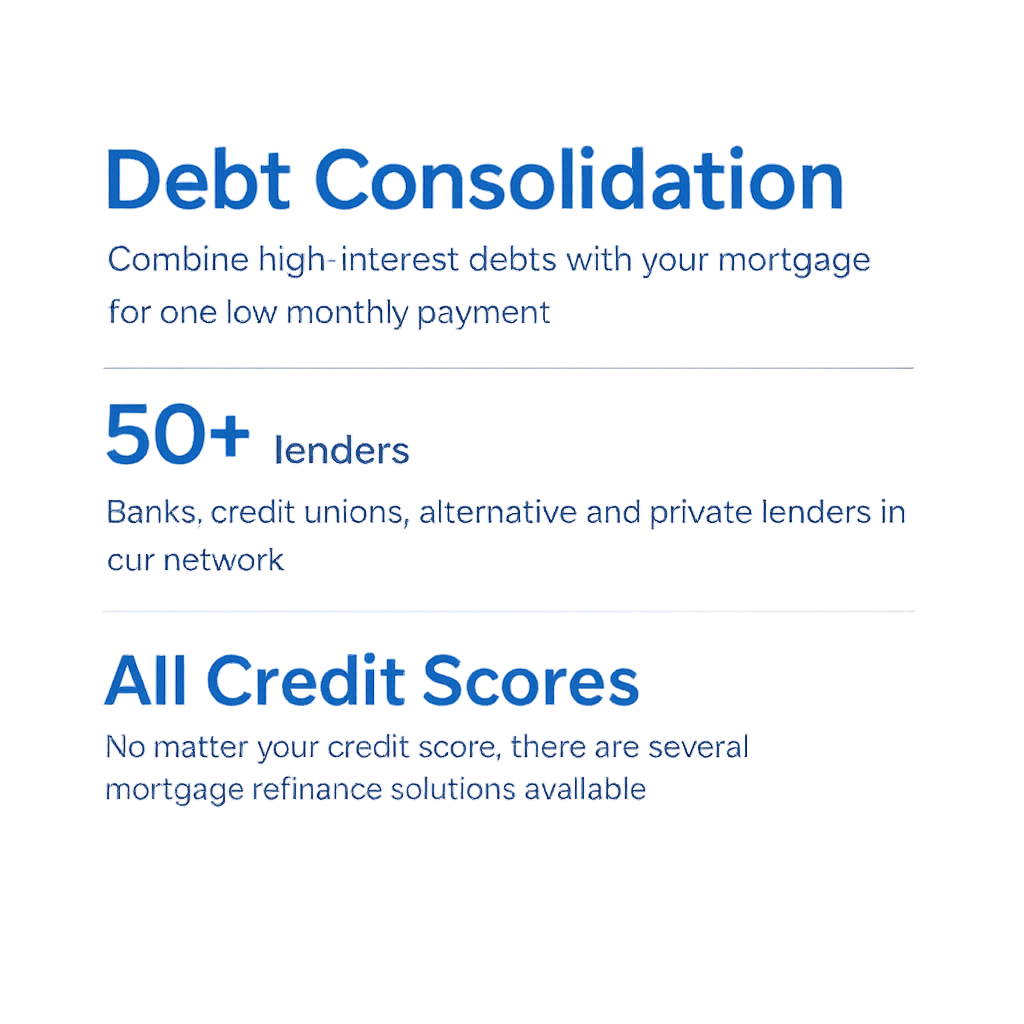
If high-interest credit cards, loans, and bills are stretching your budget every month, refinancing your mortgage to consolidate that debt can roll it all into one lower monthly payment. The equity in your home does the heavy lifting.
At LendToday, we help homeowners across Ontario, from the Greater Toronto Area and Durham Region to Ottawa, Hamilton, and London, use their home equity to clear high-interest debt, free up cash flow, and get back in control, even when the bank has said no.
What Is a Mortgage Refinance for Debt Consolidation?
A mortgage refinance replaces your current mortgage with a new one, usually for a larger amount. When you refinance to consolidate debt, you use the extra funds to pay off high-interest balances such as credit cards, lines of credit, car loans, and other bills.
The result is one mortgage payment instead of several separate payments, often at a much lower interest rate than credit cards charge. Instead of juggling many due dates and high minimums, you have a single, more manageable payment built around the equity in your home.
Because the decision leans heavily on your home equity, refinancing to consolidate debt is often possible even when your credit is not perfect. Learn more about a bad credit mortgage and how equity-based approval works.
When Refinancing to Consolidate Debt Makes Sense
Refinancing is not right for everyone, but for many homeowners it is one of the most effective ways to regain control of their finances. It is often worth considering when:
- You are carrying high-interest credit card or loan balances month to month
- Your minimum payments are hard to keep up with, or barely touch the balance
- You have built up equity in your home you could put to work
- You want a single, predictable monthly payment instead of many
- You have been declined by your bank because of your credit or debt load
- You want to free up monthly cash flow for everyday expenses
How Debt Consolidation Refinancing Works
The idea is simple. You replace scattered, high-interest debts with one mortgage payment secured by your home. Here is the plain-language version of how the numbers usually shake out.
One Payment Instead of Many
Imagine a homeowner juggling several credit card and loan payments each month, each with its own high interest rate and due date. Between the balances and the interest, keeping up can feel impossible, and much of each payment goes to interest rather than the balance itself.
By refinancing and folding those balances into the mortgage, all of that debt becomes part of a single payment, typically at a far lower rate than credit cards charge. The high-interest accounts are paid off, the monthly total is usually lower, and there is one due date to track instead of many.
This is a simplified illustration. Your actual savings depend on your balances, interest rates, home equity, and the terms you qualify for. A specialist can walk you through the exact numbers for your situation.
See how this has worked for real homeowners in our client case studies.
Estimate Your Savings
Want to see what consolidating your debt could look like? Use our free calculators to estimate your potential monthly savings and your new mortgage payment, then talk to a specialist for a precise figure based on your property.
Debt Consolidation Savings CalculatorMortgage Payment Calculator
Benefits of Consolidating Debt Into Your Mortgage
Rolling high-interest debt into your mortgage can do more than simplify your bills. For many homeowners, it changes their entire monthly picture.
Lower Your Interest Costs
Mortgage rates are typically far lower than credit card and unsecured loan rates. Moving high-interest debt to your mortgage can significantly reduce the interest you pay over time.
One Simple Payment
Instead of tracking several due dates and minimum payments, you have a single monthly mortgage payment. Less to juggle, and less chance of a missed payment.
Free Up Monthly Cash Flow
A lower combined payment can leave more room in your budget each month for everyday expenses, savings, or simply breathing space.
Approved On Your Equity
Because approval leans on your home equity, refinancing to consolidate debt is often possible even when a bruised credit history has closed other doors.
A Path to Rebuild Credit
Clearing high-interest balances and keeping up one manageable payment can support healthier credit over time as you make consistent, on-time payments.
Access Up to 80% of Your Value
Depending on your situation, refinancing can let you access up to 80% of your home's value, giving you room to consolidate debt and, where needed, keep some funds on hand.
What You Can Use a Refinance For
Debt consolidation is the most common reason homeowners refinance, but it is far from the only one. The funds you access can be put toward many goals. Choose any option to get started.
How Much Equity Do You Need to Refinance?
In Canada, refinancing typically lets you access up to 80% of your home's value, and no default insurance is available on a refinance. That means the combined total of your new mortgage and any debt you fold into it generally cannot exceed 80% of what your property is worth. The remaining 20% stays as equity you keep in the home. The Financial Consumer Agency of Canada explains the rules for borrowing against home equity in more detail.
Here is the plain-language version. If your home is worth more than what you currently owe, the gap between the two is your equity. The more equity you have built, the more room there is to consolidate debt or access funds through a refinance.
The exact amount available to you depends on your current mortgage balance, your property value, and the terms you qualify for. A specialist can confirm your numbers, and our Home Equity Calculator is a good place to start.
A quick example. Say a home is worth a certain amount and the owner still owes part of it on their mortgage. Refinancing up to 80% of the home's value could free up the difference to pay off high-interest debt, leaving one lower monthly payment in its place.
Every situation is different. The best way to know your exact numbers is a no-obligation review with a specialist.
Why Your Bank May Decline a Refinance
Traditional banks follow rigid lending rules, and a strong homeowner can still be turned down for reasons that have little to do with whether they can afford the payment. Common reasons a bank says no include:
- Too much existing debt relative to income
- Failing the federal mortgage stress test, which requires you to requalify at a higher rate
- A low or bruised credit score
- Self-employed or hard-to-document income
- A history of missed or late payments
- A current or past consumer proposal or bankruptcy
- Mortgage arrears or falling behind on payments
Alternative and private lenders often look beyond these issues. Because they weigh your home equity heavily, a challenge that stops a bank cold is frequently workable through an equity-based solution. Private lenders are also not bound by the federal stress test, so a homeowner who cannot requalify at a bank may still have a path forward. This is often the way through for homeowners dealing with mortgage arrears, property tax arrears, or CRA tax debt. Learn more about a bad credit mortgage.
Refinance vs. HELOC vs. Second Mortgage
Refinancing is one way to use your equity, but it is not the only one. Here is a general comparison of the three most common options for consolidating debt.
| Factor | Refinance | HELOC | Second Mortgage |
|---|---|---|---|
| How it works | Replaces your existing mortgage with a new, larger one | Revolving credit line secured by your equity | New loan behind your existing first mortgage |
| Best for | Consolidating debt into one payment at your mortgage rate | Ongoing or flexible access to funds | Tapping equity without touching your first mortgage |
| Payment structure | One blended mortgage payment | Interest only on what you draw | Separate second payment |
| Keeps first mortgage? | No, it is replaced | Yes, alongside it | Yes, it stays in place |
| Typical maximum | Up to 80% of home value | Up to 65% as a standalone, or 80% combined | Varies by lender and equity |
| Best credit range | Flexible, equity-driven | Stronger credit usually preferred | Flexible, equity-driven |
| Learn more | You are here | HELOC | Second Mortgage |
General comparison for illustration only. The right option depends on your equity, goals, and individual situation.
Can You Refinance With Bad Credit?
Yes. If your credit score has become a problem for your bank or credit union, it does not mean refinancing is off the table. Because a refinance for debt consolidation leans on the equity in your home, a low credit score is far less of a roadblock than it would be with a traditional lender.
Many homeowners use a refinance to consolidate high-interest debt, catch up on past-due bills, and clear obligations from a consumer proposal or bankruptcy. Where it makes sense and saves money, you can also combine a first and second mortgage into one to reduce the interest you pay. If you need faster access to funds, our emergency loan options may also be worth exploring.
Through our network of private and alternative lenders, we work to find a solution that fits your situation, not just your credit score.
A practical first step. Use our Home Equity Calculator to estimate how much you may be able to access, then talk to a specialist for a precise figure based on your property.
Not sure where your credit stands? See our guide to getting a mortgage with bad credit in Canada.
Can You Qualify? An Eligibility Snapshot
One of the biggest questions homeowners ask is whether their situation rules them out. In most cases, it does not. Here is a general snapshot of situations we help with.
| Your situation | Can you qualify? |
|---|---|
| Good credit | Yes |
| Bad or bruised credit | Yes |
| Self-employed income | Yes |
| Consumer proposal | Often |
| Past or current bankruptcy | Often |
| Mortgage arrears | Yes |
| CRA tax debt | Yes |
| Property tax arrears | Yes |
General guidance only. Every application is assessed individually, with your home equity, property, and overall situation all factoring into the decision.
Things to Consider Before Refinancing
Refinancing to consolidate debt is a powerful tool, but it is not the right move for everyone. A good broker will always help you weigh the trade-offs. Here are the main things to think through:
Longer Amortization
Rolling debt into your mortgage can stretch it over a longer period. A lower monthly payment can mean paying interest for longer, so it helps to have a plan.
Interest Over the Life of the Mortgage
Even at a lower rate, spreading a balance over many years adds up. The monthly relief is real, but it is worth understanding the full picture.
Legal and Appraisal Costs
Refinancing usually involves legal fees and, in many cases, a property appraisal. A specialist can outline these costs up front so there are no surprises.
Breaking Your Current Mortgage
If you refinance before your term ends, your existing lender may charge a prepayment penalty. Whether it still makes sense depends on the savings.
We believe in an honest, no-pressure conversation. If refinancing is the right move, we will show you why. If it is not, we will tell you that too.
Do You Qualify to Refinance and Consolidate?
There is no perfect-credit requirement here. If most of the following describe you, it is worth applying:
- You own a home in Ontario and have built up some equity in it
- You are carrying high-interest debt you want to consolidate
- Your bank or credit union has declined you, or your rate is too high
- You want one simple monthly payment instead of several
- You are ready to use your home equity to move forward
How It Works
Getting started is simple, and there is no obligation. Timelines vary by situation, but the path usually looks like this:
Complete our short, secure application. It only takes a few minutes and does not affect your decision to move forward.
A specialist looks at your home equity, the debts you want to consolidate, and your goals, not just your credit score.
Drawing on our network of lenders, we find the refinance or equity solution that fits your situation.
Apply today and we will typically get back to you within 24 hours with a clear picture of what is possible.
Why Homeowners Choose LendToday
Experience that works for you. Our team brings more than 30 years of combined experience helping Canadians access financing when the bank has said no.
We work where banks won't. We base our decisions on your equity, so a bruised credit history, a high debt load, or income that is hard to document does not automatically rule you out.
Access to private and alternative lenders. Through our network, we connect you with lenders who base their decision on your equity, not just a credit score or debt-to-income ratio.
Guidance beyond the refinance. We help you understand the numbers and, where useful, offer guidance to rebuild your credit over time so today's solution supports a stronger financial future.
An honest answer, fast. Apply online today and we will typically get back to you within 24 hours with a clear, no-obligation picture of your options.
Ready to Consolidate Your Debt Into One Payment?
High-interest debt does not have to control your monthly budget. At LendToday, we help homeowners use their equity to consolidate debt, lower their payments, and lay out the options clearly, with no obligation to proceed.
Apply online today and we will typically get back to you within 24 hours.
Mortgage Refinance Debt Consolidation FAQs
Can I refinance my mortgage to consolidate debt in Canada?
Yes. Refinancing replaces your current mortgage with a new, larger one, and you use the extra funds to pay off high-interest debts such as credit cards and loans. This leaves you with a single mortgage payment, usually at a much lower interest rate than credit cards charge.
How much of my home's value can I access when I refinance?
In Canada, refinancing typically lets you access up to 80% of your home's value, depending on your situation and the lender. The exact amount available to consolidate debt depends on your current mortgage balance, your equity, and the terms you qualify for.
How much equity do I need to refinance?
You generally need enough equity that your new mortgage, plus any debt you fold into it, stays within about 80% of your home's value. The more equity you have built beyond what you owe, the more room there is to consolidate debt or access funds.
Can I refinance to consolidate debt with bad credit?
Often, yes. Because the decision leans on your home equity rather than your credit score alone, refinancing to consolidate debt is frequently possible even when a bank has declined you. Learn more about a bad credit mortgage.
Will consolidating debt into my mortgage lower my monthly payments?
For many homeowners, yes. Moving high-interest balances to your mortgage rate and combining several payments into one often reduces the total monthly amount. Your actual result depends on your balances, interest rates, and the terms you qualify for.
Is it better to refinance or use a HELOC to consolidate debt?
It depends on your goals. A refinance folds debt into one mortgage payment at your mortgage rate, while a HELOC gives you flexible, revolving access to your equity. A specialist can help you compare which fits your situation best.
What can I use the money from a refinance for?
Beyond debt consolidation, homeowners commonly refinance to fund home renovations, pay off CRA tax debt or property tax arrears, cover a divorce buyout, or handle emergency expenses. The funds can be put toward almost any meaningful financial goal.
Does refinancing to consolidate debt hurt my credit?
Clearing high-interest balances and keeping up one manageable payment can actually support healthier credit over time. Making consistent, on-time payments demonstrates responsible credit behaviour, which many homeowners use as a stepping stone back toward traditional financing.
What should I consider before refinancing?
It is worth weighing a longer amortization, the interest paid over the life of the mortgage, legal and appraisal costs, and any prepayment penalty for breaking your current mortgage early. A specialist can lay out these trade-offs so you can decide with a clear picture.
Can I refinance if I have a consumer proposal or past bankruptcy?
Often, yes. A past or current consumer proposal or bankruptcy does not automatically disqualify you, because approval is based mainly on your equity. Many homeowners refinance to pay out a proposal and consolidate remaining debt into one payment.
What debts can I consolidate through a refinance?
Common examples include credit card balances, lines of credit, car and personal loans, CRA tax debt, property tax arrears, and mortgage arrears. Folding these into your mortgage replaces multiple high-interest payments with one lower monthly payment.
How fast can I get approved to refinance?
It varies by situation, but we typically respond within 24 hours of your application with a clear picture of your options. Equity-based solutions can often move quickly once your equity is confirmed and your documents are in order.
Do you only help homeowners in Ontario?
LendToday is a licensed Ontario mortgage brokerage serving homeowners across the province, from the Greater Toronto Area and Durham Region to Ottawa, Hamilton, and London. Contact us to find out what refinance and debt consolidation options are available for your situation.