Credit Score for a Mortgage in Canada
Your credit score is one of the first things a lender looks at, but it is only part of the picture. Understanding how credit scoring works in Canada, and what different scores mean for a mortgage, helps you see where you stand before you apply.
At LendToday, we help homeowners across Canada compare bank, alternative, and private mortgage options every day. This guide explains credit score ranges, how lenders use them, and what your options are at every level, including when credit is bruised.

On This Page
- What a credit score is
- Credit score ranges in Canada
- Credit scores and mortgage approval
- How lenders use your score
- What makes up your score
- What lowers and improves it
- Hard vs soft inquiries
- Equifax vs TransUnion
- Checking your credit & errors
- Protecting your credit from fraud
- Can I still get a mortgage?
- Explore your options
- Credit score FAQs
What Is a Credit Score, and Why Does It Matter for a Mortgage?
A credit score is a three-digit number that sums up how you have managed borrowing in the past. In Canada, scores range from 300 to 900. The higher the number, the lower the risk you appear to be to a lender.
Key takeaway: your score is a snapshot of your credit history, built from the information in your credit report. The two are related but not the same. Your credit report is the full record of your accounts, payments, and balances. Your credit score is the number calculated from that record.
For a mortgage, your score matters because it is one of the first signals a lender reviews. It helps them decide whether to approve you and which of their programs you fit. A strong score opens the door to the widest range of options. A lower score does not shut that door, it simply points you toward a different type of lender.
Important to note: your credit score is only one piece of a mortgage decision. Your income, your home equity or down payment, the property, and your debt levels all matter too. This is why two people with the same score can get very different answers.
Credit Score Ranges in Canada
Credit scores in Canada fall into five broad bands. Lenders and bureaus may use slightly different cut-offs and internal models, so treat these as a general guide rather than exact lines.
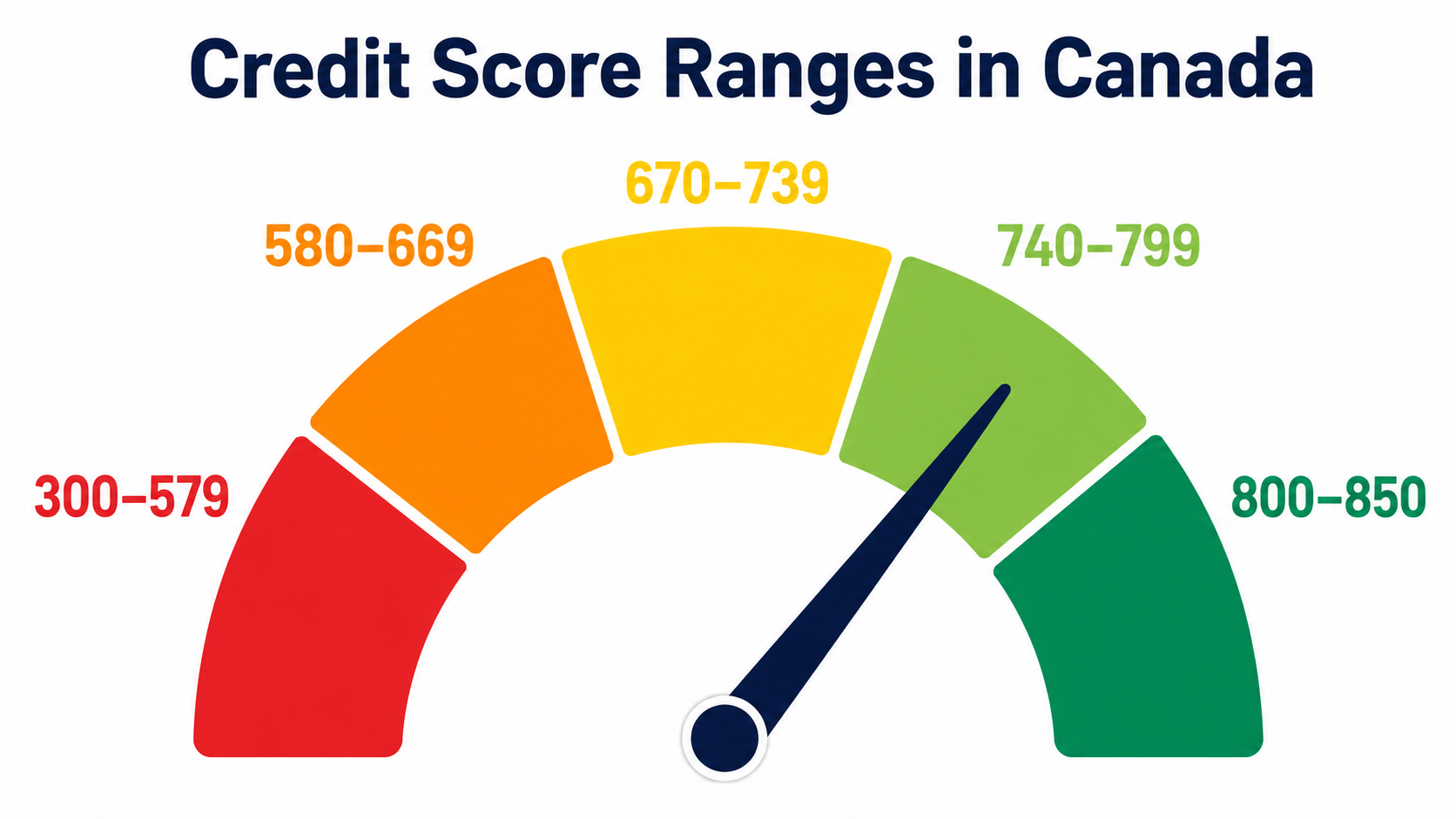
Approval with mainstream lenders is difficult. Alternative and private options are the usual path.
Some options open up. Alternative lenders often work in this range, and equity can help.
Considered a solid score. Many lenders will look at your file, subject to their guidelines.
A strong score that meets most lenders' credit expectations comfortably.
Among the highest tiers. You appear as low risk on the credit side of your application.
These bands describe credit strength only. They are not a promise of approval or decline, because every lender weighs credit alongside income, equity, and other factors under its own guidelines.
Credit Scores and Mortgage Approval in Canada
A common question is what score you need for a mortgage. There is no single national cut-off. What changes as your score moves is the type of lender most likely to fit, not whether options exist at all.
| Credit Score Band | Where You Often Fit | What It Generally Means |
|---|---|---|
| 760+ | Bank (A lender) options | Credit is rarely the obstacle. Focus shifts to income and ratios. |
| 680–759 | Most lenders | A wide range of lenders will typically consider your file. |
| 640–679 | Many A and B lenders | Bank options may still exist; alternative lenders add flexibility. |
| 600–639 | B and alternative lenders | Alternative lending is often the practical route, especially with equity. |
| 550–599 | Private mortgage may apply | Equity-focused private lending is often the starting point. |
| Below 550 | Equity lending may still help | Options can still exist where there is meaningful home equity. |
Every lender uses its own underwriting criteria, and a score alone does not decide an application. This table is general guidance, not an approval or a rate quote. A specialist review confirms your real options.
Learn more through our bad credit mortgage and private mortgages pages.
How Mortgage Lenders Use Your Credit Score
Different lenders weigh credit differently. Understanding the tiers explains why a turndown from one lender rarely means the door is closed everywhere.
Banks (A Lenders)
The big banks want strong, clean credit alongside fully documented income. Their rates are the most competitive, and their guidelines are the strictest. Credit issues are often where a bank application stalls.
Best for: strong credit and steady, provable income.Credit Unions
Credit unions can be slightly more flexible than banks and are often community focused. Many are provincially regulated, which can give them a little more room on how they assess a file.
Best for: borrowers who are close to bank criteria.Alternative (B) Lenders
Alternative lenders accept bruised credit and non-traditional income. They use common-sense underwriting and are often the practical middle ground when a bank says no.
Best for: fair credit, self-employed, or recent credit events.Private Lenders
Private lenders focus far more on your home equity and the property than on your credit score. This makes them the most flexible tier, suited to short-term and equity-driven situations.
Best for: lower scores with meaningful home equity.See the tiers compared in detail on our private mortgages page.
What Makes Up Your Credit Score
Your score is built from several parts of your credit history. The weightings below are approximate and commonly cited, and the exact formula varies by bureau and model.
These figures are illustrative. Equifax and TransUnion use their own models, so the precise weighting differs between them.
What Lowers and What Improves Your Score
Small habits move your score over time. Here is what tends to pull it down, and what tends to build it back up.
What Lowers Your Score
- Missed or late payments
- High credit utilization
- Accounts sent to collections
- A consumer proposal or bankruptcy
- Too many credit applications at once
- A short or thin credit history
- Carrying balances close to your limits
What Improves Your Score
- Keeping utilization under about 30%
- Never missing a payment
- Keeping older accounts open
- Building credit steadily over time
- Diversifying credit carefully, not all at once
- Disputing and correcting reporting errors
- Paying down revolving debt before you apply
Common mistake: closing an old credit card to tidy up. That can shorten your history and raise your utilization, which may lower your score. If you are unsure, ask before you close anything.
Hard Inquiry vs Soft Inquiry
Not every credit check affects your score. The difference between a hard and a soft inquiry is worth knowing before you shop around.
Soft Inquiry
A soft inquiry happens when you check your own credit, or when a company checks it for a pre-qualification or background purpose. Soft inquiries do not affect your score.
Checking your own credit is always a soft inquiry.Hard Inquiry
A hard inquiry happens when a lender checks your credit to make a lending decision, such as a mortgage or loan application. Each one can have a small, temporary effect on your score.
Several hard inquiries in a short window can add up.Important to note: when you work with a mortgage broker, your credit is generally pulled once and shared with suitable lenders, rather than each lender pulling it separately. This helps limit the impact of multiple hard inquiries.
Equifax vs TransUnion in Canada
Canada has two main credit bureaus. Lenders may check one or both, and your scores can differ between them.
Equifax Canada
One of the two national credit bureaus. It maintains its own credit reports and uses its own scoring model, so an Equifax score may differ from a TransUnion score.
TransUnion Canada
The other national credit bureau. It also keeps its own reports and scoring model. Lenders vary in which bureau they rely on, and some use both.
Common myth: that you have one single credit score. In reality you can have more than one, because each bureau calculates its own, and the data each holds may not be identical. A difference between them is normal.
Checking Your Credit and Fixing Errors
Reviewing your own credit regularly is a healthy habit, and it costs you nothing in score terms.
How Often to Check
Checking your own credit report is a soft inquiry, so it never lowers your score. Reviewing it a couple of times a year, and before any major application, helps you catch problems early.
Your report can also update at different times through the month, which is one reason your score may shift slightly even when nothing major has changed.
Watch for Identity Theft
Unfamiliar accounts or inquiries on your report can be an early sign of identity theft. Reviewing your credit regularly is one of the simplest ways to spot it before it grows.
Common Credit Report Errors
Errors are more common than people expect, and they can drag down a score unfairly. Look out for:
- An incorrect address or personal detail
- A duplicate account listed twice
- A payment marked late that you paid on time
- A paid collection still showing as unpaid
- An account that is not yours
If you spot an error, you can dispute it directly with the credit bureau to have it investigated and corrected.
Protecting Your Credit From Fraud
Credit fraud and identity theft can quietly damage your score and put your finances at risk, sometimes months before you notice. If you have been a victim, or simply want to guard your credit profile, there are steps you can take directly with the bureaus.
Signs Something May Be Wrong
- Accounts or credit cards you did not open
- Hard inquiries you did not authorize
- A sudden, unexplained drop in your score
- Bills or collection notices for debts that are not yours
- Mail or statements that stop arriving as expected
Ways to Protect Your Profile
- Add a fraud alert to your Equifax and TransUnion files
- Consider a consumer statement noting to verify your identity
- Review both bureau reports regularly for anything unfamiliar
- Report confirmed fraud to the bureaus and your lenders
- Update passwords and monitor your bank accounts
Add a Contact Method or Fraud Alert to Your Report
Both Equifax and TransUnion let you add an alert to your credit file that asks lenders to confirm your identity before granting new credit in your name. With an identity alert you can add a personal statement and a phone number for lenders to reach you. A fraud alert or fraud warning is the version available to confirmed victims of identity theft.
Why it helps in Ontario: for an Equifax identity alert, if you live in Ontario and apply for credit, lenders are required to call you before extending it. That extra check makes it much harder for someone else to open credit in your name.
Important to note: you add these directly with each bureau, and you need to contact both Equifax and TransUnion separately, since they keep their own files. Placing an alert is free, and it is worth doing whether you have already been a victim or simply want an added layer of protection.
A clean, protected credit profile also makes for a smoother mortgage application. If fraud has affected your credit and you are worried about qualifying, our team can review your situation and walk you through the options.
Can I Still Get a Mortgage With a Lower Score?
This is the question most people really want answered. In many cases the answer is yes, it just changes which lender fits. Here are the situations we see most often.
A Score Around 600
A score in this range often points toward an alternative or private lender rather than a bank. With reasonable equity, workable options frequently exist.
During a Consumer Proposal
A consumer proposal affects your credit, but it does not automatically rule out a mortgage. Options may exist, particularly with equity, and improve once it is complete.
After a Bankruptcy
It is often possible to qualify once a bankruptcy is discharged and you have begun to rebuild. An alternative or private lender is usually the starting point.
Self-Employed Income
Self-employed and hard-to-document income does not rule you out. Alternative lenders take a more flexible view of how income is proven.
Collections or Tax Debt
These can complicate a bank application but are frequently workable through an alternative or private lender, especially where there is equity.
The Right Question
Rarely is it "do I qualify" in general. It is "which lender fits my situation." That is exactly what a specialist review is built to answer.
This is where a mortgage broker helps most.At LendToday, we review mortgage applications from Canadians with a wide range of credit profiles every day. While your credit score is important, it is only one part of the overall lending decision. Your income, home equity, debt ratios, and each lender's guidelines all play a role.
Unsure whether your credit score is good enough for a mortgage? Our team can review your situation and compare lenders to help identify suitable options, with no obligation.
Explore Your Options
Whatever your credit looks like, one of these solutions may be the right next step. Choose any option to learn more.
Not Sure Where Your Credit Stands?
Your credit score is only one part of the picture. We compare bank, alternative, and private mortgage options to help you find the best fit for your situation, before you apply.
Apply online today and we will typically get back to you within 24 hours with a clear, no-obligation picture of your options.
Credit Score and Mortgage FAQs
What credit score do I need for a mortgage in Canada?
There is no single national minimum. Banks generally want strong credit, while alternative and private lenders work with lower scores. What changes as your score drops is the type of lender that fits, not whether any options exist. A specialist can tell you what is realistic for your situation.
Can I get a mortgage with a 600 credit score?
Often, yes. A score around 600 usually points toward an alternative or private lender rather than a bank, especially if you have equity in your home. Learn more about a bad credit mortgage.
Does checking my own credit hurt my score?
No. Checking your own credit is a soft inquiry, and soft inquiries never affect your score. Only a hard inquiry, such as a lender checking your credit for an application, can have a small, temporary effect.
How often does my credit score update?
Your credit report can update at different points through the month as lenders report activity. Because of this timing, your score may move slightly even when nothing major has changed.
What is a good credit score in Canada?
As a general guide, a score of 670 or higher is often considered good, and 740 or higher is very good. That said, lenders use their own models and thresholds, so a score is only meaningful alongside your full application.
Which credit bureau do mortgage lenders use?
Canada has two main bureaus, Equifax and TransUnion. Lenders vary in which they rely on, and some use both. Your score can differ between them, which is completely normal.
Can I get a mortgage during a consumer proposal?
It is sometimes possible, particularly where you have home equity. A consumer proposal affects your credit but does not automatically rule out a mortgage, and options usually improve once it is complete.
Can I qualify for a mortgage after a bankruptcy?
Often, yes, especially once the bankruptcy is discharged and you have started to rebuild your credit. An alternative or private lender is usually the starting point, as a bridge back toward a bank over time.
Do collections affect mortgage approval?
They can complicate a bank application, but they are frequently workable through an alternative or private lender, especially if you have equity. These are exactly the cases a specialist review is built for.
How long do missed payments stay on my credit report?
Negative information such as a missed payment generally remains on your credit report for several years before it drops off. Its impact tends to fade over time as you build a stronger recent history.
Can I improve my credit score quickly?
Some steps work faster than others. Paying down high card balances to lower your utilization, and correcting any reporting errors, can help within a cycle or two. A longer, steady payment history builds the most lasting improvement.
What is the difference between a credit score and a credit report?
Your credit report is the full record of your accounts, payments, and balances. Your credit score is the single number calculated from that report. Lenders look at both when they review a mortgage application.
Does a hard inquiry from a mortgage application hurt me?
Each hard inquiry can have a small, temporary effect. When you work with a mortgage broker, your credit is generally pulled once and shared with suitable lenders, which helps limit the impact of multiple checks.
Can I qualify for a mortgage if I am self-employed with a lower score?
Yes, this is common. Self-employed income and a lower score often point toward an alternative lender that takes a more flexible view. Explore self-employed mortgage options.
Does home equity help if my credit is weak?
Yes. Strong equity gives a lender more security and can offset a weaker credit picture. It also opens up options such as a home equity line of credit or a second mortgage.
How do I fix an error on my credit report?
If you spot an error, such as a duplicate account or a payment wrongly marked late, you can dispute it directly with the credit bureau. They will investigate and correct verified errors, which can help your score.
Sources: Financial Consumer Agency of Canada, Credit report and score basics and How to improve your credit score; Checking your credit report for errors and fraud; Equifax Canada identity protection; TransUnion Canada; Canadian Anti-Fraud Centre, reporting fraud and identity theft.