9 Important Differences Between Arm’s Length Mortgages and Non-Arm’s Length Mortgages in Canada
If you are buying, refinancing, or arranging a mortgage with someone you are related to (or closely connected with), you are stepping into a world lenders call non-arm’s length. It is not automatically a problem, but it changes how the deal is underwritten, documented, and sometimes insured.
In plain language:
-
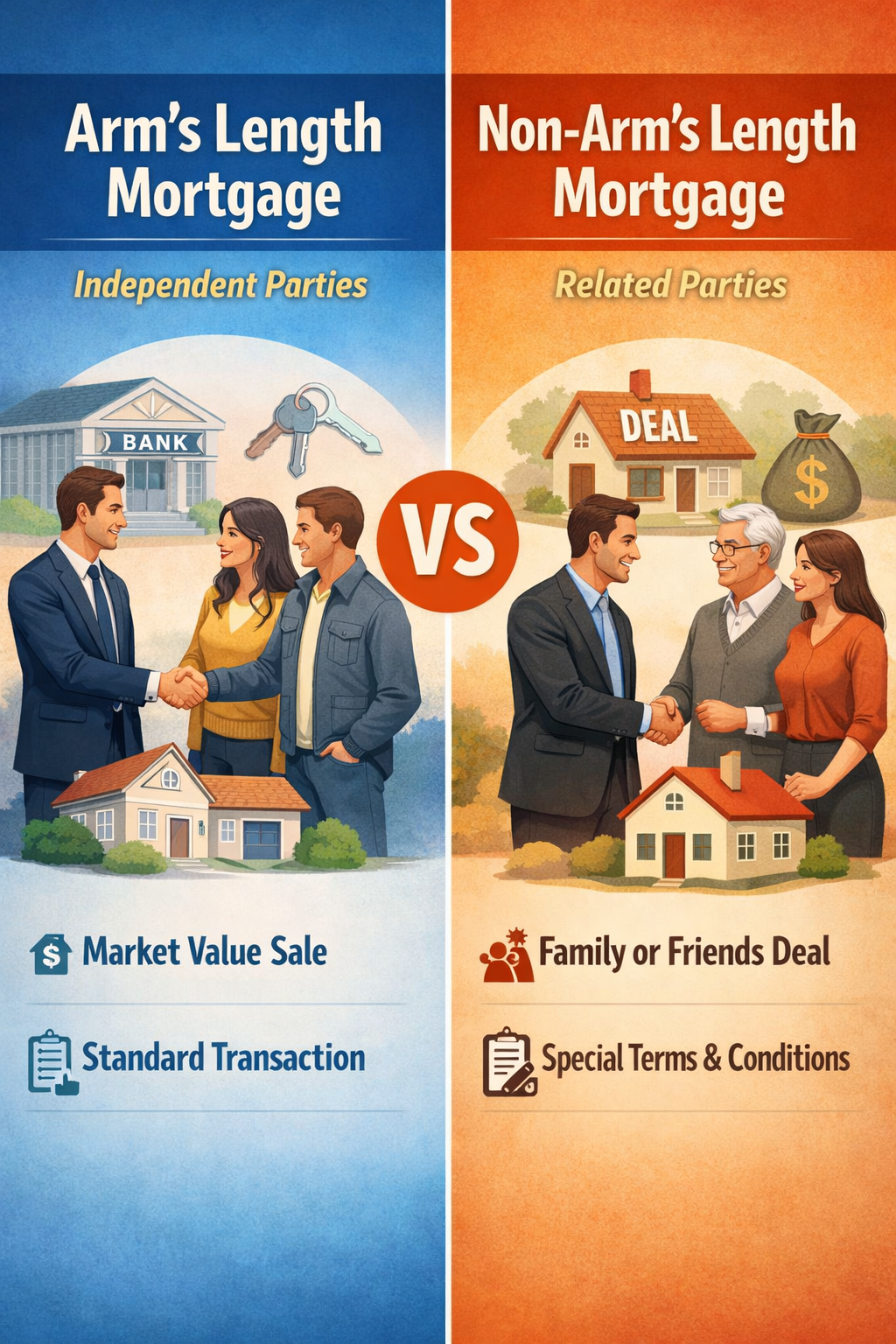
Arm’s length means the parties are acting independently, with no special relationship influencing the price or terms.
-
Non-arm’s length means there is a relationship (family, spouse, business control, etc.) that could affect the deal, so lenders typically require more proof that everything is legitimate and at fair market value.
Canada’s Revenue Agency has long-standing criteria for whether parties deal at arm’s length and what “related persons” generally means.
Below is what this means in a real mortgage file, what can go wrong, and how to set it up properly.
What “arm’s length” vs “non arm’s length” actually means
Arm’s length (typical mortgage transaction)
Most purchases are arm’s length: you buy from a stranger, you negotiate price, and nobody is trying to “help” the other side.
Common signs:
-
Market-listed property (MLS or otherwise broadly marketed)
-
Price supported by comparable sales
-
Down payment is your savings or a properly documented gift
-
No hidden agreements (like getting money back after closing)
Non arm’s length (related party transaction)
Non arm’s length usually means the borrower and the other party are related or connected in a way that could influence the deal: spouse, parent, child, sibling, or a corporation you control.
This shows up in mortgages when:
-
You buy a home from family
-
You refinance and a family member is paying out another family member
-
You do a “private mortgage” with family or a related corporation
-
You are gifted equity (selling below market value)
Why lenders care: relationship-based deals are statistically more vulnerable to inflated values, undisclosed side agreements, and fraud risk, so the file has to be clean and well documented.
Difference 1: The price and value get questioned more often
In a normal purchase, the accepted offer plus an appraisal often settles the value discussion.
In a non-arm’s length purchase, lenders may ask:
-
Was this property exposed to the market?
-
Why is the price higher or lower than comparable sales?
-
Is there “gifted equity” and how is it documented?
Expect a stronger push for:
-
Full appraisal
-
Clear comparables
-
Paper trail explaining the relationship and the rationale for the price
Difference 2: Down payment rules can tighten (especially if the mortgage is insured)
If the mortgage needs default insurance, down payment sourcing becomes a bigger deal.
For example, insured mortgage rules often require that non-traditional down payments be “arm’s length” and not connected to the purchase (directly or indirectly), including situations like unsecured borrowing tied to the deal.
Practical takeaway:
-
If you are relying on borrowed funds, a cash-back arrangement, or anything that looks tied to the sale, the insurer or lender may decline it.
-
Gifts are commonly acceptable, but the gift letter and account history matter a lot.
Understanding the Importance of an Arm’s Length Mortgage
Difference 3: More documentation is required (and it is not optional)
Non-arm’s length deals usually trigger extra conditions, such as:
-
Relationship disclosure (who is related and how)
-
Appraisal and comparables
-
Confirmation of who provided the down payment and where it came from
-
If there is gifted equity: a gift of equity letter and clear purchase terms
-
Clear explanation of occupancy (owner-occupied vs rental)
This is not busywork. It is how you protect the deal from being flagged late in the process.
Difference 4: Lenders watch for “hidden agreements” and cash-back risks
A classic problem: buyer and seller agree on one price for the lender, but there is an off-to-the-side agreement where the buyer receives money, renovations, or other value back after closing.
In arm’s length deals, this still happens, but is easier to detect through market pricing.
In non-arm’s length deals, lenders treat this as a higher-risk pattern, so the file gets reviewed more carefully.
Difference 5: Refinances and buyouts are underwritten differently
Non-arm’s length is not just about buying a house. It comes up a lot with:
-
Spousal buyouts after separation
-
Estate transfers where one beneficiary buys out another
-
Adding or removing title holders while refinancing
In these cases, lenders focus on:
-
Net payout amounts
-
Settlement agreements or legal documentation
-
Clear direction of funds (who gets paid, and why)
-
Title changes matching the story
If the numbers do not align with the documentation, the deal can stall.
Difference 6: Private mortgages with family can be workable, but require a clean structure
A mortgage funded by a family member (or a related corporation) is often possible, but expect requirements like:
-
Formal mortgage commitment or promissory note
-
Clear interest rate and payment terms
-
Independent appraisal
-
Lawyer instructions and proper registration on title
-
In many cases, independent legal advice is strongly recommended
In Ontario real estate transactions, lawyers have professional rules about acting for multiple parties in mortgage or loan transactions, and conflicts can matter more when parties are connected.
Difference 7: Appraisals can be stricter, and conditions can be heavier
A lender may require:
-
Full appraisal (not desktop or automated)
-
Extra photos and supporting data
-
Review appraisal (second look)
-
Condition that value must support “as-is” without future improvements
If the deal is below market value (gift of equity), the appraiser and lender may need to confirm how that is being handled.
Difference 8: The underwriting lens is more “policy-driven” than “common sense”
Even if the deal is reasonable, it still must fit policy.
Federally regulated lenders in Canada follow underwriting expectations that emphasize prudent verification and risk controls.
That often translates into:
-
More proof of income stability
-
More scrutiny on debt servicing
-
More conditions around down payment and liabilities
-
More questions about occupancy and intent
Difference 9: The timeline risk is higher if you do not set expectations early
A normal file can often move quickly because the questions are predictable.
A non-arm’s length file can slow down late if:
-
The relationship is disclosed late
-
The purchase price rationale is unclear
-
The gift of equity paperwork is missing
-
Appraisal comes in with an unexpected value
-
Lawyer flags a representation issue
The “costly” part is not just the rate or fees. It is the risk of a closing delay or a last-minute decline.
Common scenarios and how to structure them properly
1) Buying from parents (below market value)
Best practice approach:
-
Use a proper appraisal to establish fair market value
-
Document gift of equity clearly (if applicable)
-
Ensure the down payment source is acceptable for the lender and insurer, if insured
-
Make sure the purchase contract matches what will actually happen
2) Spousal buyout refinance
Best practice approach:
-
Provide a separation agreement or a direction letter from lawyers
-
Show the payout statement and how the proceeds will be used
-
Confirm title changes and mortgage registration plan
3) Estate purchase from siblings or beneficiaries
Best practice approach:
-
Provide estate documentation and executor authority
-
Confirm the value with the appraisal
-
Document buyout amounts and distribution of proceeds
4) Private mortgage from a family member
Best practice approach:
-
Put everything in writing with legal registration
-
Avoid vague or informal terms that cause legal or lender discomfort
-
Address conflicts and representation rules early
Non-arm’s length mortgage checklist (quick and practical)
If you want a smoother approval, have these ready up front:
-
Signed purchase agreement or refinance details
-
Written explanation of the relationship and purpose of the deal
-
Appraisal (or willingness to order one)
-
Down payment proof (90-day history where relevant)
-
Gift letter or gift of equity letter (if applicable)
-
Income documents (job letter, paystubs, T4s, NOAs, etc.)
-
Debt statements (loans, credit cards, child support, car loans)
-
Lawyer contact info and timing expectations
FAQ
What is an arm’s length mortgage transaction?
It is a mortgage tied to a transaction where the parties are independent and acting in their own self-interest, with no relationship influencing the price or terms. Canadian guidance on arm’s length criteria and related persons is well established.
Is a non arm’s length mortgage allowed in Canada?
Yes. It is common (family purchases, spousal buyouts, estate transactions). It just typically requires more documentation, stronger valuation support, and clearer down payment sourcing.
Can I buy a home from my parents below market value?
Often, yes, using a gift of equity structure, but the lender will want the value supported by an appraisal and the gift documented clearly. If mortgage default insurance is involved, down payment rules can be stricter.
Why do lenders care if it is non-arm’s length?
Because related-party deals can have a higher risk of inflated values, undisclosed agreements, or unusual fund movement. Lenders reduce that risk through verification, appraisal, and documentation.
Does CMHC require down payments to be arm’s length?
Insured mortgage guidelines can require that certain non-traditional down payments be arm’s length and not tied to the purchase and sale, directly or indirectly.
Will a non-arm’s length deal take longer to close?
It can. The underwriting conditions are often heavier, and appraisals or extra document reviews can add time. Planning early helps.
Do I need a lawyer for a private mortgage with family?
You typically need a lawyer to register the mortgage and handle the legal documents. In Ontario, representation and conflict rules can matter, especially when parties are connected.
Conclusion
Arm’s length deals are the “default” mortgage world. Non-arm’s length mortgages are absolutely doable, but only when the file is built to withstand extra scrutiny: fair value support, clean down payment sourcing, and crystal-clear documentation.
If you are buying from family, doing a spousal buyout, transferring an estate property, or setting up a private mortgage, the team at LendToday can help you structure it properly, avoid delays, and match the deal to the right lender from the start.

- 9 Important Differences Between Arm’s Length Mortgages and Non Arm’s Length Mortgages in Canada - February 3, 2026
- 7 Smart Truths: HELOC vs Refinance, What’s Cheaper for High-Equity Homeowners? - February 1, 2026
- 9 Powerful Steps to Calculate Your Home Equity Accurately (And Avoid Expensive Surprises) - January 30, 2026