Financing a Garden Suite 2026 Guide: How a Second Mortgage Can Turn Your Backyard Into Rental Income
In 2026, the Ontario housing market will have shifted. Homeowners are no longer just looking at their properties as places to live—they are looking at them as mini-development sites. With the provincial government’s push for “gentle densification,” the humble backyard has become one of the most valuable pieces of real estate in the country.
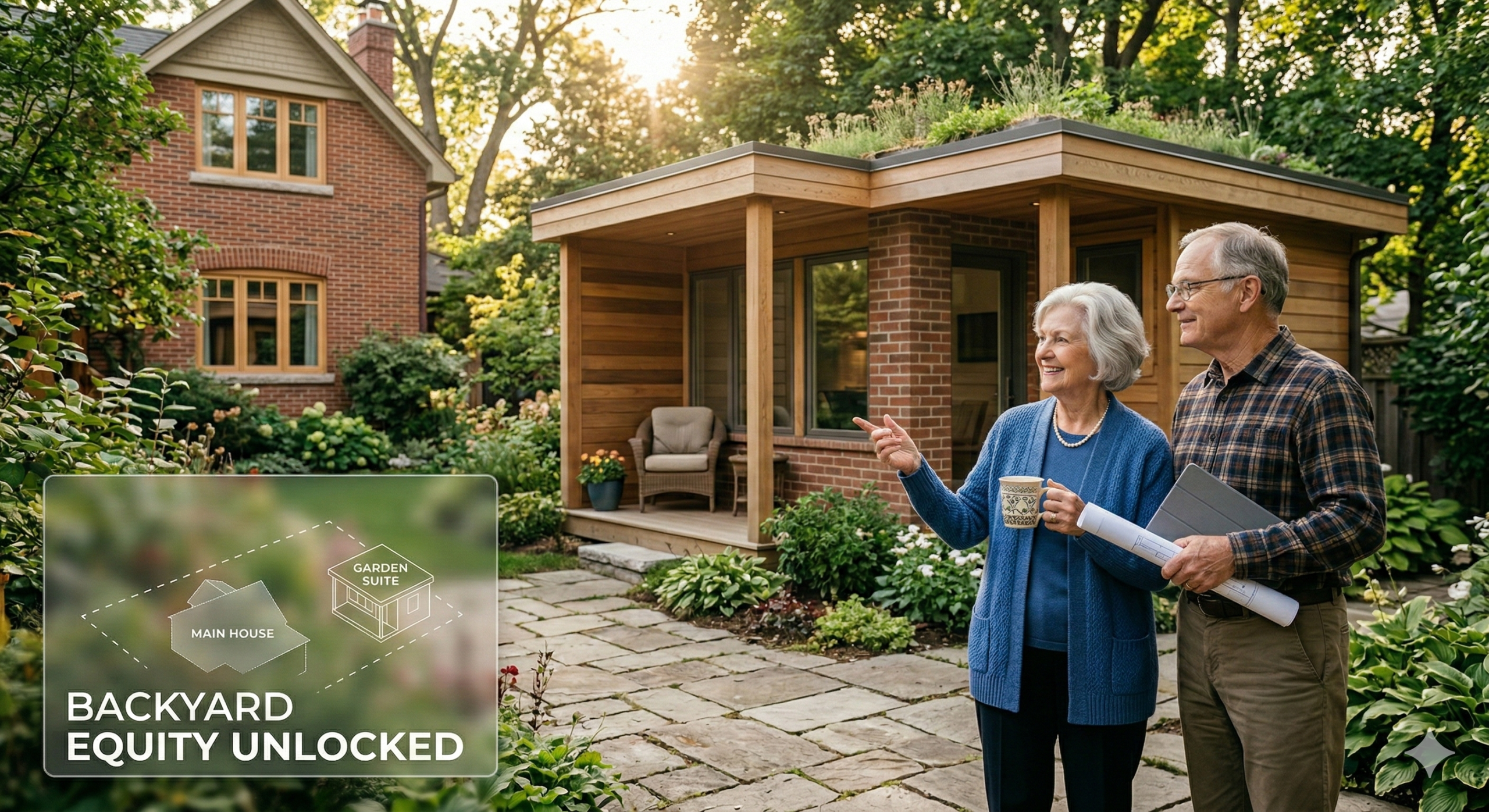
Enter the Garden Suite. Also known as an Accessory Dwelling Unit (ADU) or “Coach House,” these self-contained backyard homes are the ultimate solution for homeowners who want to generate massive rental income without the “underground” feel of a basement apartment.
But here is the million-dollar question: How do you pay for it? In this guide, we’ll explore how to use a second mortgage, HELOC, or the new 2026 “As-Completed” refinance rules to turn your lawn into a legacy.
1. What Exactly is a Garden Suite? (The 2026 Definition)
An ADU is a detached, secondary dwelling located in the rear yard of a principal residence. Unlike a laneway house (which requires a public through-way), a garden suite can be built on most standard detached, semi-detached, and even some row-house lots across Ontario.
Key Requirements for a Legal Suite:
-
Self-Contained: It must have its own kitchen, bathroom, and sleeping area.
-
Separation: There are specific “separation distance” rules (usually 2 to 3 metres) between the main house and the suite.
-
Emergency Access: You must have a clear path (usually 0.9m to 1.0m wide) from the street to the suite for emergency services.
2. Why 2026 is the “Year of the Garden Suite.”
Two major things happened recently that made 2026 the perfect time to build:
-
Zoning Reform: Most Ontario municipalities (including Toronto, Mississauga, and Ottawa) now allow these “as-of-right,” meaning you don’t need a special hearing to get started.
-
Mortgage Innovation: New rules now allow homeowners to refinance based on the “As-Completed Value” of the property. This means the bank lends you money based on what the house will be worth with the suite, not just what it’s worth today.
3. Financing Strategies: How to Fund the Build
Most ADUs in Ontario cost between $150,000 and $350,000 to build. Unless you have that sitting in a high-interest savings account, you’ll need a strategic financing plan.
Option A: The Second Mortgage (The “Speedy” Route)
A second mortgage sits behind your existing first mortgage. It’s an excellent choice if you have a great rate on your primary mortgage (like a 2% or 3% fixed rate from years ago) and don’t want to break it.
-
Pros: Faster approval, keeps your low-interest first mortgage intact.
-
Cons: Slightly higher interest rates than a first mortgage.
Option B: The 90% LTV “As-Completed” Refinance
This is the “Gold Standard” for 2026. Under new federal guidelines, you can refinance your home up to 90% of its future value. > Example: Your home is worth $1M today. With an ADU, it will be worth $1.3M. You can potentially access 90% of that $1.3M to pay off your old mortgage and fund 100% of the construction.
Option C: The HELOC (Home Equity Line of Credit)
A HELOC is like a giant credit card attached to your home. You only pay interest on what you use.
-
Best For: Homeowners who want to pay the contractor in “draws” rather than taking all the cash at once.
4. The Math: Costs vs. Rental Returns
Let’s look at a typical mid-range garden suite project in the GTA for 2026.
| Project Phase | Estimated Cost |
| Permits & Soft Costs (Architect, Engineering) | $15,000 – $25,000 |
| Site Prep & Utility Hookups (Water/Hydro) | $20,000 – $40,000 |
| Construction (Materials & Labour) | $180,000 – $250,000 |
| Total Investment | ~$250,000 – $315,000 |
The Income Potential
In high-demand areas like North York, Hamilton, or Durham Region, a one-bedroom garden suite can rent for $2,400 – $3,200 per month. The ROI Breakdown:
-
Annual Income: $30,000+
-
Mortgage Carry Cost (on $300k): Approx. $1,800/month
-
Net Monthly Profit: $600 – $1,200
-
Property Value Lift: Usually $300,000 – $500,000 upon completion.
5. Step-by-Step: From Backyard to Bank Account
Step 1: The Feasibility Study
Before you call a lender, call a designer. You need to know if your “protected trees,” soil conditions, or utility locations will allow for a build.
Step 2: Get a “Subject-To” Appraisal
Ask your mortgage broker at Lendtoday.ca to order a “subject-to” appraisal. This tells the bank exactly how much value the suite will add, which unlocks the higher loan amounts.
Step 3: Secure the Construction Loan
Once approved, the funds are usually released in stages (draws).
-
Draw 1: Foundation and rough-ins.
-
Draw 2: Framing and roof.
-
Draw 3: Interior finishes and occupancy.
6. Common “Budget Busters” to Avoid
Building in a backyard is different from a standard home build. Watch out for these:
-
The “Trenching” Trap: If your garden suite is far from the main street, running water and sewage pipes through your yard can cost $30,000+.
-
The Tree Protection Zone (TPZ): In Ontario, hitting a “protected tree” root can result in massive fines and project shutdowns.
-
Electrical Upgrades: Most older homes have 100-amp service. To power two homes, you’ll likely need to upgrade to 200-amp service.
FAQ: Financing Garden Suites
Can I use rental income from the future garden suite to qualify for the loan?
Yes! Many lenders in 2026 allow “offsetting,” where they use up to 50–80% of the projected market rent to help you qualify for the higher mortgage amount.
Are there grants for garden suites in Ontario?
Some municipalities, like Toronto, offer forgivable loans of up to $50,000 if you agree to keep the rent “affordable” for a set period. Always check with your local housing office.
How does a garden suite affect my property taxes?
Expect your property taxes to increase. Typically, MPAC will reassess your home once the suite is complete. However, the rental income usually far outweighs the tax increase.
Does a garden suite count as a separate property?
No. A garden suite cannot be sold separately (severed) from the main house. It is one property with two legal dwellings.
The Bottom Line: Don’t Wait for Appreciation, Create It.
In a market where traditional “house flipping” has become difficult, backyard development is the new frontier. By adding a garden suite, you are creating a permanent, cash-flowing asset that increases your property’s resale value by six figures.
At Lendtoday.ca, we don’t just provide the mortgage; we provide the strategy. Whether you want a second mortgage to keep your low rate or a full refinance to fund the entire build, we have the tools to help you build.

- Financing a Garden Suite 2026 Guide: How a Second Mortgage Can Turn Your Backyard Into Rental Income - March 2, 2026
- The Empty Nester’s Guide (2026): Should You Downsize or Use a Reverse Mortgage to Age in Place? - February 28, 2026
- Can a Mortgage Company Evict You in Ontario? (2026 Power of Sale Guide) - February 23, 2026