Table of Contents
Toggle7 Smart Truths: HELOC vs Refinance, What’s Cheaper for High-Equity Homeowners?
If you have significant equity in your home, you are sitting on one of the most powerful financial tools available in Canada: the ability to borrow at rates that are often lower than unsecured debt. The question is not whether equity can help. The question is how to access it in the cheapest, safest, and most flexible way.
For most high-equity homeowners, the decision usually comes down to two popular options:
-
A HELOC (Home Equity Line of Credit): revolving credit secured against your home.
-
A refinance (often called an equity take-out refinance): replacing or increasing your mortgage to pull equity out as a lump sum (or to restructure debt).
Both can be excellent. Both can also be expensive if you pick the wrong tool for the job. Let’s break this down in a way that helps you decide what is cheaper based on how you plan to use the funds, how long you will carry the balance, and what risks you are willing to accept.
Truth #1: “Cheaper” depends on time horizon, not just the rate
Most people compare HELOC vs refinance by looking at interest rates only. That is a start, but it is not the full story.
A refinance might offer:
-
a lower rate
-
a fixed payment
-
a long amortization that keeps payments manageable
But a refinance often comes with:
-
Penalties if you break your current mortgage early
-
legal and appraisal costs in some cases
-
lender fees depending on the structure and lender
A HELOC might offer:
-
lower setup friction in some situations
-
interest-only payment flexibility
-
revolving access so you borrow only what you need
But a HELOC often comes with:
-
a variable rate that can move
-
a rate that may be higher than a prime mortgage rate
-
The temptation to keep a balance longer because payments feel small
So “what’s cheaper” is really:
Which option costs less over the period you actually plan to carry the debt?
If you will carry the balance for years, the rate advantage of a refinance can outweigh its upfront costs. If you will repay quickly, a HELOC can be cheaper because you avoid paying refinance costs and penalties for a short-term need.
Truth #2: The highest hidden cost of refinancing is often the penalty
If you are currently in a fixed-rate mortgage term, breaking your mortgage early can trigger a penalty that ranges from manageable to extremely painful.
Two common penalty approaches:
-
Three months’ interest
-
Interest Rate Differential (IRD) for many fixed-rate mortgages, which can be significantly higher
This is why a refinance is not automatically cheaper even if the new rate looks better. If your penalty is large, it can wipe out the savings you thought you were getting.
Practical example (simple illustration):
-
If refinancing saves you $150 per month in interest or payments, that is $1,800 per year.
-
If your penalty is $7,000, you need nearly 4 years just to break even, before even considering other costs.
A HELOC, by contrast, typically does not require breaking your existing mortgage if it is set up behind it (assuming you have room in your equity and your lender allows it). That can make a HELOC cheaper in the short term because you avoid the biggest landmine: the mortgage break penalty.
Key takeaway:
-
If you are mid-term in a fixed mortgage, ask about your penalty first before deciding anything.
Truth #3: HELOCs win on flexibility, but you pay for it in rate risk
HELOCs are popular with high-equity homeowners for a reason. You can access funds when you need them, pay interest only on what you use, and re-borrow as you repay.
Where HELOCs often shine:
-
Renovations where you draw funds in stages
-
emergency backup liquidity (as a safety net)
-
short-term borrowing with a clear payoff plan
-
people who want revolving access rather than a single lump sum
The catch is rate risk. Most HELOCs are variable, and payments can rise when rates rise.
Refinancing into a fixed-rate mortgage can protect you from interest rate increases. For homeowners who hate uncertainty, that peace of mind has value.
Key takeaway:
-
If you need flexibility and plan to repay quickly, HELOCs can be cheaper.
-
If you need long-term stability, refinancing can be cheaper even if it costs more upfront.
Truth #4: If you are consolidating high-interest debt, refinancing is often cheaper long-term
Many high-equity homeowners consider these options because they are carrying:
-
credit card balances
-
lines of credit
-
car loans
-
CRA balances (depending on structure)
-
other unsecured debt at higher rates
If the goal is debt consolidation, refinancing often wins on total cost because:
-
The rate is typically lower than unsecured credit
-
The payment can be amortized over a longer period
-
It forces discipline through a structured payment
HELOCs can still work for consolidation, but they often fail for a psychological reason: revolving credit stays available. Many borrowers consolidate, feel relief, then slowly re-use the HELOC and end up with both the consolidated debt and the new balance.
If you want the cheapest solution over time, structure matters. A refinance tends to be more “set it and crush it.”
Key takeaway:
-
For consolidation with a multi-year payoff plan, refinancing is often the cheapest path.
-
For consolidation with rapid payoff and strict discipline, a HELOC can be cheaper.
Truth #5: For renovations, a HELOC can be cheaper because you borrow in phases
Renovation spending often happens in chunks:
-
deposit to a contractor
-
materials
-
progress payments
-
finishing costs
-
surprises behind the walls
Refinancing gives you a lump sum right away. If you take out $80,000 but only need $30,000 in the first few months, you are paying interest on money you are not using yet.
A HELOC lets you draw only what you need. That can reduce interest costs meaningfully.
However, for major renovations with a long timeline or a balance you will carry for years, refinancing can still become cheaper if:
-
The refinance rate is meaningfully lower
-
You lock into a fixed rate
-
You roll the renovation debt into a stable long-term payment
Key takeaway:
-
HELOC: cheaper for phased draws and short-term use
-
Refinance: cheaper if the renovation debt becomes long-term debt
Truth #6: The “break-even point” is the real decider
If you want a practical method to decide, use a break-even calculation. You do not need complex math, just the right inputs.
Step 1: List refinance costs
Common costs can include:
-
mortgage break penalty (if applicable)
-
appraisal (sometimes covered, sometimes not)
-
legal fees (sometimes covered, sometimes not)
-
discharge or registration fees
-
lender or broker-related fees (depending on lending channel and product)
Step 2: Estimate monthly savings (or cost difference)
Compare:
-
interest cost on HELOC balance (your expected average balance)
vs -
interest cost on refinance (on the portion you took out, plus the blended mortgage impact)
Step 3: Break-even formula (simple)
Break-even months = total refinance costs ÷ monthly savings
If you keep the balance longer than that break-even time, refinancing is often cheaper. If you will repay sooner, HELOC is often cheaper.
Key takeaway:
-
Do not choose based on rate alone. Choose based on how long you will carry the debt.
Truth #7: High-equity homeowners should also think about risk, not just cost
When you have high equity, lenders often offer more options. That can be a blessing and a trap.
Cost is important, but so is risk:
-
Variable-rate risk (HELOC) can raise costs unexpectedly.
-
Payment shock risk matters if the prime increases.
-
Discipline risk matters if you use revolving credit without a plan.
-
Refinance risk matters if penalties and fees lock you into a bad deal.
A “cheaper” option can become expensive if it does not match your habits and your tolerance for uncertainty.
A good rule of thumb:
-
If you want flexibility and you have a clear payoff plan, a HELOC can be a cheaper tool.
-
If you want stability and structure, refinancing is often the cheaper tool over the long haul.
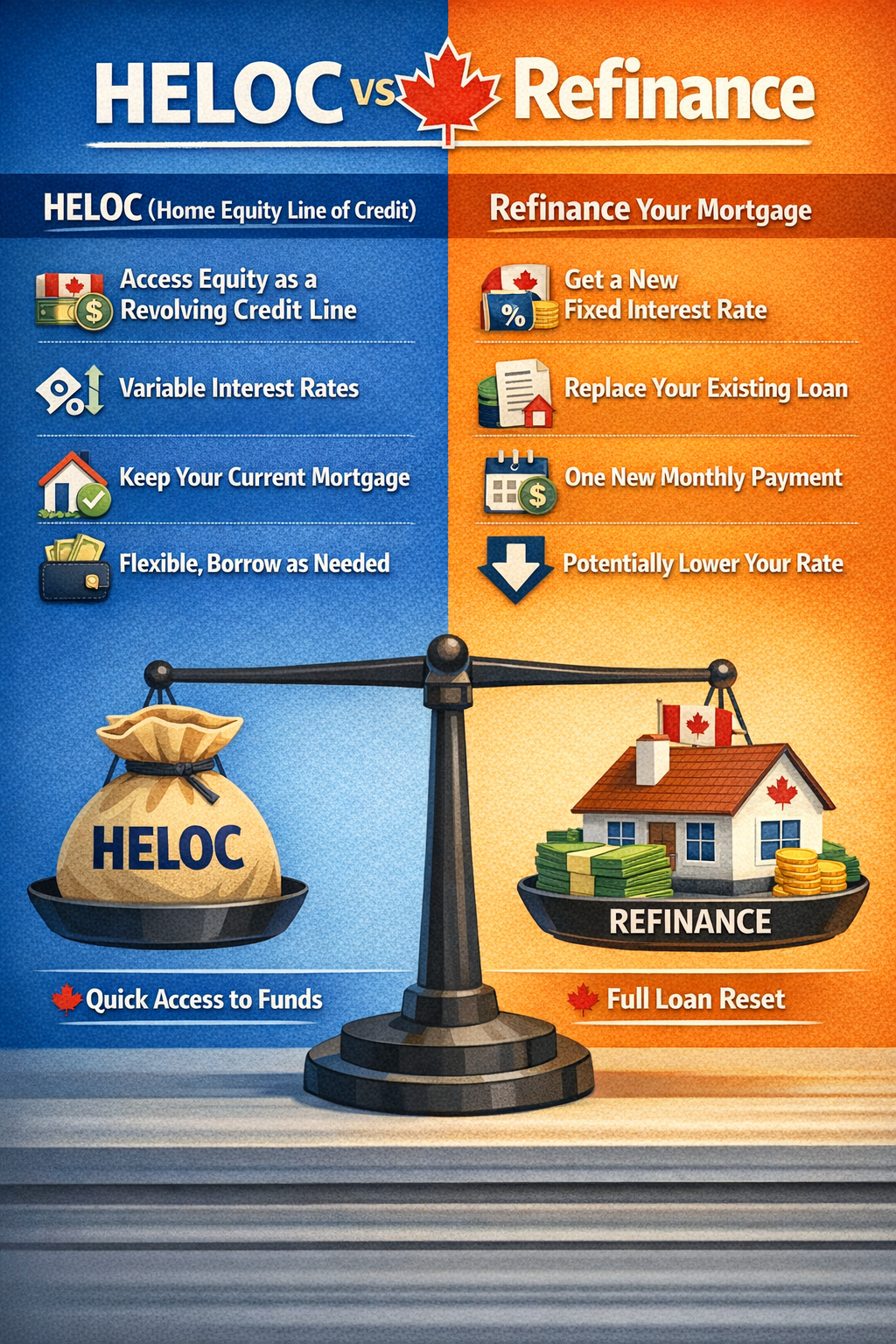
HELOC vs Refinance: Quick comparison for high-equity homeowners
When a HELOC is usually cheaper
-
You need funds for a short period (months, not years)
-
You want to borrow in stages (renos)
-
You are avoiding a large mortgage penalty
-
You only need a small portion of your available equity
-
You have strong discipline and a payoff plan
When refinancing is usually cheaper
-
You will carry the balance for years
-
You want a fixed rate and a predictable payment
-
You are consolidating expensive debt and want a structure
-
Your refinance penalty is low (or your term is close to renewal)
-
You want to simplify multiple debts into one payment
FAQ: HELOC vs refinance for high-equity homeowners
Is a HELOC always cheaper than refinancing?
No. HELOCs can be cheaper short term because you avoid refinance penalties and costs. Refinancing can be cheaper long-term if the rate is lower and you keep the balance for years.
What is the biggest cost people forget when refinancing?
The mortgage break penalty. It can be the difference between refinancing being a smart savings move or an expensive mistake.
Are HELOC rates higher than refinance rates?
Often, yes, because a refinance is a mortgage product and HELOCs are revolving credit. But the real cost depends on how much you borrow and for how long.
Can I get a HELOC without refinancing my mortgage?
In many cases, yes, depending on your lender, your equity, and how the mortgage is structured. It is common to set up a HELOC behind an existing mortgage if there is room.
Which is better for debt consolidation, HELOC or refinance?
Refinancing is often better for disciplined, long-term consolidation because it creates a structured payment. A HELOC can work if you will pay it down quickly and avoid re-borrowing.
Which is better for renovations?
A HELOC is often better for renovations because you borrow in phases and only pay interest on what you use. For big renos where the balance becomes long-term, refinancing can be cheaper.
What if I have a low fixed rate and I do not want to lose it?
That is a key factor. If you break a low-rate mortgage, the penalty and losing that rate can make refinancing expensive. A HELOC or a second mortgage strategy may be worth exploring instead.
How do I know my break-even point?
Add up all refinance costs (especially the penalty) and divide by the estimated monthly savings versus the HELOC. If you keep the debt longer than the break-even period, refinancing often wins.
Conclusion: tying it back to LendToday
For high-equity homeowners, the cheapest option is rarely universal. It depends on your mortgage term, penalty, how long you will carry the balance, and whether you want flexibility or certainty. If you want a clean comparison with real numbers, the LendToday team can review your current mortgage, estimate your penalty, and map out the true break-even between a HELOC and refinancing so you can choose the option that actually saves you money.