Going through a separation or divorce is hard enough. Working out what happens to the family home, the mortgage, and the equity built up over years of shared payments can feel like adding a second crisis on top of the first. For many separating couples in Ontario, the question is not whether to sell the home but whether one spouse can stay, take over the mortgage, and buy the other out of their share of the equity.
Table of Contents
ToggleA spousal buyout mortgage is the financing tool that makes that possible. Under Canada’s insured spousal buyout program, the spouse keeping the home can refinance up to 95 percent of the property’s appraised value, which is significantly higher than the 80 percent limit on a standard refinance. This guide explains exactly how a spousal buyout mortgage works in Ontario, who qualifies, what documents are required, and how to complete the process without losing the home in the middle of an already difficult time.
What Is a Spousal Buyout Mortgage in Ontario?
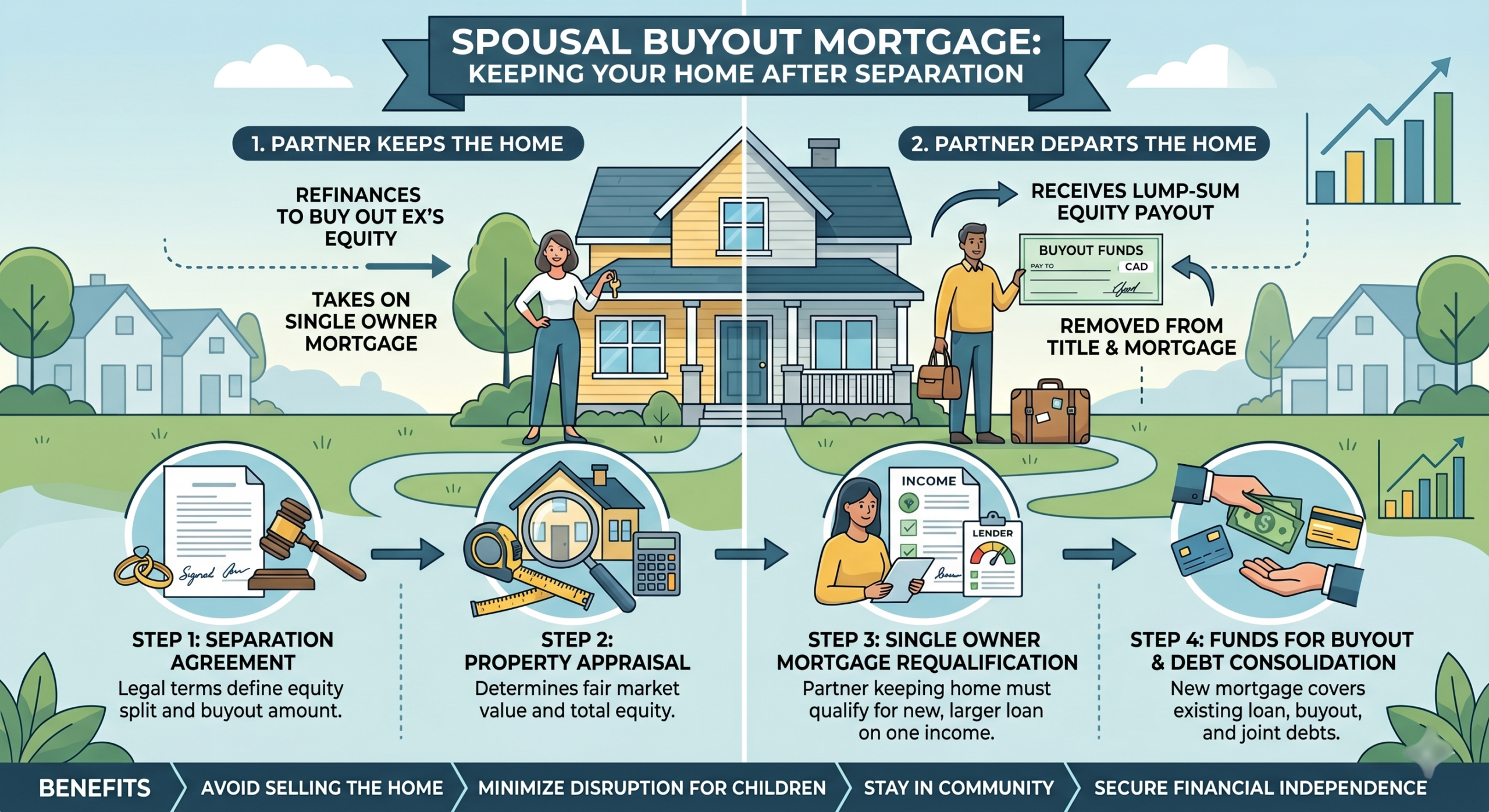
A spousal buyout mortgage is a refinance arranged when one spouse purchases the other spouse’s interest in the matrimonial home as part of a separation or divorce settlement. The refinance proceeds are used specifically to pay out the departing spouse’s share of the equity, in addition to discharging the existing mortgage.
What makes a spousal buyout mortgage different from a standard refinance is the financing limit. Under guidelines set by Canada’s mortgage default insurers, CMHC, Sagen, and Canada Guaranty, an insured spousal buyout can be arranged up to 95 percent loan-to-value, even though the funds are being used to extract equity. A regular equity take-out refinance is capped at 80 percent loan-to-value, and conventional refinances follow the same 80 percent rule.
How a Spousal Buyout Refinance Works
The mechanics are straightforward. An appraisal establishes the current market value of the home. The total mortgage required is calculated by adding the payout amount owed to the departing spouse plus the balance owing on the existing mortgage. If that total falls within 95 percent of the appraised value and the remaining spouse qualifies for the payments on their own income, the refinance can proceed under the insured spousal buyout program.
The new mortgage is registered in the name of the spouse keeping the home. The departing spouse receives their share of the equity at closing, signs off on the title, and is fully released from the mortgage obligation.
The 95 Percent LTV Insured Spousal Buyout Rule
The 95 percent loan-to-value allowance is the single most important feature of the spousal buyout program in Canada. It exists because federal mortgage policy recognizes that selling a matrimonial home is often the worst financial outcome for separating couples, particularly when there are children involved.
Key takeaway: A spousal buyout mortgage allows the spouse staying in the home to access up to 95 percent of the home’s value to pay out the departing spouse. This is 15 percent higher than the limit on any other type of refinance in Canada.
The catch is that the program is only available when the funds are used specifically for the buyout. The remaining spouse cannot use the additional borrowing capacity to consolidate other debts, complete renovations, or extract extra cash for personal use. The structure is purpose-specific.
What Happens to a Mortgage When Couples Separate?
When a couple separates, the mortgage on the matrimonial home does not automatically change. Both spouses remain legally responsible for the debt, regardless of who lives in the home, who makes the payments, or what the separation agreement eventually says. The lender’s contract is with both borrowers, and that obligation continues until the mortgage is either paid out, transferred, or refinanced into one spouse’s name alone.
This creates a real problem during the separation period. The spouse who has moved out is still on the mortgage and still liable if payments are missed. The spouse who remains in the home may be carrying the full payment alone, but cannot remove the other from the title without either selling the home or refinancing.
Joint Mortgages vs Sole Ownership
The path to a spousal buyout depends on how the property was originally registered.
If the home was held in joint ownership, which is the most common arrangement for married couples in Ontario, both spouses are on title, and both are on the mortgage. A spousal buyout refinance is required to release the departing spouse from both.
If the home was held in the name of one spouse only, with the other spouse not on title, the situation is more nuanced. Even when only one spouse holds legal title, the matrimonial home receives special treatment under Ontario’s Family Law Act, and both spouses have an equal right to possession during the marriage. A buyout may still be required as part of the equalization process, even though the refinance itself is mechanically simpler.
Equalization and the Matrimonial Home
Ontario’s Family Law Act treats the matrimonial home differently from other family assets. Even if one spouse owned the home before the marriage, its full value at the date of separation is included in the equalization calculation. This is why so many separations come down to a question of whether the home can be retained at all.
The equalization payment owed by one spouse to the other often becomes the buyout amount that the spousal buyout mortgage is structured to cover. The exact figure is negotiated through the separation agreement, ideally with the help of family lawyers and sometimes a financial mediator.
Common mistake: Assuming that the separation agreement and the mortgage refinance can be sorted out independently. They cannot. The mortgage lender needs to see the separation agreement, and the separation agreement needs to reflect a buyout amount that is actually financeable.
Can One Spouse Buy Out the Other Without Selling the Home?
Yes, and the spousal buyout mortgage is the primary tool used to make that possible. Selling the home is often presented as the default solution, but it is rarely the best one when a refinance can keep one spouse in the property, preserve a stable environment for children, and avoid the transaction costs of selling and rebuying elsewhere.
Important to note: The spousal buyout program is available to married spouses and to common law partners who meet the definition of spouse under provincial law. The structure is the same for both, although the underlying family law treatment varies by province.
Why a Spousal Buyout Is Different From a Standard Refinance
In a standard refinance, a lender will only advance up to 80 percent of the property’s value, regardless of what the funds are being used for. If a couple has a home worth 700,000 dollars with 400,000 dollars owing on the mortgage, a standard refinance maxes out at 560,000 dollars. After paying off the existing mortgage, only 160,000 dollars remains for any other purpose. If the departing spouse is owed 200,000 dollars in equity, a standard refinance falls short.
Under the spousal buyout program, that same couple can access up to 95 percent of the home’s value, which on a 700,000 dollar home is 665,000 dollars. After paying off the 400,000 dollar mortgage, 265,000 dollars is available for the buyout, more than enough to cover the 200,000 dollar payout owed to the departing spouse.
Key takeaway: The spousal buyout program exists specifically to bridge the gap between a couple’s equity and what a standard refinance can deliver. It is the difference between keeping the home and being forced to sell.
Who Qualifies for an Insured Spousal Buyout
To qualify for an insured spousal buyout in Canada, several conditions must be met.
The applicant must qualify for the new mortgage on their own income, including under the OSFI mortgage stress test. The home must be the principal residence of the spouse keeping it. The refinance funds must be used solely to pay off the existing mortgage and to buy out the departing spouse’s share of equity. A signed separation agreement or court order documenting the buyout amount must be in place. And the new mortgage must be insured, which means premium costs are added to the mortgage balance.
Borrowers with credit challenges or harder to verify income may not qualify for the insured program with an A lender. In those situations, a B lender or alternative refinance structure can still complete the buyout, although usually at a lower loan to value ratio.
What Documents Do Lenders Require for a Spousal Buyout?
A spousal buyout refinance involves more documentation than a standard refinance because the lender is essentially underwriting both a family law settlement and a new mortgage at the same time.
The Separation Agreement Requirement
The lender requires a signed separation agreement, a court order, or a divorce decree that clearly identifies the buyout amount, confirms that the departing spouse will be released from title and the existing mortgage, and shows that the funds from the refinance are being used to settle that obligation.
In some cases, lenders will accept a draft separation agreement that has been signed by both spouses and their respective lawyers, with the final version to follow at closing. Many family lawyers work directly with mortgage brokers to make sure the agreement is structured in a way that the lender will accept.
Common mistake: Submitting a separation agreement that says “the parties will negotiate the buyout amount” rather than specifying a dollar figure. Lenders need a clear, defined number to underwrite the file.
Income, Credit, and Property Appraisal
Beyond the separation agreement, the spouse keeping the home must provide the standard refinance documentation: government identification, recent pay stubs and letter of employment for salaried borrowers, two years of T1 generals and notices of assessment for self-employed borrowers, a recent mortgage statement, a property tax bill, and a void cheque. The lender will also order an independent appraisal to confirm the current market value of the property.
The credit and income review is conducted on the remaining spouse alone. The departing spouse’s income is not included in the qualification, even if they were the higher earner during the marriage. This is the most common reason a spousal buyout fails at the A lender level and gets redirected to a B lender or alternative refinance structure.
How to Complete a Spousal Buyout Mortgage in Ontario
The process from initial inquiry to funded mortgage typically takes 30 to 60 days, although the family law side of the equation can extend the overall timeline significantly. Here is how the moving pieces fit together.
Working With a Family Lawyer
The starting point is almost always a family lawyer, who handles the separation agreement, the equalization calculation, and the legal release of the departing spouse from title and from the mortgage. The lawyer’s work runs in parallel with the mortgage process, but the refinance cannot close until the separation agreement is signed.
Each spouse should have their own independent legal advice. A single lawyer cannot represent both parties in a separation, and lenders generally require evidence that each spouse received independent legal advice before signing.
Choosing the Right Lender
Not every lender offers the insured spousal buyout program with equal expertise. Some A lenders process these files routinely, while others treat them as unusual and slow the process down with extra requests. Credit unions, B lenders, and certain monoline lenders all participate in the program with varying degrees of efficiency.
If the remaining spouse cannot qualify for an insured refinance because of credit, income, or debt service issues, alternative lenders can structure the buyout as a conventional refinance at 80 percent loan to value, or as a combination of a first mortgage and a private second mortgage to bridge the gap. The right structure depends on the equity, the income, and the urgency.
Important to note: A spousal buyout completed with a private or alternative lender is often a temporary solution, with the goal of refinancing back to an A lender within 12 to 24 months once the remaining spouse’s financial picture has stabilized.
When to Call a Mortgage Broker
The earlier in the separation process a mortgage broker is involved, the better. A broker can review the numbers, confirm whether the buyout amount being negotiated is actually financeable, and identify the right lender before time and legal fees are spent on a settlement structure that the lender will not approve.
In an ideal sequence, the mortgage broker is consulted at the same time as the family lawyer, not after the separation agreement is already drafted. This avoids the painful and expensive scenario of reopening negotiations because the agreed buyout amount cannot actually be financed.
Insured vs Conventional Spousal Buyout: Side by Side
| Factor | Insured Spousal Buyout | Conventional Refinance |
|---|---|---|
| Maximum loan to value | 95 percent | 80 percent |
| Insurance premium required | Yes, added to mortgage balance | No |
| Available with A lenders | Yes | Yes |
| Available with B and private lenders | Limited | Yes |
| Credit and income flexibility | Lower | Higher with alternative lenders |
| Use of funds | Buyout and existing mortgage only | More flexible |
| Stress test required | Yes | Yes with federally regulated lenders |
| Typical use case | Strong applicant, high equity payout needed | Lower payout required or alternative lending needed |
See an example: Read how a homeowner completed a spousal buyout without selling the family home.
Frequently Asked Questions
Q: What is a spousal buyout mortgage in Canada? A: A spousal buyout mortgage is a refinance arranged when one spouse purchases the other’s share of the matrimonial home as part of a separation or divorce settlement. Under the insured spousal buyout program offered by CMHC, Sagen, and Canada Guaranty, the refinance can be completed up to 95 percent of the home’s appraised value, which is significantly higher than the 80 percent limit on a standard refinance.
Q: Do I need a signed separation agreement to refinance for a spousal buyout? A: Yes. Lenders require a signed separation agreement, court order, or divorce decree that clearly identifies the buyout amount and confirms that the departing spouse will be released from title and the existing mortgage. Some lenders will accept a draft agreement signed by both spouses and their lawyers, with the final version to follow at closing.
Q: Can I qualify for a spousal buyout mortgage on my own income? A: You must qualify for the new mortgage based on your own income alone, including under the OSFI mortgage stress test. Your former spouse’s income cannot be included in the qualification, even if they were the higher earner during the marriage. This is the most common reason spousal buyouts get redirected from an A lender to a B lender or an alternative refinance structure.
Q: How much equity do I need to do a spousal buyout in Ontario? A: Under the insured spousal buyout program, you need enough equity that the new mortgage, including the existing balance plus the buyout amount, falls within 95 percent of the appraised value. If you exceed that threshold, a private second mortgage or alternative lender solution may be required to bridge the gap.
Q: Can common law partners use the spousal buyout program in Canada? A: Yes. The insured spousal buyout program is available to married spouses and to common law partners who meet the definition of spouse under provincial law. The structure of the refinance is the same in both cases.
Q: What if my credit was damaged during the separation? A: Separation often causes credit damage because of missed payments, increased debt loads, or income disruption. If your credit no longer meets A lender standards, a B lender or private lender can still complete the spousal buyout, usually at a lower loan-to-value or with a combination of first and second mortgages. The goal in those cases is to refinance back to an A lender within 12 to 24 months once your credit recovers.
Q: Can a spousal buyout be used for any debts beyond the buyout itself? A: No. The insured spousal buyout program restricts the use of funds to paying off the existing mortgage and buying out the departing spouse. Funds cannot be used to consolidate other debts, complete renovations, or take extra equity. If additional borrowing is needed, a separate conventional refinance or second mortgage structure may be required.
Q: How long does a spousal buyout mortgage take to close? A: The mortgage portion typically takes 30 to 60 days from application to closing, assuming all documentation is in order. The overall timeline depends largely on how quickly the separation agreement is finalized and signed. Coordinating the family lawyer and the mortgage broker in parallel from the start is the best way to keep the process moving.
Conclusion
A spousal buyout mortgage in Ontario is one of the most underused financial tools available to separating couples. The 95 percent loan to value insured program exists specifically to keep families in their homes when separation makes a traditional refinance impossible. Most borrowers, and many lawyers, do not realize how much further the financing can go when the structure is set up correctly.
The couples who navigate this process most successfully are the ones who bring a mortgage broker into the conversation early, alongside their family lawyer. That coordination avoids settlement structures that cannot actually be financed and ensures the buyout amount in the separation agreement matches what a lender will approve.
If you are working through a separation in Ontario and want to know whether a spousal buyout mortgage is realistic for your situation, contact LendToday at 1-855-242-7732 or visit lendtoday.ca to speak with a mortgage broker who understands both the insured spousal buyout program and the alternative lender options when the insured route does not fit.