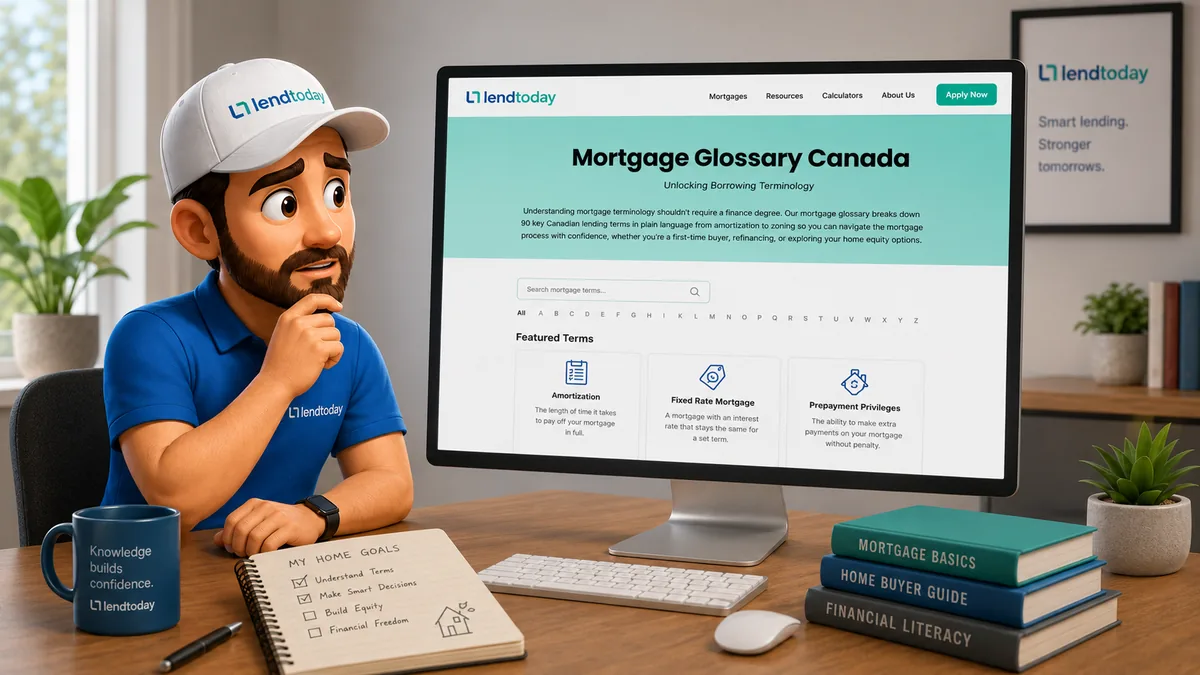
Mortgage Glossary Canada
Unlocking borrowing terminology.
Understanding mortgage terminology should not require a finance degree. This mortgage glossary breaks down key Canadian lending terms in plain language, from amortization to zoning, so you can navigate the mortgage process with confidence, whether you are a first-time buyer, refinancing, or exploring your home equity options. Use the search box or the A to Z index below to jump straight to any term.
Last reviewed: July 2026. Definitions are kept current with Canadian lending rules and reviewed periodically by the LendToday team.
Popular mortgage terms
Adjustable-Rate Mortgage (ARM)
A type of variable-rate mortgage where your payment changes whenever the lender's prime rate moves, so both the interest portion and the total payment can rise or fall over time. This differs from some variable-rate mortgages that keep the payment fixed and instead adjust how much of each payment goes to principal versus interest. See the Variable-Rate Mortgage entry for the related structure.
Amortization
The total length of time it takes to pay off a mortgage in full through regular payments. In Canada, the most common amortization period is 25 years, though some lenders offer 30-year amortization for certain insured or uninsured mortgages. A longer amortization reduces monthly payments but increases the total interest paid over the life of the loan.
Amortization Schedule
A table showing every scheduled mortgage payment over the life of the loan, broken down into principal and interest portions. Early in the amortization, most of each payment goes toward interest. Over time, a larger share applies to the principal balance.
Appraisal
A professional assessment of a property's market value conducted by a certified appraiser. Lenders require an appraisal to confirm the property is worth enough to secure the mortgage. The borrower typically pays the appraisal fee, which varies by property type and location.
Approval-in-Principle (Pre-Approval)
A conditional commitment from a lender indicating how much you may be eligible to borrow, based on an initial review of your income, credit, and debts. A pre-approval is not a guarantee of financing. Final approval depends on the property appraisal and a full verification of your financial details.
Arrears
Payments that are overdue. If you fall behind on your mortgage payments, you are said to be in arrears. Mortgage arrears can trigger penalties, damage your credit score, and eventually lead to power of sale or foreclosure proceedings if not resolved.
Assignment of Mortgage
The transfer of an existing mortgage from one lender to another, or from one borrower to another. An assignment may occur when a mortgage is sold between financial institutions or when a buyer assumes the seller's existing mortgage as part of a home purchase.
Assumable Mortgage (Assumption)
A mortgage that allows a qualified buyer to take over the seller's existing mortgage, including its current interest rate, balance, and remaining term. The buyer must usually qualify with the lender before the assumption is approved. Assumability can be attractive when the seller's existing rate is lower than current market rates, though not all mortgages are assumable and lender approval is required.
B Lender (Alternative Lender)
A financial institution that lends to borrowers who may not meet the strict qualification criteria of A lenders (the big banks and credit unions). B lenders typically serve self-employed individuals, those with bruised credit, or borrowers with non-traditional income documentation. Their rates are generally higher than A lender rates but lower than private mortgage rates.
Beacon Score
Another name for your credit score in Canada, specifically the score produced by Equifax using the FICO scoring model. Credit scores range from 300 to 900. Many A lenders look for a minimum score in the 600 to 680 range for mortgage approval, while B lenders and private lenders may accept lower scores.
Blanket Mortgage
A single mortgage that covers two or more properties. Blanket mortgages are most commonly used by real estate investors or developers who want to finance multiple properties under one loan rather than obtaining separate mortgages for each.
Blended Payment
A mortgage payment that combines both principal and interest into a single, fixed amount. It is the most common payment structure in Canada. While the total payment stays the same, the ratio of principal to interest shifts over time, with more interest at the beginning and more principal toward the end.
Bona Fide Sale Clause
A clause found in some closed mortgages that prevents a borrower from breaking the mortgage early simply to refinance at a lower rate with another lender. Under a bona fide sale clause, you can typically only pay out the mortgage before maturity if there is a genuine, arm's-length sale of the property. It is designed to protect the lender's expected interest revenue over the term.
Bridge Financing (Bridge Loan)
A short-term loan that helps homeowners cover the gap when the closing date of a new home purchase falls before the closing date of the sale of their existing home. Bridge loans are typically arranged through your mortgage lender and carry higher interest rates due to their short duration.
Broker (Mortgage Broker)
A licensed professional who acts as an intermediary between borrowers and lenders. Unlike a bank representative who can only offer products from one institution, a mortgage broker has access to multiple lenders and can shop your application across the market to find suitable rates and terms for your situation.
Buydown
An arrangement where the borrower pays an upfront lump sum to reduce the mortgage interest rate for a set period or the entire term. A buydown effectively lowers monthly payments in exchange for higher upfront costs.
Canada Mortgage and Housing Corporation (CMHC)
A federal Crown corporation that provides mortgage loan insurance to lenders for borrowers with a down payment of less than 20%. CMHC insurance protects the lender, not the borrower, against default. The premium is calculated as a percentage of the mortgage amount and can be added to the mortgage balance.
Cash-Back Mortgage
A mortgage that returns a lump sum of cash to the borrower on closing, usually expressed as a percentage of the mortgage amount. The cash can be used for closing costs, furniture, or renovations. In exchange, cash-back mortgages generally carry a higher interest rate, and if you break the mortgage early the lender may require you to repay a portion of the cash received.
Closed Mortgage
A mortgage that restricts prepayment beyond the terms specified in the contract. Breaking a closed mortgage before the end of the term typically triggers a prepayment penalty, calculated as either three months' interest or the interest rate differential (IRD), whichever is greater. Closed mortgages usually offer lower interest rates than open mortgages.
Closing Costs
The expenses beyond the purchase price that a buyer must pay when completing a real estate transaction. In Canada, common closing costs include legal fees, land transfer tax, title insurance, appraisal fees, home inspection fees, and adjustments for property taxes or utility bills prepaid by the seller.
Closing Date
The date on which the property sale is finalized, legal ownership transfers to the buyer, and the mortgage funds are advanced by the lender. In Canada, the buyer's lawyer or notary handles the closing process, including registering the mortgage on title.
Co-signer
A person who signs the mortgage alongside the primary borrower and shares full legal responsibility for the debt. Unlike a guarantor, a co-signer is usually on the property title and is equally liable for payments from day one. Adding a co-signer with strong income or credit can help a borrower qualify who would not qualify on their own.
Collateral
An asset pledged as security for a loan. In a mortgage, the property itself serves as collateral. If the borrower defaults, the lender has the legal right to seize and sell the property to recover the outstanding debt.
Collateral Charge Mortgage
A type of mortgage registration that allows the lender to secure additional lending (such as a line of credit) against the same property without re-registering the mortgage. Major banks in Canada commonly use collateral charges. The downside is that switching lenders at renewal typically requires paying discharge and new registration fees.
Commitment Letter
A formal document from a lender confirming the approved mortgage amount, interest rate, term, and conditions. The commitment letter outlines everything the borrower must provide or satisfy before the mortgage can close.
Compound Interest
Interest calculated on both the original principal and the accumulated interest from previous periods. In Canada, mortgage interest is compounded semi-annually for fixed-rate mortgages (as required by law) and typically monthly for variable-rate mortgages.
Consumer Proposal
A legally binding agreement negotiated through a Licensed Insolvency Trustee (LIT) in which a borrower offers to repay a portion of their debts over a period of up to five years. A consumer proposal is an alternative to bankruptcy and, while it affects your credit rating, it may allow you to keep your home and eventually qualify for new mortgage financing.
Conventional Mortgage
A mortgage where the borrower's down payment is 20% or more of the property's purchase price. Because the loan-to-value ratio is 80% or lower, CMHC mortgage insurance is not required. Conventional mortgages may still require an appraisal depending on the lender.
Debt Consolidation
The process of combining multiple debts (credit cards, personal loans, vehicle financing) into a single loan, often secured against your home. By consolidating high-interest debts into a lower-interest mortgage, borrowers can reduce their total monthly payments and simplify their finances.
Debt Service Ratio
A calculation lenders use to determine whether a borrower can afford a mortgage. There are two types: the Gross Debt Service (GDS) ratio, which measures housing costs as a percentage of gross income, and the Total Debt Service (TDS) ratio, which includes all debt obligations. Many A lenders look for a GDS commonly around 39% and a TDS commonly around 44%. A Debt Service Calculator can help you run the numbers.
Default
The failure to meet the legal obligations of a mortgage, most commonly by missing payments. A mortgage default can lead to the lender initiating power of sale or foreclosure proceedings to recover the debt.
Discharge
The legal process of removing a mortgage from the title of a property once the loan has been paid in full or when a borrower switches to a new lender. A discharge fee is charged by the existing lender to process the removal, and the amount varies by lender and province.
Down Payment
The portion of the purchase price that the buyer pays upfront from their own funds. In Canada, the minimum down payment is 5% on the first $500,000 of the purchase price and 10% on the portion between $500,000 and $1.5 million. Homes priced at $1.5 million or more require a minimum 20% down payment and are not eligible for mortgage default insurance.
Easement
A legal right for someone to use a portion of your property for a specific purpose, such as a utility company running lines across the lot or a neighbour's shared driveway. Easements are registered on title and can affect how a property may be used or developed. Lenders review easements as part of assessing the property.
Encumbrance
Any claim, charge, or liability registered against a property that may affect its title or transfer. Common encumbrances include mortgages, liens, easements, and unpaid property taxes. A title search reveals encumbrances, and most must be cleared or accounted for before a property can be sold or refinanced.
Equitable Mortgage
A mortgage arrangement where the borrower's property serves as security for the loan, but the mortgage has not been formally registered against the title. Equitable mortgages are less common and carry a higher risk for the lender, which typically results in higher interest rates.
Equity
The difference between the current market value of your home and the amount you owe on your mortgage and any other debts secured against the property. Equity increases as you pay down your mortgage and as the value of your home appreciates. You can borrow against your equity through a home equity loan, HELOC, or refinance.
Equity Take-Out (Equity Release)
The process of accessing the equity in your home by increasing your mortgage amount or taking out a new loan secured against the property. Homeowners commonly use equity take-out for renovations, debt consolidation, investing, or covering large expenses.
First Home Savings Account (FHSA)
A registered account introduced by the Canadian government that allows first-time home buyers to save up to $8,000 per year, to a lifetime limit of $40,000, toward the purchase of a qualifying home. Contributions are tax-deductible (like an RRSP), and qualifying withdrawals for a home purchase are tax-free (like a TFSA).
First Mortgage
The primary mortgage registered against a property, which takes priority over all other liens and mortgages in the event of default. If the property is sold through power of sale or foreclosure, the first mortgage is paid out before any second or third mortgages.
Fixed vs Variable
The core choice between a fixed-rate mortgage, where your rate and payment stay constant for the term, and a variable-rate mortgage, where your rate moves with the lender's prime rate. Fixed offers certainty and easier budgeting; variable can start lower but carries the risk of rising payments if rates increase. The right choice depends on your risk tolerance, budget, and how you expect rates to move. See the individual Fixed-Rate Mortgage and Variable-Rate Mortgage entries, and check the market report for where rates sit today.
Fixed-Rate Mortgage
A mortgage where the interest rate remains the same for the entire term. Your regular payment amount does not change, regardless of fluctuations in the market interest rate. Fixed-rate mortgages offer payment predictability but typically start at a slightly higher rate than variable-rate mortgages.
Foreclosure
A legal process in which the lender takes ownership of a property after the borrower defaults on the mortgage. In some Canadian provinces (such as Alberta), foreclosure is the standard remedy. In Ontario, lenders more commonly use the power of sale process. Foreclosure can severely damage your credit rating for years.
FSRA (Financial Services Regulatory Authority of Ontario)
The provincial regulator that oversees mortgage brokerages, brokers, and agents in Ontario. All mortgage professionals in Ontario must be licensed through FSRA. You can verify a broker's license status through the FSRA public registry.
Gifted Down Payment
Money given by an immediate family member to help a buyer cover their down payment, with no expectation of repayment. Lenders typically require a signed gift letter confirming the funds are a genuine gift and not a loan. A gifted down payment can help buyers reach the minimum down payment sooner.
Gross Debt Service Ratio (GDS)
A calculation that measures your annual housing costs (mortgage payments, property taxes, heating, and 50% of condo fees if applicable) as a percentage of your gross annual household income. Many A lenders look for a GDS ratio commonly around 39% or below. A Debt Service Calculator can help you understand the numbers.
Guarantor
A person who agrees to take responsibility for a mortgage if the primary borrower defaults. Having a guarantor can help borrowers with insufficient income or credit history qualify for a mortgage. The guarantor's income, credit, and assets are assessed alongside the primary borrower's.
High-Ratio Mortgage
A mortgage where the borrower's down payment is less than 20% of the purchase price, resulting in a loan-to-value ratio greater than 80%. High-ratio mortgages require mortgage default insurance from CMHC, Sagen, or Canada Guaranty. The insurance premium is added to the mortgage balance.
Home Buyers' Plan (HBP)
A Government of Canada program that allows first-time home buyers to withdraw up to $60,000 from their RRSPs tax-free to use toward the purchase of a qualifying home. The withdrawn amount must be repaid to the RRSP over a 15-year period beginning the second year after the withdrawal.
Home Equity Line of Credit (HELOC)
A revolving line of credit secured against the equity in your home. Unlike a traditional mortgage, a HELOC allows you to borrow, repay, and re-borrow funds up to a set limit. HELOCs typically carry variable interest rates tied to the lender's prime rate. The maximum combined loan-to-value for a HELOC plus your first mortgage is generally 80% in Canada.
Home Equity Loan
A lump-sum loan secured against the equity in your property. Unlike a HELOC, a home equity loan provides all the funds at once with a fixed repayment schedule. These loans are commonly used for debt consolidation, renovations, or large one-time expenses.
Insured Mortgage
A mortgage that is backed by mortgage default insurance (from CMHC, Sagen, or Canada Guaranty). All mortgages with a down payment of less than 20% must be insured. Some lenders also insure conventional mortgages (with 20% or more down) at their own cost in exchange for more favourable terms on the secondary market.
Interest Adjustment Date (IAD)
The date from which your regular mortgage payments begin. If you close your mortgage partway through a month, you will owe a one-time interest adjustment covering the days from closing to the end of that month (or to your first regular payment date). This amount is typically collected at closing.
Interest Rate Differential (IRD)
A prepayment penalty formula used by lenders when a borrower breaks a fixed-rate mortgage before the end of the term. The IRD calculates the difference between your existing mortgage rate and the lender's current rate for the remaining term, applied to the outstanding balance. IRD penalties can be significantly larger than the three-months'-interest penalty.
Joint Tenancy
A form of property ownership where two or more people hold equal, undivided interest in a property. If one owner passes away, their share automatically transfers to the surviving owner or owners without going through probate.
Land Transfer Tax
A tax imposed by the province (and in Toronto, the city) when real estate changes hands. The amount is based on the purchase price and is paid by the buyer on closing day. First-time home buyers in Ontario may qualify for a full or partial rebate of the provincial land transfer tax.
Lien
A legal claim registered against a property as security for the payment of a debt. Mortgages are the most common type of lien. Other liens can include unpaid property taxes, construction liens from contractors, or court judgments. Liens must generally be cleared before a property can be sold.
Loan-to-Value Ratio (LTV)
The ratio of the mortgage amount to the appraised value of the property, expressed as a percentage. For example, if your home is worth $400,000 and your mortgage balance is $300,000, your LTV is 75%. Most lenders will lend up to 80% LTV for conventional mortgages. Some private lenders may go higher.
Lump-Sum Payment (Prepayment)
An extra one-time payment made against your mortgage principal, over and above your regular payments. Most closed mortgages allow annual lump-sum prepayments of a set percentage of the original mortgage amount without penalty. Lump-sum payments reduce the principal balance and can significantly shorten the amortization.
Maturity Date
The date on which the mortgage term expires and the remaining balance must be repaid, renewed with the same lender, or refinanced with a new lender. If you do not renew or refinance before the maturity date, the lender may call the loan due in full.
MIC (Mortgage Investment Corporation)
A private lending company that pools investor capital to fund mortgages, typically for borrowers who do not qualify with traditional lenders. MICs are regulated under the Income Tax Act and commonly fund second mortgages, construction loans, and short-term financing. Interest rates from MICs are higher than bank rates.
Mortgage
A loan secured by real property. The borrower agrees to repay the principal plus interest over a set amortization period, with the property serving as collateral. If the borrower fails to meet the repayment obligations, the lender can enforce the mortgage by selling the property.
Mortgage Stress Test
A federal regulation (Guideline B-20) requiring that borrowers qualify for their mortgage at a rate higher than the one they will actually pay. The qualifying rate is the greater of the contracted rate plus two percentage points, or the federal benchmark rate. The stress test reduces the maximum mortgage amount most borrowers can obtain. For current benchmark and posted rates, see our market report.
Mortgage Term
The length of time your current mortgage agreement (interest rate, payment schedule, and conditions) is in effect. Common terms in Canada are 1, 2, 3, 4, and 5 years. At the end of the term, the borrower can renew, refinance, or pay the balance in full. The term is different from the amortization period.
Net Worth
The total value of all your assets (property, savings, investments, vehicles) minus all your liabilities (mortgages, loans, credit card balances). Lenders may consider your net worth as part of the overall risk assessment, particularly for larger mortgage requests.
Non-Resident Mortgage
A mortgage issued to a borrower who is not a Canadian citizen or permanent resident. Non-residents typically face stricter qualification requirements, including larger down payments, and may not qualify for CMHC-insured mortgages.
Notice of Assessment (NOA)
The summary the Canada Revenue Agency issues after processing your tax return, confirming your reported income and any taxes owing or refunded. Lenders often request recent Notices of Assessment to verify income, especially for self-employed borrowers or those with variable earnings. It is one of the most commonly requested income documents in a mortgage application.
Notice of Sale (Notice of Default)
A formal legal notice sent by the lender to the borrower advising that the mortgage is in default and that the lender intends to exercise its right to sell the property. In Ontario, the borrower has a redemption period to bring the mortgage current before the sale can proceed.
Open Mortgage
A mortgage that allows the borrower to make additional payments or pay off the entire balance at any time without penalty. Open mortgages offer maximum flexibility but carry higher interest rates than closed mortgages. They are ideal for borrowers who expect to sell their property, receive a large sum of money, or refinance in the near term.
Origination Fee
A fee charged by some lenders to cover the administrative costs of processing a new mortgage. Origination fees are more common with private lenders and B lenders. The fee is typically expressed as a percentage of the loan amount and may be deducted from the mortgage advance or added to the balance.
Porting (Mortgage Portability)
The ability to transfer your existing mortgage, including its rate and terms, from your current property to a new one. Porting allows borrowers to avoid prepayment penalties when selling and buying simultaneously. Not all lenders offer portability, and additional qualification may be required for the new property.
Power of Sale
A legal remedy available to lenders in Ontario and some other Canadian provinces that allows the lender to sell a property after the borrower defaults, without obtaining a court order for full foreclosure. The lender must provide the borrower with a notice period. Any sale proceeds beyond the outstanding mortgage debt and costs are returned to the borrower.
Prepayment Penalty
A fee charged by the lender if you pay off all or part of your mortgage before the end of the term, beyond the allowed prepayment privileges. For fixed-rate mortgages, the penalty is typically the greater of three months' interest or the Interest Rate Differential (IRD). For variable-rate mortgages, it is usually three months' interest.
Prepayment Privileges
The terms in your mortgage contract that specify how much extra you can pay toward your mortgage each year without triggering a penalty. Common prepayment privileges include increasing your regular payment and making annual lump-sum payments, each up to a set percentage of the original mortgage amount.
Prime Rate
The benchmark interest rate set by individual banks, typically influenced by the Bank of Canada's overnight target rate. Variable-rate mortgages and HELOCs are priced relative to prime. When the Bank of Canada changes its key interest rate, lenders generally adjust their prime rate accordingly. Our market report tracks the current prime and policy rates.
Principal
The original amount borrowed on a mortgage, or the remaining balance of the loan excluding accrued interest. Each mortgage payment consists of a principal portion (which reduces the amount owed) and an interest portion (which compensates the lender for lending you the money).
Private Mortgage (Private Lending)
A mortgage funded by an individual investor or a Mortgage Investment Corporation (MIC) rather than a bank or institutional lender. Private mortgages are typically short-term, carry higher interest rates, and are used by borrowers who cannot qualify through traditional channels due to credit issues, income documentation challenges, or urgent timelines.
Property Tax
An annual tax levied by your municipality based on the assessed value of your property. Property taxes fund local services such as roads, schools, and emergency services. Unpaid property taxes can result in a lien on your property and, in extreme cases, a tax sale.
Qualifying Rate
The interest rate used in the mortgage stress test to determine whether a borrower can afford their mortgage payments. It is the higher of the borrower's contracted rate plus two percentage points, or the federal benchmark rate. This is different from the actual rate you will pay. See our market report for current rate context.
Rate Hold
A guarantee from a lender that a quoted interest rate will be honoured for a specific period (often 90 to 120 days), regardless of rate changes in the market. Rate holds are commonly provided as part of a pre-approval. If rates drop during the hold period, some lenders will offer the lower rate.
Readvanceable Mortgage
A mortgage combined with a home equity line of credit, where the available credit limit increases as you pay down the mortgage principal. This lets you re-borrow the equity you build without applying for new financing each time. Readvanceable mortgages are useful for homeowners who want ongoing access to their growing equity.
Refinancing
The process of replacing your existing mortgage with a new one, typically to access a lower interest rate, extend or shorten the amortization, consolidate debts, or access equity in the home. Refinancing a mortgage in Canada before the end of the term may result in a prepayment penalty.
Renewal
The process of renegotiating the terms of your mortgage at the end of the current term. At renewal, you can negotiate a new interest rate, change the term length, switch between fixed and variable rates, or transfer the mortgage to a different lender. You are not obligated to renew with your current lender.
Reverse Mortgage
A financial product available to Canadian homeowners aged 55 and older that allows them to convert up to 55% of their home's appraised value into tax-free cash without selling the home or making regular mortgage payments. The loan and accumulated interest are repaid when the homeowner sells the home, moves out, or passes away.
Second Mortgage
An additional mortgage registered behind the first mortgage on a property. If the property is sold or the borrower defaults, the first mortgage is paid out before the second mortgage. Because of this higher risk, second mortgages carry higher interest rates. They are commonly used to access equity without refinancing the existing first mortgage.
Self-Employed Mortgage
A mortgage designed for borrowers who earn income through their own business rather than as salaried employees. Self-employed borrowers often face additional documentation requirements (such as Notices of Assessment, T1 Generals, and financial statements). Some lenders offer stated-income programs that require less documentation in exchange for higher rates.
Standard Charge Mortgage
A type of mortgage registration where the mortgage is registered for the exact amount borrowed. Unlike a collateral charge, a standard charge mortgage can typically be transferred to a new lender at renewal without incurring discharge and re-registration fees.
Stated Income Program
A mortgage program that allows self-employed borrowers to declare their income on the application without the full traditional documentation (such as T4 slips or employment letters). Lenders offering stated income programs typically charge higher rates and require a larger down payment or more equity to offset the risk.
Subordination
A legal agreement that establishes the priority of one mortgage or lien over another. In a refinancing scenario, the first mortgage lender may agree to subordinate to a new lender, meaning the new lender's claim takes priority, which is a common arrangement in second mortgage transactions.
Survey (Real Property Report)
A legal document prepared by a licensed surveyor that shows the property boundaries, the location of buildings and structures on the lot, and any encroachments or easements. Some lenders require a survey as part of the mortgage process, though title insurance has largely replaced this requirement in Ontario.
Title
The legal ownership of a property. When you purchase a home, the title is registered in your name at the provincial land registry. A clear title means there are no outstanding claims, liens, or disputes against the property.
Title Insurance
An insurance policy that protects the homeowner and/or lender against losses caused by defects in the title, such as fraud, errors in public records, undisclosed liens, or encroachments. Title insurance is a one-time cost paid at closing and is required by most lenders in Canada.
Title Search
A review of the public land registry records to confirm who owns the property, identify any mortgages, liens, easements, or other encumbrances registered against the title, and verify that the seller has the legal right to transfer ownership.
Total Debt Service Ratio (TDS)
A calculation that measures all of your monthly debt obligations (housing costs plus car payments, credit card minimums, student loans, and any other debts) as a percentage of your gross monthly household income. Many A lenders look for a TDS ratio commonly around 44% or below.
Underwriting
The process by which a lender evaluates a mortgage application to determine the risk involved in lending to a particular borrower. Underwriters review the borrower's credit history, income, employment, debts, and the property itself before issuing an approval, denial, or conditional approval.
Uninsured Mortgage
A mortgage that does not carry mortgage default insurance. This applies to most mortgages with a down payment of 20% or more, or mortgages on properties valued above the insured cap (which are not eligible for CMHC insurance). Uninsured mortgages may have slightly different interest rates than insured mortgages.
Variable-Rate Mortgage
A mortgage where the interest rate fluctuates based on changes to the lender's prime rate. With a variable-rate mortgage, the payment may remain fixed (with the principal and interest split changing) or the payment itself may change when prime moves. Variable-rate mortgages typically start with a lower rate than fixed-rate mortgages but carry the risk of rate increases.
Vendor Take-Back Mortgage (VTB)
A financing arrangement where the seller of a property provides a mortgage to the buyer for a portion of the purchase price. VTBs are most common in situations where the buyer cannot qualify for full financing through traditional lenders, or in commercial and rural property transactions.
Walk-Away Clause (Condition of Financing)
A clause in a purchase agreement that allows the buyer to cancel the transaction without penalty if they are unable to secure mortgage financing within a specified time period. Including a financing condition protects the buyer's deposit and is strongly recommended, especially for buyers with non-standard financial situations.
Wraparound Mortgage
A type of financing where a new mortgage wraps around the existing first mortgage. The borrower makes a single payment to the new lender, who in turn continues making payments on the original mortgage. Wraparound mortgages are rare in Canada but are occasionally used in creative financing arrangements.
Yield
The annual return on an investment expressed as a percentage. In the context of mortgages, yield refers to the effective return the lender earns on the mortgage, taking into account the interest rate, fees, and any discount or premium at which the mortgage was originated.
Zoning
The municipal regulations that govern how a property can be used (residential, commercial, industrial, agricultural, and so on). Zoning bylaws affect property values and can impact mortgage financing. For example, a lender may decline to finance a property if its current use does not conform to local zoning regulations.
Find Terms by What You Are Trying to Do
The language of lending makes more sense when it is tied to a real goal. Here is where common terms fit together, with links to the pages that go deeper.
Buying your first home
Getting your deposit and approval in order is the first hurdle. These terms come up early in the journey.
Accessing your home equity
If you have built up value in your home, these are the ways to put it to work.
Struggling with payments
Falling behind is stressful, but options exist. Understanding these terms helps you act early.
Turned down by a bank
A bank "no" is not the end of the road. These terms describe the alternative lending world.
Self-employed or non-traditional income
Earning through your own business changes how lenders assess you. Start here.
Comparing rates and terms
The fine print is where mortgages differ most. These terms help you compare offers fairly.
Ready to Talk to a Real Person?
A glossary can explain the words, but the right mortgage depends on your situation. Our team works with homeowners across Ontario, including those who have been turned down elsewhere. Every initial consultation is free and comes with no obligation.
Apply Now Call 1-855-242-7732Mortgage Glossary FAQs
What is the difference between a mortgage term and amortization?
The amortization is the total time it takes to pay off the entire mortgage, commonly 25 years in Canada. The term is the length of your current contract with its specific rate and conditions, commonly 1 to 5 years. You will renew or refinance several terms over the full amortization.
What is the difference between an A lender and a B lender?
A lenders are the big banks and credit unions with the strictest qualification rules and the lowest rates. B lenders, also called alternative lenders, serve borrowers who do not fit those rules, such as the self-employed or those with bruised credit. B lender rates are higher than A lender rates but lower than private mortgage rates.
What is the difference between power of sale and foreclosure?
Both are remedies a lender can use after a borrower defaults. In Ontario, power of sale is the more common route, allowing the lender to sell the property without a court order and return any surplus to the borrower. Foreclosure transfers ownership of the property to the lender and is more common in some other provinces.
What is a prepayment penalty and when does it apply?
A prepayment penalty is a fee charged when you pay off all or part of a closed mortgage before the end of the term, beyond your allowed prepayment privileges. For fixed-rate mortgages it is typically the greater of three months' interest or the interest rate differential. For variable-rate mortgages it is usually three months' interest.
Do I need a 20% down payment to buy a home in Canada?
No. The minimum down payment is 5% on the first $500,000 of the purchase price and 10% on the portion between $500,000 and $1.5 million. A down payment below 20% requires mortgage default insurance. Homes priced at $1.5 million or more require at least 20% down and are not eligible for that insurance.
Where can I see current mortgage rates?
This glossary avoids listing specific rate numbers because they change constantly. For live Bank of Canada rates, bond yields, and what they mean for fixed and variable mortgages, visit our market report page, which updates automatically from official data.
Can a mortgage broker help me if a bank turned me down?
Yes. A mortgage broker has access to many lenders, including alternative and private lenders that a single bank branch cannot offer. If a bank has declined you, a broker can shop your application across the market to find options that fit your situation.
Sources for figures cited on this page. Government program limits and down payment rules are drawn from official sources and are current as of the last update. Rules can change, so confirm details before you rely on them.
Minimum down payment rules: Financial Consumer Agency of Canada. First Home Savings Account limits: Canada Revenue Agency. For live interest rate context, see our Canadian mortgage market report.
This glossary is general information, not financial or legal advice. Definitions are simplified for clarity and may not cover every situation or provincial variation.