Choosing a mortgage rate type is one of the most consequential decisions a Canadian borrower makes, and it is often the least well explained part of the mortgage conversation. Most borrowers walk into a bank knowing they can choose between fixed and variable, but very few understand the meaningful differences between a variable rate with a fixed payment and a variable rate with a floating payment, or when a convertible mortgage might serve them better than a straight fixed rate. The 2022 and 2023 rate hike cycle exposed these gaps in a painful way, when hundreds of thousands of Canadians discovered mid-term that the mortgage they thought they understood behaved very differently from what they expected.
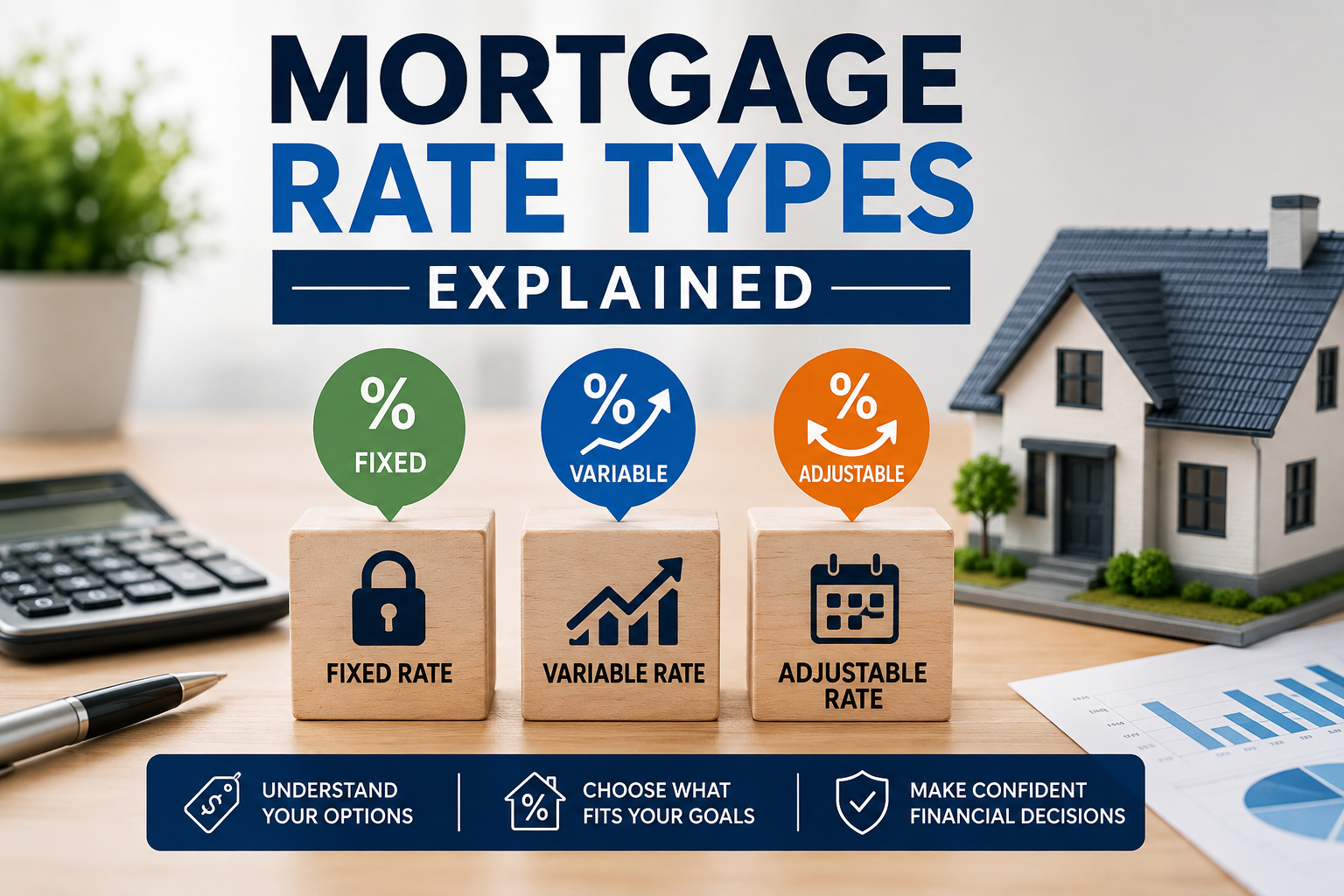
The core rate types available in Canada are fixed rate, variable rate with fixed payment (adjustable amortization), variable rate with floating payment (true adjustable rate), convertible rate, and hybrid mortgages that combine features of more than one. Each option has different implications for monthly payment stability, interest rate risk, prepayment flexibility, and how the mortgage behaves when the Bank of Canada changes its policy rate. This article walks through each type in plain language, explains how each one actually behaves during rate changes, and helps you decide which type fits your situation and risk tolerance in the 2026 rate environment.
Table of Contents
ToggleWhat Are Mortgage Rate Types in Canada?
A mortgage rate type is the structure that determines how your interest rate is set, how it changes over the term of the mortgage, and how those changes flow through to your monthly payment. Two mortgages with the same starting rate can behave very differently based on their rate type, and that difference can be worth thousands of dollars over a five year term.
The rate type is separate from the rate itself. A five year fixed at 5 percent and a five year variable at 5 percent are the same starting rate but fundamentally different products. Understanding this distinction is the first step in choosing the right mortgage.
The Difference Between Rate and Rate Type
The rate is the number, the annual interest percentage charged on the outstanding mortgage balance. The rate type is the framework that determines whether that number can change during the term, what causes it to change, and how the change affects the borrower.
Key takeaway: The rate is the price you pay today. The rate type determines the price you pay tomorrow.
How Rate Types Relate to the Bank of Canada Policy Rate
The Bank of Canada sets the overnight policy rate, which most Canadian lenders use as the reference point for their prime rate. Variable and adjustable mortgages are priced as prime minus or prime plus a set amount, so they move up and down when the Bank of Canada changes the policy rate. Fixed rate mortgages are priced based on Government of Canada bond yields, not the policy rate directly, which is why fixed and variable rates do not always move together.
1. Fixed Rate Mortgages
Fixed rate mortgages are the most popular choice in Canada. The interest rate is locked in for the entire term, and the monthly payment stays the same regardless of what happens in the broader rate environment.
How Fixed Rates Are Set
Fixed rates are priced based on Government of Canada bond yields, which reflect market expectations about future inflation and interest rates. When bond yields rise, fixed mortgage rates rise. When bond yields fall, fixed rates typically follow. This is why fixed and variable rates sometimes move in opposite directions in the short term.
Once you sign a fixed rate mortgage, the rate is set for your entire term, typically 1 to 5 years, with some lenders offering 7 and 10 year terms as well.
Pros and Cons of Fixed Rates
Pros: Predictable payments for the full term. Protection from rate increases. Easier to budget around. No exposure to trigger rate scenarios.
Cons: Higher penalty structure for breaking the mortgage early. Historically, fixed rates have averaged higher than variable rates over long periods, meaning fixed rate borrowers have paid more in total interest across full mortgage cycles.
The penalty structure is worth understanding. Fixed rate mortgages are usually broken using an Interest Rate Differential (IRD) calculation, which can result in penalties of tens of thousands of dollars in certain rate environments, particularly when the borrower is breaking a mortgage with a high contract rate to take advantage of lower current rates.
Common misconception: That fixed rates are always safer than variable rates. Fixed rates protect against rate increases, but they can create very expensive break penalties if the borrower needs to exit the mortgage early. Safety depends on the borrower’s specific situation.
2. Variable Rate Mortgages With Fixed Payment
This is the most misunderstood mortgage product in Canada. The interest rate floats with the Bank of Canada policy rate, but the monthly payment stays the same. The difference gets absorbed by changes to the amortization.
How the Adjustable Amortization Works
When the Bank of Canada raises rates, the interest portion of each payment rises, but because the payment is fixed, less money goes toward the principal. The amortization effectively extends. When the Bank of Canada cuts rates, the opposite happens: more of each payment goes to principal, and the amortization effectively shortens.
The payment amount does not change on a monthly basis, which is the appeal of this product. Borrowers get variable rate pricing (usually lower than fixed) with the payment stability of a fixed rate mortgage.
The Trigger Rate Problem
The 2022 and 2023 rate hike cycle exposed a serious flaw in this structure. When rates rise fast enough, the fixed payment can eventually stop covering even the interest portion of the loan. At that point, the amortization can no longer extend, and something has to change.
The point at which the fixed payment stops covering the interest is called the trigger rate. Once a borrower hits their trigger rate, the lender must intervene, usually by requiring a lump sum payment, a payment increase, or a switch to a different mortgage structure.
During the 2022 to 2023 rate cycle, hundreds of thousands of Canadian borrowers hit their trigger rates, and lenders extended amortizations dramatically in many cases, sometimes to 50, 60, or even 70 years on paper. Those extensions were paper adjustments that will need to be resolved at renewal, which is a major theme in the 2026 to 2027 renewal cycle.
Important to note: Variable rate mortgages with fixed payments are still available in Canada in 2026, but many lenders have adjusted the structure to reduce the trigger rate risk. Understanding how your specific product handles rate changes is essential before signing.
3. Adjustable Rate Mortgages With Floating Payment
An adjustable rate mortgage, sometimes called a true variable rate mortgage, floats both the rate and the payment with the Bank of Canada policy rate. When the policy rate changes, the mortgage rate changes, and the monthly payment changes accordingly.
How Payments Change With Prime
Adjustable rate mortgages are priced as prime plus or prime minus a set amount. If the mortgage is priced at prime minus 0.50 and prime is 5 percent, the mortgage rate is 4.50 percent. When the Bank of Canada raises the overnight rate by 0.25 percent, most lenders raise their prime rate by the same amount, and the mortgage rate rises to 4.75 percent. The monthly payment is recalculated at the new rate, and the borrower’s payment goes up.
This creates payment volatility, which is what most borrowers dislike about the product. Payments can rise or fall meaningfully during the term, which makes budgeting harder for borrowers with tight cash flow.
Who Adjustable Rate Mortgages Suit Best
Adjustable rate mortgages generally suit borrowers with financial flexibility, a longer time horizon in the property, and comfort with rate volatility. Historically, adjustable rate borrowers have paid less total interest over full rate cycles compared to fixed rate borrowers, but the shorter the time horizon, the more the specific starting rate matters versus the long term average.
The elimination of the trigger rate risk is a significant advantage of adjustable rate mortgages over variable rate mortgages with fixed payments. The borrower feels every rate change immediately in the payment, which is uncomfortable, but the mortgage never hits the mechanical breaking point that fixed payment variable mortgages did in 2022 and 2023.
Common mistake: Assuming a variable rate mortgage and an adjustable rate mortgage are the same product. In Canadian mortgage terminology, they are structurally different. Variable typically means fixed payment with adjustable amortization. Adjustable typically means floating payment. Confirm exactly which structure your lender is offering before signing.
4. Convertible Mortgages
A convertible mortgage lets the borrower convert from one rate type to another during the term, usually from variable or adjustable to fixed, without paying a penalty. It provides an escape hatch for borrowers who start in a floating rate product and later decide they want the stability of a fixed rate.
How Conversion Works
The borrower notifies the lender of their intent to convert. The lender offers a fixed rate at current market pricing, typically for a term equal to or longer than the remaining term on the original mortgage. The borrower accepts or declines. If accepted, the mortgage converts from variable to fixed at the new rate, and payments are recalculated.
Some lenders limit conversions to certain term lengths or require the new term to extend beyond the original maturity. Confirm the specific rules before assuming a convertible option is unlimited.
When Convertible Makes Sense
Convertible mortgages suit borrowers who want to start in a variable or adjustable rate for the initial lower rate, but who also want the flexibility to lock in if rates rise unexpectedly or if their personal risk tolerance changes. The trade-off is usually a slightly higher variable rate compared to a non-convertible product, though the gap varies by lender.
For borrowers who value optionality and are willing to pay slightly more for it, convertible mortgages can be a smart compromise between fixed and variable.
5. Hybrid Mortgages
A hybrid mortgage splits the mortgage into two or more portions, each with its own rate type. The most common structure is half fixed and half variable, allowing the borrower to hedge between the stability of a fixed rate and the potential savings of a variable rate.
How the Split Works
The lender divides the mortgage into two components, typically registered as separate mortgages on the same property. Each component has its own rate, term, and structure. Payments are calculated for each component and combined into a single monthly payment.
Some lenders allow custom splits (60/40, 70/30) rather than the standard 50/50, and some allow more than two components.
The Pros and Cons of Hybrid Structures
Pros: Blends the risk profile of two rate types. Reduces exposure to any single rate movement. Provides some stability while retaining some potential savings.
Cons: More complex to manage. Break penalties are more complicated because each component has its own calculation. Renewal timing can differ across components, creating administrative friction.
Hybrid mortgages are less common in Canada than in some other markets, but they exist for borrowers who genuinely want to hedge their rate exposure and are comfortable with the added complexity.
6. Open vs Closed Mortgages
The open versus closed distinction is a separate axis from the rate type discussion but interacts with it in ways worth understanding.
How Open Mortgages Fit the Rate Type Discussion
A closed mortgage limits the borrower’s ability to make lump sum payments or pay off the mortgage early without penalty, though most closed mortgages include annual prepayment privileges. An open mortgage allows the borrower to pay off any amount at any time without penalty, but comes with a significantly higher interest rate.
Open mortgages are usually chosen by borrowers who expect to pay off the mortgage within a short window, often less than a year, such as those selling a property, receiving an inheritance, or moving into a new construction. Both fixed and variable rate types can be open or closed.
For most Canadian borrowers with normal timelines, a closed mortgage with reasonable prepayment privileges is the more cost-effective choice. Open mortgages exist for specific short-term situations, not as a default product.
How to Choose the Right Rate Type for Your Situation
The right rate type is the one that fits your financial situation, risk tolerance, and expected timeline in the property.
Assessing Your Risk Tolerance
If a payment increase of $200 to $400 per month would cause you serious stress or force uncomfortable choices in your household budget, a fixed rate mortgage is likely the right fit. The peace of mind is worth the slightly higher long-term average cost.
If your household can absorb payment fluctuations without significant stress, and you have some savings buffer, a variable or adjustable rate mortgage becomes a reasonable option.
Matching the Rate Type to Your Time Horizon
For borrowers who expect to move within two or three years, a shorter-term fixed rate (1 to 3 years) or a convertible variable rate often makes more sense than a five-year fixed. The shorter term reduces the risk of a large break penalty if the borrower needs to exit the mortgage before the term ends.
For borrowers with a long time horizon in the property, the choice to renew or refinance comes down to whether they want stability (fixed) or the historical long-term cost advantage of variable rates. There is no universally correct answer.
The 2026 Rate Environment
As of 2026, the Bank of Canada has held the overnight rate steady at 2.25 percent following the easing cycle of 2024 and 2025. Fixed rates from major lenders sit in the 4.4 to 4.9 percent range for a five year term, and variable rates sit in similar territory depending on the discount off prime.
With rates near this level and inflation expectations relatively stable, the fixed versus variable decision is more evenly balanced than it was during the ultra-low rate era or the aggressive hike cycle. Borrowers with a strong preference for payment stability continue to favour fixed. Borrowers with a longer horizon and higher risk tolerance are increasingly comfortable with variable or adjustable structures again.
Important to note: The rate environment can change, and any commentary about “the right choice today” reflects current conditions. What matters more than timing the market is choosing a rate type that fits your household and your time horizon.
Mortgage Rate Types in Canada: Side by Side
| Rate Type | Payment Behaviour | Rate Behaviour | Trigger Rate Risk | Best Suited For |
|---|---|---|---|---|
| Fixed rate | Constant for entire term | Locked at contract | None | Stability seekers, budget focused borrowers |
| Variable with fixed payment | Constant unless trigger rate is hit | Floats with prime | Yes | Payment stability focused borrowers accepting some risk |
| Adjustable with floating payment | Changes with rate changes | Floats with prime | None | Rate savings focused borrowers with flexibility |
| Convertible | Depends on initial type | Floating with option to fix | Depends on initial type | Borrowers wanting flexibility to lock in later |
| Hybrid (split) | Combines behaviours of components | Combines rate types | Depends on components | Borrowers wanting to hedge rate exposure |
Frequently Asked Questions
Q: What is the difference between a variable rate and an adjustable rate mortgage in Canada? In Canadian mortgage terminology, a variable rate mortgage typically has a fixed monthly payment, with the amortization adjusting to absorb rate changes. An adjustable rate mortgage has a floating payment that changes when the Bank of Canada policy rate changes. Both products have floating interest rates, but the way rate changes flow through to the borrower is structurally different.
Q: What is a trigger rate on a variable mortgage? The trigger rate is the interest rate at which the fixed monthly payment on a variable rate mortgage stops covering the interest portion of the loan. When a borrower hits their trigger rate, the lender must intervene, typically by requiring a lump sum payment, increasing the payment, or converting the mortgage to a different structure. Trigger rates became a widespread issue during the 2022 and 2023 rate hike cycle in Canada.
Q: Is a fixed rate or variable rate mortgage better in Canada? Neither is universally better. Fixed rate mortgages offer payment predictability and protection from rate increases, at the cost of higher potential break penalties and historically slightly higher long-term average rates. Variable and adjustable rate mortgages offer rate flexibility and historically lower long-term average cost, at the cost of payment volatility (for adjustable) or trigger rate risk (for variable with fixed payment). The right choice depends on your risk tolerance, time horizon, and financial situation.
Q: What is a convertible mortgage in Canada? A convertible mortgage allows the borrower to convert from one rate type to another during the term, most commonly from variable or adjustable to fixed, without paying a break penalty. This provides flexibility for borrowers who want to start in a floating rate product but preserve the option to lock in a fixed rate if the rate environment changes or if their personal risk tolerance shifts.
Q: What is a hybrid mortgage and how does it work? A hybrid mortgage splits the mortgage into two or more portions, each with its own rate type. The most common structure is half fixed and half variable, blending the payment stability of a fixed rate with the potential savings of a variable rate. Payments are calculated for each portion and combined into a single monthly payment, though break penalties and renewal timing can differ across components.
Q: How does the Bank of Canada policy rate affect my mortgage? The Bank of Canada policy rate directly affects variable and adjustable rate mortgages because they are priced as prime plus or minus a set amount, and lenders adjust their prime rate when the Bank of Canada changes the policy rate. Fixed rate mortgages are priced based on Government of Canada bond yields, which are influenced by policy rate expectations but do not move in lockstep with the policy rate itself.
Q: What are the risks of a variable rate mortgage in 2026? The main risks are payment volatility (for adjustable rate mortgages) and trigger rate exposure (for variable rate mortgages with fixed payments). If the Bank of Canada raises rates faster than expected, adjustable payments rise immediately, and variable mortgages with fixed payments can hit trigger rates that force lender intervention. Borrowers considering these products should stress test their household budget against a meaningful rate increase before committing.
Q: Can I switch from a variable to a fixed rate mortgage during my term? Yes, if you have a convertible mortgage or if you are willing to pay the break penalty on a non-convertible product. Convertible mortgages allow the switch without penalty, at whatever fixed rate the lender is currently offering. Non-convertible variable mortgages require breaking the current mortgage, which triggers a penalty of typically three months of interest, plus the cost of the new fixed rate mortgage.
Conclusion
The choice of mortgage rate type shapes how your mortgage behaves through every twist and turn of the interest rate cycle. The differences between fixed, variable, adjustable, convertible, and hybrid products are not just marketing categories. They affect your monthly payment, your total interest cost, your penalty exposure, and your ability to sleep well when the Bank of Canada makes an unexpected move.
The borrowers who choose well are the ones who understand not just the rate they are getting today, but the mechanics of how that rate can change tomorrow. A five-year fixed at 4.7 percent and a five-year variable at 4.7 percent are not the same product, and the difference will matter enormously depending on what happens in the broader rate environment over the next five years.
If you are shopping for a new mortgage, approaching renewal, or trying to decide whether to switch your current mortgage to a different rate type, contact LendToday at 1-855-242-7732 or visit lendtoday.ca to speak with a mortgage broker who can walk you through the specific structures each lender offers and help you choose the rate type that actually fits your situation.