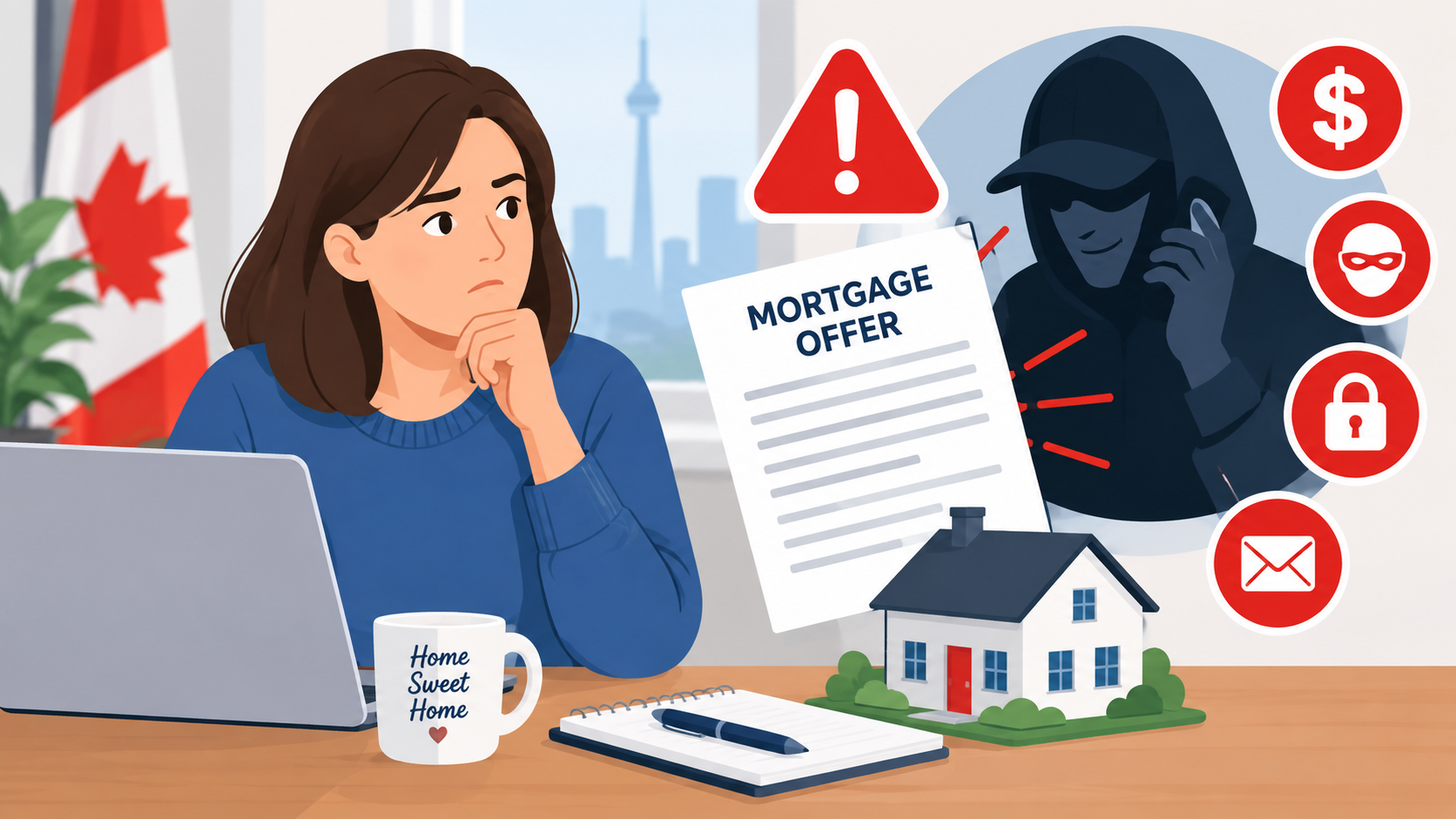
Mortgage scams in Canada almost never target the homeowner with perfect credit and a salaried job. They target the homeowner who has just been declined by a bank, who is three months behind on payments, who has a notice of sale on the kitchen table, or who owes Revenue Canada more than they can pay. Fraudsters go where the pressure is, because pressure makes people skip the checks they would normally make.
That makes this topic personal for us. The homeowners who call LendToday.ca are often in exactly the situations scammers look for, and every year we hear from people who lost money to someone else before they found us. A deposit wired to a “lender” who vanished. A “processing fee” paid for an approval that never came. A signature on a document that turned out to transfer the house.
This guide covers the nine red flags that show up again and again, what the rules in Ontario actually say about fees, how to check whether the person you are dealing with is licensed, and what to do if you think you have already been caught.
Table of Contents
ToggleThree Rules That Stop Most Mortgage Scams
If you remember nothing else from this article, remember these three.
Check the licence before you share anything. Every mortgage brokerage, broker and agent operating in Ontario must be licensed by the Financial Services Regulatory Authority of Ontario (FSRA), and the licence can be verified in minutes on the FSRA public registry.
Never send money to a broker before your mortgage funds. On a mortgage of $400,000 or less, an Ontario brokerage is not allowed to require or accept an advance payment at all. Legitimate lender and broker fees are disclosed in writing and deducted from the mortgage proceeds by the lawyer at closing.
Never sign anything without independent legal advice. A real lender wants your lawyer involved. A scammer does not.
Red Flag 1: You Are Asked to Pay a Fee Before Funding
This is the most common mortgage scam in Canada and the easiest to spot. You are told you have been approved, or are almost approved, and all that stands between you and the money is a fee. It might be called an application fee, a processing fee, an insurance premium, a lender deposit, a “good faith” payment or a first payment in advance. The amount is usually a few hundred to a few thousand dollars, and it is always urgent.
Ontario’s rules here are unusually clear. Under the Standards of Practice regulation for mortgage brokerages, if the mortgage is $400,000 or less, a brokerage cannot require or accept an advance payment or deposit for services it will provide or expenses it or anyone else will incur. On larger mortgages where an advance payment is permitted, that money is treated as trust funds and must go into the brokerage’s trust account, not an operating account and certainly not a personal email money transfer address.
So how do legitimate fees work? On a private mortgage or second mortgage, there are normally lender and brokerage fees. They are set out in writing on your disclosure documents and commitment before you sign, and they are deducted from the advance by the real estate lawyer when the mortgage funds. You never write a cheque to the broker. If an appraisal is needed before funding, it should be ordered from a recognized appraisal firm and invoiced by that firm, not paid to the person arranging your loan.
Anyone who needs your money before your money arrives is telling you something important.
Red Flag 2: Approval Is “Guaranteed”
No licensed broker or lender can guarantee approval before they have seen your credit, your income documents and an appraisal of the property. Even private lenders, who are far more flexible than banks, decline files every day because the equity is not there, the property has title problems, or the exit plan does not hold up.
Phrases like “guaranteed approval,” “no credit check, no problem, no questions” or “approved regardless of your situation” are marketing designed for people who have been turned down and are desperate to hear yes. What a legitimate broker will tell you is that there is likely a lender for your situation and what it is likely to cost. That is a very different sentence.
If your credit has been damaged, our guide to bad credit mortgages explains what alternative lenders actually look at, and why the property usually matters more than the score.
Red Flag 3: No Licence Number, or One That Does Not Check Out
In Ontario, anyone who deals or trades in mortgages must hold an FSRA licence unless the law specifically exempts them. Licensed brokerages display their licence number openly on their website, business cards, email signatures and documents. Individual brokers and agents hold their own separate licence numbers as well.
Here is how to check in under five minutes:
- Ask for the brokerage name, the brokerage licence number, and the individual’s licence number.
- Search both on the FSRA mortgage brokering consumer pages and confirm the names match exactly.
- Confirm the individual is licensed with that specific brokerage, not a different one.
- Check the FSRA enforcement actions and warning notices for the person and the company.
- Call the brokerage using the phone number on its official website, not the number in the email or text you received, and confirm the person works there.
One detail most borrowers do not know: since April 2023, Ontario has had two levels of mortgage agent licence. A Level 1 agent can only arrange mortgages with banks, other financial institutions and CMHC approved lenders. Arranging a private mortgage requires a Level 2 agent or a licensed mortgage broker. If someone offering you a private loan holds only a Level 1 licence, that is a problem.
FSRA is taking this seriously. In its 2024 to 2025 enforcement cycle, the regulator more than doubled sanctions against mortgage professionals, and maximum penalties now reach $100,000 for individuals and $500,000 for brokerages. That is good news for consumers, but enforcement happens after the damage is done. The licence check happens before.
LendToday.ca is the consumer brand of Tango Financial Mortgage Corporation, licensed by FSRA as brokerage #13691. We would encourage you to look us up exactly as described above.
Red Flag 4: Pressure to Sign Today
“The rate expires tonight.” “The lender has another borrower waiting.” “If you do not sign in the next hour the approval is gone.” Urgency is the oldest tool in fraud because it stops you from calling your lawyer, your spouse or your accountant.
Real mortgage timelines can be tight, especially if you are trying to stop a power of sale or clear arrears before a deadline. A legitimate broker will move fast with you. What they will not do is ask you to skip legal advice, sign blank pages, or commit to terms you have not seen in writing. Speed and pressure are not the same thing.
Red Flag 5: Someone Offers to “Fix” Your Income or Documents
If a broker, agent or “consultant” suggests inflating your income, creating an employment letter, adjusting bank statements, or listing a relative as a co owner who will never live there, walk away immediately.
This is mortgage fraud, and the borrower is not protected from it. If the lender discovers the misrepresentation, it can call the loan. Your name is on the application, so you carry the legal exposure alongside whoever suggested it. People in financial trouble are sometimes told “everyone does this” or “the lender knows how it works.” Neither is true.
If your income is hard to document because you are self employed, paid by commission, or earn from several sources, there are legitimate lenders built for that. Our article on income requirements for a mortgage explains how banks, B lenders and private lenders each read income differently. The answer is finding the right lender, not changing the paperwork.
Red Flag 6: A “Rescue” That Involves Signing Over Your Title
This one is aimed squarely at homeowners in arrears or facing power of sale, and it can cost you everything.
It usually sounds generous. An investor or company offers to take over your mortgage, stop the lender, and let you stay in the home as a tenant, with an option to buy it back once your finances recover. To make it happen, you transfer the title. Sometimes it is presented as a temporary arrangement or buried among other documents.
Once title is transferred, the equity you spent years building belongs to someone else. The “buy back” price often turns out to be unaffordable, the rent rises, and the homeowner is eventually evicted from a house they no longer own. This is commonly called equity stripping, and it works because the homeowner is frightened and the offer sounds like a lifeline.
There are genuine options when you are behind, including reinstating the mortgage, refinancing, a second mortgage to bring the account current, or a planned sale that protects your equity. Our mortgage arrears assistance page covers them. None of them require you to give your home to a stranger.
Red Flag 7: New Payment Instructions by Email or Text
Close to funding, you receive an email that looks like it came from your lawyer, broker or lender. It says the banking details have changed and asks you to wire your down payment, closing funds or a payout amount to a new account.
This is payment redirection fraud, and it succeeds because the email often comes from a compromised account or a near identical address, and it arrives exactly when you are expecting instructions. Wire transfers are very difficult to recover once sent.
The protection is simple. Banking instructions do not change at the last minute on a real transaction. If you receive any change, call your lawyer’s office using the number from their official website or your original retainer, not the number in the message, and confirm before moving a single dollar.
Red Flag 8: Missing Disclosure or Blank Documents
On a legitimate Ontario mortgage arranged through a broker, you receive written disclosure before you commit. That includes the cost of borrowing, the annual percentage rate once fees are factored in, the fees you will pay and to whom, whether the broker has any conflict of interest, and the material risks of the mortgage. On private mortgages in particular, you should see exactly what you will receive after every fee and holdback is deducted.
If the numbers are vague, the fees are described as “standard,” the net advance is never stated, or you are asked to sign pages with blank spaces to be “filled in later,” stop. Everything should be in writing and complete before your signature goes on it. If you are unfamiliar with any of the terms, our mortgage glossary covers the language you will see on a commitment.
Red Flag 9: No Office, No Paper Trail, Only Texts
Scammers prefer channels that are hard to trace. The entire relationship happens over WhatsApp, text messages or social media direct messages. There is no office address, or the address is a virtual mailbox. The website was created recently, has no licence number, and the reviews all appeared in the same month. Payments are requested by email money transfer, gift card or cryptocurrency.
A licensed brokerage has a registered address, a licence you can verify, documents on letterhead, a real estate lawyer handling funds, and a trust account for any money it legally holds. None of that is optional.
Legitimate Mortgage vs Mortgage Scam: A Side by Side
| What happens | Legitimate broker | Likely scam |
|---|---|---|
| Licence | Displayed openly, verifiable with FSRA | Missing, vague, or belongs to someone else |
| Fees | Disclosed in writing, deducted at closing by the lawyer | Paid up front by email transfer, wire or gift card |
| Approval | Conditional on credit, income and appraisal | Guaranteed before anything is reviewed |
| Legal advice | Required and encouraged | Discouraged or rushed |
| Documents | Complete, dated, on brokerage letterhead | Blank spaces, unsigned, or text messages only |
| Your title | Stays in your name, mortgage registered against it | Transferred to a third party |
| Timeline | Fast when needed, never pressured | Artificial deadlines measured in hours |
What About Title Fraud?
Title fraud is a related risk worth understanding. It happens when a fraudster uses stolen identity documents to register a mortgage against your property or transfer it into their name without your knowledge. Mortgage free homes and homes whose owners live elsewhere are frequent targets because nobody notices the new registration.
Most Ontario homeowners have title insurance from their purchase, which can help, and Ontario’s land registration system has a process for correcting fraudulent registrations. Practical protection includes checking your property’s title periodically, contacting the lender immediately if you receive mail about a mortgage you did not take out, and keeping identity documents secure. If your home is fully paid off, a periodic title check is especially worth doing.
If You Think You Have Been Scammed
Act quickly. The first hours matter most, especially with wire transfers.
- Call your bank immediately and ask it to stop or recall the payment. Ask for the fraud department specifically.
- Stop all contact with the other party and do not send any further money, including “fees to release” the original payment. Recovery scams often follow the first loss.
- Report to your local police and get a file number.
- Report to the Canadian Anti-Fraud Centre, which tracks fraud patterns nationally.
- File a complaint with FSRA if the person claimed to be a mortgage broker or agent in Ontario, whether or not they were actually licensed.
- Speak to a real estate lawyer if you signed any document affecting your property title.
- Deal with the original problem. The arrears, the tax debt or the bank decline that made you a target has not gone away, and it may now be more urgent.
Frequently Asked Questions
Is it legal for a mortgage broker to charge an upfront fee in Ontario?
If the mortgage is $400,000 or less, an Ontario brokerage cannot require or accept an advance payment or deposit for services or expenses. On larger mortgages where advance payments are allowed, the money must be held in the brokerage’s trust account. Legitimate lender and broker fees are normally disclosed in writing and deducted from the mortgage proceeds at closing.
How do I check if a mortgage broker is licensed in Ontario?
Ask for the brokerage licence number and the individual’s licence number, then search both on the FSRA public registry. Confirm the names match, that the individual is licensed with that brokerage, and that no enforcement actions or warnings are listed. Call the brokerage using the number on its official website to confirm the person works there.
Can a lender really guarantee mortgage approval?
No. Every legitimate lender, including private lenders, must review your credit, income and property before approving a mortgage. A licensed broker can tell you whether a lender is likely to exist for your situation and what it may cost, but no one can promise approval before that review.
What is a foreclosure rescue scam?
It is an offer to save a homeowner from power of sale or foreclosure that requires them to transfer title of the home to an investor or company, usually with a promise that they can rent the property and buy it back later. Once title is transferred, the homeowner loses their equity and often the home. Legitimate solutions to arrears never require giving up ownership.
Are private mortgage fees a sign of a scam?
Not on their own. Private and alternative mortgages normally include lender and brokerage fees because the lender is taking more risk. What matters is how they are handled. Legitimate fees are disclosed in writing before you sign, shown in the cost of borrowing, and deducted by the lawyer at closing. Fees demanded before funding, paid directly to an individual, are the warning sign.
What should I do if I already sent money to a mortgage scammer?
Call your bank’s fraud department immediately to try to stop or recall the payment, stop contact with the scammer, and report the fraud to your local police and the Canadian Anti-Fraud Centre. If the person claimed to be an Ontario mortgage broker or agent, file a complaint with FSRA. Do not pay anyone who offers to recover the money for a fee.
Why are homeowners in financial trouble targeted?
Because pressure makes people skip checks. Homeowners facing arrears, power of sale, tax debt or a recent bank decline are often frightened, short on time, and eager to hear good news. Scammers use that urgency to push for fees, signatures or title transfers before the homeowner has a chance to verify anything or speak to a lawyer.
Verify First, Then Talk to Us
The best defence against mortgage scams is a two-minute habit: check the licence, refuse upfront payments, and insist on a lawyer. Every legitimate broker in Ontario will welcome those questions. Anyone who does not is showing you who they are.
LendToday.ca is a licensed Ontario mortgage brokerage, FSRA #13691, working with a network of more than 50 lenders including banks, B lenders and private lenders. Every fee on a legitimate file, including ours, should be disclosed to you in writing before you sign anything, and you are always encouraged to have your own lawyer review the documents.
If you have been declined, you are behind on payments, or you simply want a second opinion on an offer someone else has made you, call 1-855-242-7732 or apply online. The consultation is free and there is no obligation.
This article is general information for Ontario homeowners and is not legal or financial advice. Regulatory references reflect FSRA guidance and Ontario regulations as of September 2026. If you believe you are a victim of fraud, contact your bank, local police and the Canadian Anti-Fraud Centre directly.