A reverse mortgage default sounds like a contradiction. The entire product is built on the promise that you never make a monthly payment, so most borrowers reasonably assume there is nothing to miss and nothing to default on. The brochures do nothing to correct that impression.
The reality is that a reverse mortgage carries ongoing obligations. They are written into the agreement, they are enforceable, and breaking them can result in the lender demanding the full balance, interest included, with your home as security. Canada’s reverse mortgage lenders publish these conditions openly, but they appear in client FAQ pages and contract clauses rather than in the advertising, so the first time many families read them is when a letter arrives.
This article covers the three default triggers that catch Canadian homeowners most often, two more that almost nobody mentions, what actually happens after a default, and what your options are if you are already in one.
Table of Contents
ToggleFirst, the Reassurance: Ownership Stays With You
Let us be clear about what a reverse mortgage is not. The lender does not own your home. You remain on title exactly as you were. The lender registers a charge against the property, the same as any bank would with a conventional mortgage, and that charge secures the balance.
Canadian reverse mortgages also carry a no negative equity guarantee. If you have met your obligations and the home is sold at fair market value, neither you nor your estate will owe more than the home sells for, even if the loan balance has grown past that point.
Read that sentence again, because the conditional clause at the front of it is the entire subject of this article. The guarantee applies as long as you have met the terms of the agreement. Default and that protection is no longer something you can count on.
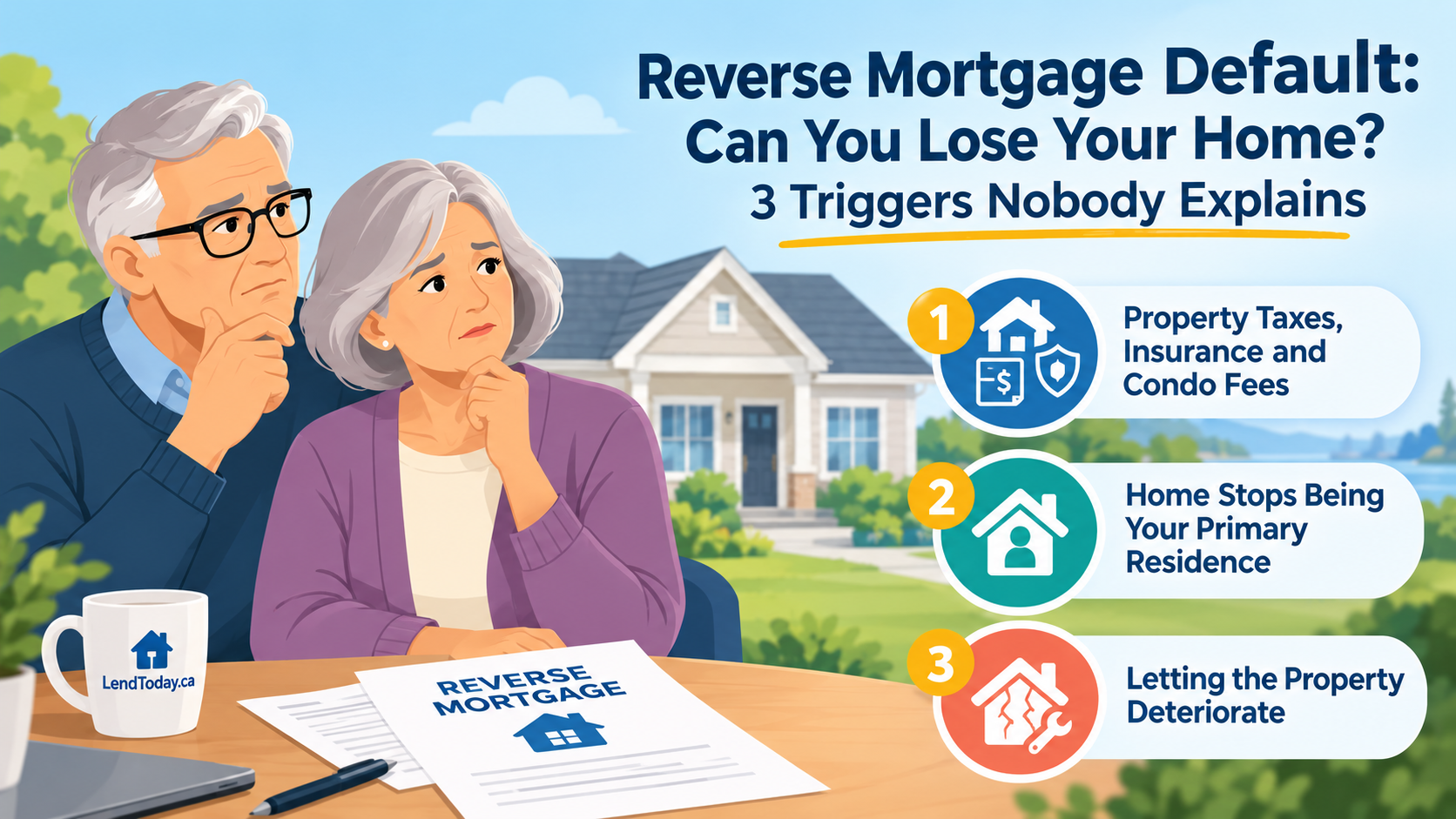
Default Trigger 1: Property Taxes, Insurance and Condo Fees
This is the most common reverse mortgage default in Canada, and it is almost always accidental.
Your agreement requires you to keep your property taxes current and your home insurance active for the life of the loan. If you own a condominium or a townhouse with a condo corporation, it also requires you to keep your common expense fees paid. Falling behind on any of these is a breach of contract, and the lender can demand full repayment.
Why does it happen to people who have never missed a bill in their lives? Usually one of three ways. The homeowner took a reverse mortgage because cash flow was tight, and the same tightness eventually reaches the tax bill. An insurance policy lapses after a premium increase, a change of insurer, or a cancellation the homeowner did not fully register. Or cognitive decline sets in, mail goes unopened, and nobody is checking.
Municipal property tax arrears are especially dangerous because they create a second problem on their own. In Ontario, unpaid property taxes rank ahead of your mortgage, and a municipality can begin a tax sale process after taxes have been in arrears for a set period. So the same unpaid bill can trigger both a lender default and a municipal collection process at the same time. Our guide to property tax arrears explains that second timeline.
How to protect yourself. Set up monthly preauthorized property tax payments with your municipality rather than paying in instalments you have to remember. Ask your insurer to send renewal notices to a family member as well as yourself. If you are in a condo, confirm your common expense payments are automatic. And ask your lender at setup whether they will accept a tax holdback from the advance, which some will.
Default Trigger 2: The Home Stops Being Your Primary Residence
A reverse mortgage requires the property to remain your primary residence, generally meaning you live there at least six months of every year. When the last borrower stops living there, the loan becomes due.
Most people hear that and think about selling or renting the place out. The scenario that actually catches families is health.
If you move into a retirement residence or a long-term care facility and you are the last borrower living in the home, the loan becomes repayable. The specific timeline depends on your lender and your contract, so it is worth asking in writing how long the estate or family has, and whether a temporary stay is treated differently from a permanent move. There is one piece of relief worth knowing: when the last borrower moves into long-term care, some lenders reduce the prepayment charge by half.
Two protections worth understanding. First, if two people are on the mortgage and one moves into care, the other can stay in the home for as long as they wish. The loan does not become due until the last borrower leaves. Second, extended travel is not the same as moving, but a snowbird spending more than six months a year away could technically breach the primary residence requirement, so check your terms before you commit to a long winter abroad.
There is also a timeline after death that families should know in advance. When the last borrower passes away, the reverse mortgage typically becomes due and payable within a set window, commonly 180 days. If it has not been repaid by then, the mortgage falls into default. Six months sounds generous until you account for probate, clearing a lifetime of belongings, listing, selling and closing. Families who learn about this window during a funeral are already behind.
Default Trigger 3: Letting the Property Deteriorate
The lender’s security is the house. Your agreement therefore requires you to keep it in reasonable condition, and significant deterioration is a breach.
Nobody loses a home over peeling paint. The risk is real deterioration: a roof that has failed, water damage left unrepaired, a furnace that stopped working two winters ago, structural issues, or the kind of accumulated neglect that occurs when a homeowner no longer has the money or the physical capacity for upkeep.
This trigger has a particular cruelty to it. People often take a reverse mortgage precisely because money is tight, and tight money is exactly what causes deferred maintenance. A lender can require an inspection, and in practice this usually surfaces during a renewal or when something else about the file draws attention.
How to protect yourself. Budget for maintenance out of the proceeds at the start rather than treating the full advance as spending money. If a major repair is beyond reach, say so early. Depending on your equity position, there may be financing available to fix it, and there are provincial and municipal grant programs for seniors covering accessibility and essential repairs that are worth asking about.
Two More Triggers Almost Nobody Mentions
Bankruptcy. Filing for bankruptcy can place a reverse mortgage in default under the terms of the agreement. If you are a reverse mortgage holder considering bankruptcy or a consumer proposal to deal with other debts, raise the reverse mortgage with your licensed insolvency trustee before you file, because the interaction between the two is not obvious and the consequences land on your home.
Missed payments on additional borrowing. If you have taken additional funds beyond the original reverse mortgage, or hold another product with the same lender that does require payments, missing those payments can trigger a default on the reverse mortgage itself. The no payment feature applies to the reverse mortgage, not to everything attached to it.
What Actually Happens After a Default
Lenders do not seize homes the day a bill goes unpaid. The usual sequence looks like this.
- Notice. The lender writes to you identifying the breach and asking you to correct it, often with a deadline.
- Opportunity to cure. For taxes, insurance or condo fees, paying the arrears and providing proof usually resolves the matter. Some lenders will pay the arrears on your behalf and add the amount plus costs to your loan balance, which fixes the default but increases what you owe.
- Demand. If the breach continues, the lender can declare the loan due and demand the full balance including accumulated interest.
- Enforcement. If the demand is not met, the lender can enforce its security. In Ontario this generally means power of sale, following the statutory notice periods.
The important point is that there is time between step one and step four, and that time is when solutions exist. If you have received a notice of any kind, our pages on mortgage arrears assistance and stopping a power of sale in Ontario explain how the process works and where it can be interrupted.
What to Do If You Are Already in Default
Four steps, in order.
1. Open the mail and call the lender. Silence is the single worst response. Lenders generally prefer a cured default to an enforcement file, which is expensive and slow for them too. Ask exactly what the breach is, what will cure it, and by when.
2. Work out the real number. What does it take to clear the arrears in full, including any administration costs the lender has added? Get it in writing.
3. Look at the equity. This is where most reverse mortgage defaults are actually solvable. If your home has appreciated since the reverse mortgage was arranged, there may be room for a second mortgage to clear the arrears, or for a refinance that replaces the reverse mortgage entirely. Alternative and private lenders weigh equity far more heavily than income, which matters when the borrower is retired.
4. Consider a controlled sale. If the obligations genuinely cannot be sustained, selling on your own terms almost always nets more than a sale conducted under power of sale, and it protects whatever equity remains. Nobody wants to hear this, but a planned sale at month two is a far better outcome than an enforced sale at month ten.
Should You Avoid Reverse Mortgages?
No. For the right homeowner, they solve a real problem, and the defaults above are avoidable with a bit of structure. The goal of this article is not to talk anyone out of the product. It is to make sure the obligations are understood before the documents are signed rather than after.
Worth asking before you commit: can the lender hold back funds to cover property taxes? What exactly is the repayment window after the last borrower passes away? How is a move into care treated, and is the prepayment charge reduced? What happens if one spouse moves into care and the other stays? Who else can be copied on notices, so an unopened envelope never becomes a default?
It is also worth confirming that a reverse mortgage is the right tool at all. For homeowners who can carry a monthly payment, a HELOC or a second mortgage is usually cheaper over time and carries fewer ongoing conditions. Terminology on the commitment can be checked against our mortgage glossary, and our reverse mortgage page covers how the product works in full.
Frequently Asked Questions
Can you lose your home with a reverse mortgage?
Yes, although not through missed mortgage payments, because none are required. A reverse mortgage default can be triggered by unpaid property taxes, lapsed home insurance, unpaid condo common expense fees, significant deterioration of the property, the home no longer being your primary residence, or bankruptcy. If a default is not cured, the lender can demand full repayment and enforce its security against the home.
What happens to a reverse mortgage if I move into long term care?
If you are the last borrower living in the home, the loan generally becomes due because the property is no longer your primary residence. If two people are on the mortgage and one moves into care, the other can remain in the home and the loan does not become due. Some lenders reduce prepayment charges by half when the last borrower moves into long term care.
How long does my estate have to repay a reverse mortgage after death?
The loan typically becomes due and payable within a set window after the last borrower passes away, commonly 180 days, after which it falls into default. Confirm the exact period in your own agreement, and make sure your executor knows about it in advance, because probate and a property sale can both take months.
Does the no negative equity guarantee still apply if I default?
The guarantee is conditional on meeting the terms of the agreement, including keeping property taxes paid, insurance active and the property maintained. If those obligations have not been met, you cannot rely on it. This is the most important and least advertised detail of the product.
Can I get a second mortgage to fix a reverse mortgage default?
Sometimes. It depends on how much equity remains after the reverse mortgage balance, the value and condition of the property, and whether the reverse mortgage lender will permit a subsequent charge. A licensed broker can review your position and tell you quickly whether it is possible.
Will the lender pay my property taxes for me?
Some lenders will pay outstanding property taxes on your behalf to cure a default and add the amount, plus administration costs, to your loan balance. That resolves the breach but increases what you owe and accelerates how fast the balance compounds. It is a remedy, not a solution.
Can I rent out my home if I have a reverse mortgage?
Not as a replacement for living there. The property must remain your primary residence, generally meaning you occupy it at least six months a year. Moving out and renting the home would breach that requirement. Check your agreement before renting any portion of the property, since rules on secondary suites vary by lender.
Get a Clear Answer Before the Deadline
If you have received a notice from a reverse mortgage lender, or you are helping a parent who has, the worst thing you can do is wait. Defaults based on taxes, insurance or condo fees are usually fixable, and the options narrow the longer the file sits.
LendToday.ca is a licensed Ontario mortgage brokerage, FSRA #13691, with access to a network of more than 50 lenders including banks, B lenders and private lenders who work with retired homeowners on equity rather than income alone. We can tell you quickly whether the arrears can be cleared, whether the reverse mortgage can be replaced, or whether a planned sale is the better outcome.
Call 1-855-242-7732 or apply online. The consultation is free and there is no obligation.
This article is general information for Canadian homeowners and is not legal, tax or financial advice. Reverse mortgage terms vary by lender and by contract, and the obligations described here are typical rather than universal. Always read your own agreement and seek independent legal advice. Information reflects publicly available lender terms as of September 2026.