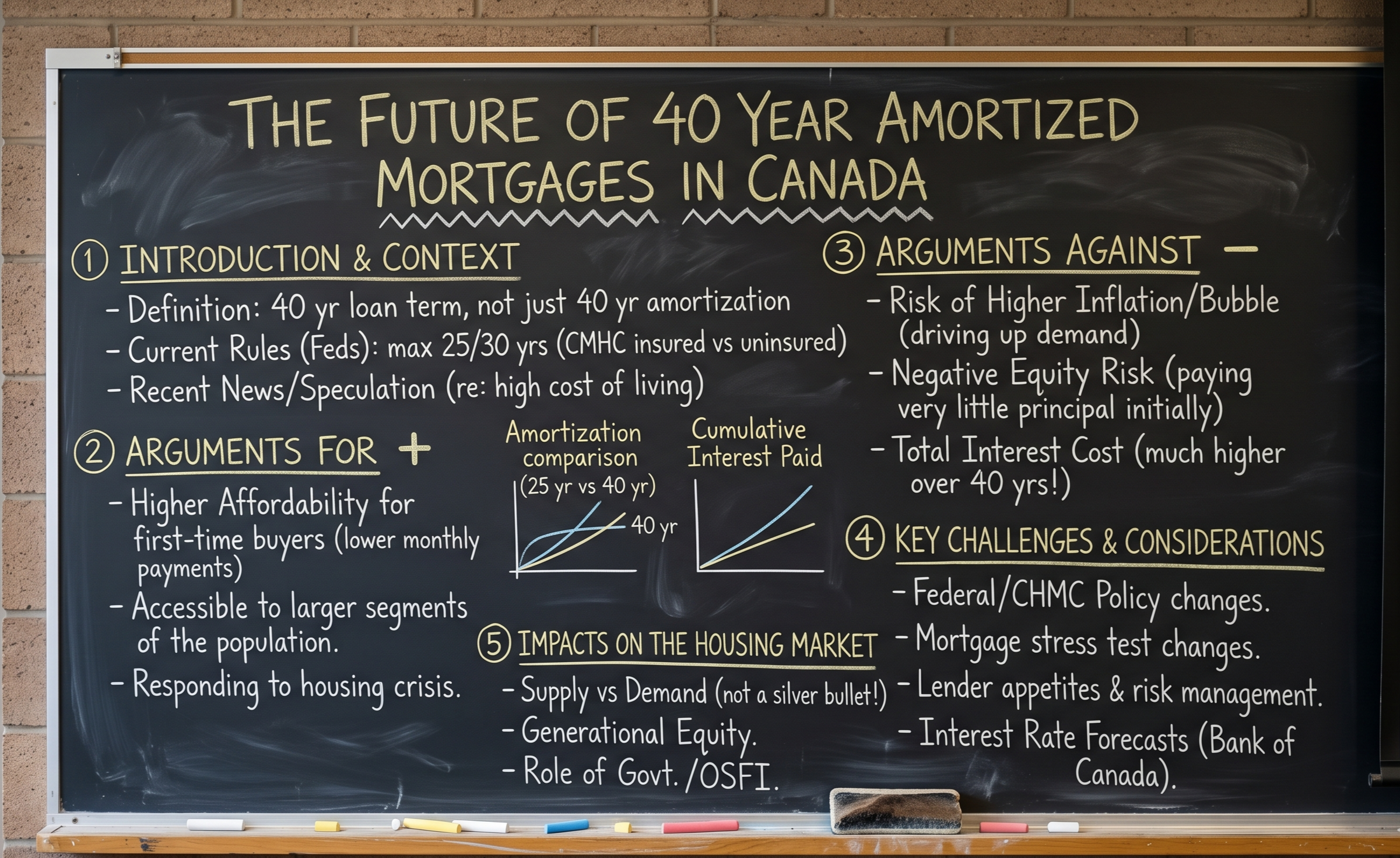
Housing affordability has dominated the Canadian conversation for years, and every now and then, the idea of a 40-year mortgage resurfaces as a possible solution. For some homeowners and aspiring buyers, the appeal is obvious. A longer amortization means a lower monthly payment, which can be the difference between qualifying for a mortgage and being shut out of the market entirely. For others, including most policymakers, the longer payback period raises serious concerns about debt loads, equity growth, and household financial stability.
In Canada, 40-year amortizations are no longer offered on insured mortgages, but they have quietly returned through alternative and private lenders for uninsured borrowers with at least 20 percent down. The question now is whether they have a real future as a mainstream financing option, and whether they actually make sense for the homeowners considering them. This article walks through how 40-year amortizations work in Canada today, the real pros and cons for borrowers, and where the product may be heading as affordability pressure continues to reshape the market.
Table of Contents
ToggleWhat Is a 40 Year Amortized Mortgage?
A 40-year amortized mortgage is a home loan structured so that the principal is fully repaid over a 40-year period rather than the more standard 25 or 30-year window. The longer schedule reduces the size of each monthly payment because the principal portion is spread across more months. The interest rate, the lender, and the term of the mortgage are all separate from the amortization itself.
In Canada, 40-year amortizations are currently available only on uninsured mortgages through alternative and private lenders. They cannot be obtained with a mortgage default insurer like CMHC, Sagen, or Canada Guaranty, which means the borrower must have at least 20 percent equity or down payment to qualify.
How Amortization Affects Your Monthly Payment
The longer the amortization, the lower the monthly payment, but the total interest paid over the life of the loan rises significantly. On a 500,000 dollar mortgage at a 5 percent interest rate, a 25-year amortization produces a monthly payment of roughly 2,908 dollars. The same mortgage stretched to 40 years drops the monthly payment to roughly 2,400 dollars at the same rate, a difference of about 500 dollars per month. Over the life of the loan, however, the total interest paid more than doubles.
Key takeaway: Amortization controls cash flow, not the cost of borrowing. The interest rate determines how expensive the loan is. The amortization determines how that cost is spread out over time.
The Difference Between Term and Amortization
These two concepts are often confused. The term is the length of the contract with the lender, typically 1 to 5 years in Canada. The amortization is the total length of time scheduled to pay the mortgage off in full. At the end of each term, the mortgage renews, and the amortization continues to count down. A 40-year amortization with a 5-year term means the borrower will renew the mortgage eight times before it is fully paid off.
The History of 40 Year Mortgages in Canada
Canadians have not always lived in a 25-year amortization world. The history of how the country arrived at the current rules is an important context for understanding where the product may be heading.
The 2008 Reversal and Why It Happened
In 2006, the federal government introduced extended amortization periods for insured mortgages through a CMHC pilot project, eventually allowing insured mortgages to be amortized up to 40 years. The change was intended to improve affordability for first-time buyers and create more flexibility in the market.
Two years later, the policy was reversed. In 2008, in the midst of the global financial crisis, the federal government rolled back the maximum amortization on insured mortgages to 35 years. Further rollbacks followed: down to 30 years in 2011, and finally down to 25 years in 2012, where it remained for more than a decade. The reasoning was straightforward. Longer amortizations were viewed as a factor in the household debt buildup that contributed to the U.S. housing crisis, and Canadian regulators wanted to avoid a similar outcome.
The Path Back to Longer Amortizations
After more than a decade of static rules, the conversation shifted again. Effective August 1, 2024, the federal government announced that 30-year amortizations would be available on insured mortgages for first-time buyers purchasing new builds. The rule was expanded on December 15, 2024, to include all first-time buyers and all purchases of newly built homes.
The 30-year insured amortization is now an established policy. The 40-year amortization, however, has only reemerged in the alternative lending channel and is not currently part of any government-insured program.
Where 40 Year Amortizations Stand in Canada Today
The 40-year mortgage is no longer the mainstream product it briefly became before the 2008 reversal. It exists in a more specialized corner of the market, with specific rules and a narrower borrower profile.
Who Offers Them in 2026
Canada’s major banks do not offer 40-year amortizations on standard mortgage products. The product is generally available through alternative lenders, mortgage investment corporations, and certain private lenders. A small number of monoline and alternative lenders, including Equitable Bank through a third-party arrangement and lenders like Compass, have offered 40-year amortizations in select provinces, primarily Ontario, Alberta, and British Columbia.
Important to note: A 40-year amortization is not a 40-year commitment to one rate. The borrower still renews at the end of each term, usually every one to five years, and the rate and lender can change at every renewal.
The Down Payment and Insurance Rules
Because mortgage default insurance in Canada is only available on amortizations of 25 years or less, with the 30-year exception for first-time buyers and new builds, a 40-year mortgage must be uninsured. That requires the borrower to have at least 20 percent equity or down payment.
For purchases, this means saving a larger down payment up front. For refinances, it means having built up at least 20 percent equity in the home before the 40-year option becomes accessible.
The Pros of a 40 Year Amortized Mortgage
There are real and legitimate reasons a 40-year amortization can be the right tool for the right borrower. The product would not exist if it served no purpose.
Lower Monthly Payments and Improved Cash Flow
The most obvious advantage is the reduction in the monthly payment. On the same 500,000 dollar mortgage at 5 percent, moving from a 25-year amortization to a 40-year amortization frees up roughly 500 dollars per month. For a household navigating a tight budget, a temporary income disruption, or a high-cost-of-living region, that monthly relief can be significant.
The improved cash flow can be used to pay down higher-interest debts like credit cards, build an emergency fund, cover child care, or absorb the cost of a renovation that improves the property’s value over time.
Qualifying for a Larger Mortgage
Lower monthly payments improve the borrower’s debt service ratios, which can mean qualifying for a larger mortgage than would otherwise be possible. For buyers in markets where home prices have outpaced wages, this can be the difference between getting into a home and being priced out indefinitely.
Common misconception: That a 40-year amortization is only useful for borrowers in financial trouble. In reality, it is also used by financially stable borrowers in high-cost markets who simply need more borrowing capacity to compete.
A Bridge for Self-Employed and Alternative Income Borrowers
The 40-year amortization is most commonly used by self-employed borrowers, commission income earners, and other applicants whose income does not fit cleanly into bank underwriting models. The product is offered by alternative lenders who use it as a tool to keep monthly payments manageable while the borrower works toward qualifying for a mainstream mortgage at renewal.
The exit strategy is usually a refinance to a shorter amortization with an A lender within one or two terms, once income documentation, credit, or both have improved.
The Cons of a 40 Year Amortized Mortgage
The drawbacks are equally real, and borrowers should not commit to a 40-year amortization without understanding the long-term cost.
Significantly More Interest Over Time
The interest cost of a 40-year mortgage is substantially higher than a 25-year mortgage. On the same 500,000 dollar mortgage at 5 percent, the total interest paid over a 25-year amortization is roughly 372,000 dollars. Stretched to 40 years, the total interest paid climbs to roughly 643,000 dollars, an additional 271,000 dollars over the life of the loan.
Key takeaway: A 40-year amortization saves money in the short term and costs significantly more in the long term. The longer the borrower keeps the loan on a 40 year schedule, the higher that cost grows.
Slower Equity Buildup
In the early years of a mortgage, most of each payment goes toward interest rather than principal. The longer the amortization, the more pronounced this effect becomes. A 40 year mortgage builds equity much more slowly than a 25-year mortgage, which means it takes longer to reach the equity thresholds needed to refinance, access a HELOC, or sell the home with meaningful proceeds.
For homeowners hoping to leverage equity for future investments, renovations, or financial flexibility, the slower equity buildup can be a meaningful constraint.
Higher Rates From Alternative Lenders
Because 40-year amortizations are only available through alternative and private lenders, the interest rate is typically higher than what an A lender would offer on a 25 or 30-year amortization. That higher rate can completely or partially offset the monthly payment savings that the longer amortization is supposed to provide.
To illustrate: a 500,000 dollar mortgage at 5 percent over 25 years carries a monthly payment of about 2,908 dollars. The same 500,000 dollar mortgage at 6.5 percent over 40 years carries a monthly payment of about 2,896 dollars. The borrower pays roughly the same amount each month, but for 15 additional years and at a much higher total interest cost.
Common mistake: Comparing only the monthly payment without comparing the interest rate. The combination of a longer amortization and a higher rate can mean the borrower is paying significantly more for the same monthly affordability.
The Future of 40 Year Mortgages in Canada
This is where the conversation gets genuinely interesting. The 40-year amortization is currently a niche product, but several pressures could push it back toward the mainstream.
Affordability Pressure and Policy Debate
Canadian housing affordability has not improved meaningfully despite recent rate cuts and the introduction of 30-year insured amortizations for first-time buyers. With home prices still well above historical norms in most major markets and wage growth lagging behind, policymakers continue to look for tools that can help young Canadians enter the market.
Industry groups and some economists have argued for further amortization extensions. Others argue that longer amortizations only paper over the affordability problem by allowing borrowers to take on more debt, without addressing the underlying issue of housing supply.
Could 40 Year Amortizations Return to the Mainstream?
A return to 40-year insured amortizations is possible but not imminent. The federal government has shown willingness to extend amortizations incrementally, as the 30-year change demonstrated, but the regulatory memory of the 2008 reversal remains strong. OSFI and CMHC continue to emphasize household debt sustainability as a guiding principle.
The most likely path forward is continued availability of 40-year amortizations in the uninsured and alternative lending channel, with possible expansion to additional provinces and lenders. A full return to mainstream insured 40-year amortizations would require a significant policy shift and would likely be accompanied by other restrictions, such as higher down payment requirements or income tests.
The Role of Trigger Rates and Variable Mortgages
The recent rate hike cycle of 2022 and 2023 produced an unintended preview of what 40 year and longer amortizations can look like in practice. Many Canadian borrowers with variable rate mortgages on fixed payment schedules hit their trigger rates, the point at which monthly payments no longer covered the interest portion of the loan. To keep the payments stable, lenders effectively extended the amortizations of these mortgages, in some cases beyond 40, 50, or even 60 years on paper.
These extensions are not a deliberate product offering. They are a side effect of variable rate mortgage structures meeting an unexpected rate environment. The episode highlighted both the demand for lower payments and the risks of extending amortizations without a clear repayment plan. As renewals from that era continue to work through the system in 2026 and 2027, the issue will keep the 40 year question very much alive.
40 Year vs 30 Year vs 25 Year Amortization: Side by Side
The following table illustrates the trade offs using a 500,000 dollar mortgage at a 5 percent interest rate, with the 40 year scenario adjusted to a 6.5 percent rate to reflect typical alternative lender pricing.
| Factor | 25 Year Amortization | 30 Year Amortization | 40 Year Amortization |
|---|---|---|---|
| Monthly payment | ~$2,908 | ~$2,668 | ~$2,896 (at 6.5%) |
| Total interest paid | ~$372,000 | ~$460,000 | ~$890,000 (at 6.5%) |
| Lender type | A lender | A lender | Alternative or private |
| Insurance available | Yes (under 20% down) | First time buyers / new builds only | No |
| Minimum down payment | 5% | 5% (eligible buyers) | 20% |
| Equity buildup pace | Faster | Moderate | Slower |
| Typical interest rate | Best available | Slightly higher | Significantly higher |
| Best suited for | Standard purchase, refinance | First time buyers, new builds | Self employed, alternative income, cash flow constrained borrowers |
Note: Figures are illustrative. Actual rates vary by lender, market conditions, credit profile, and property.
Frequently Asked Questions
Q: Can I get a 40 year mortgage in Canada in 2026? A: Yes, but only on an uninsured mortgage through an alternative or private lender. Canada’s major banks do not offer 40 year amortizations. You must have at least 20 percent down payment or equity, and the product is most commonly available in Ontario, Alberta, and British Columbia.
Q: Why did Canada eliminate 40 year insured mortgages? A: The federal government rolled back insured amortizations from 40 years to 35 years in 2008, then to 30 years in 2011, and finally to 25 years in 2012. The change was made in response to the global financial crisis and concerns about household debt levels driven in part by long amortizations in the U.S. market.
Q: How much more interest will I pay on a 40 year mortgage compared to a 25-year mortgage? A: On a 500,000 dollar mortgage at 5 percent, a 25 year amortization produces about 372,000 dollars in total interest. The same mortgage stretched to 40 years produces about 643,000 dollars in interest. At a more realistic alternative lender rate of 6.5 percent, the 40 year total interest cost rises to roughly 890,000 dollars.
Q: Do 40-year mortgages have higher interest rates than 25 or 30 year mortgages? A: Yes, in most cases. Because 40 year amortizations are only available through alternative and private lenders, the interest rate is typically higher than what an A lender would offer on a shorter amortization. The higher rate can completely or partially offset the monthly payment savings.
Q: Can a 40-year mortgage be refinanced to a shorter amortization later? A: Yes. Many borrowers who start with a 40 year amortization through an alternative lender plan to refinance to a 25 or 30-year amortization with an A lender once their credit, income, or financial picture has improved. This is one of the most common exit strategies for the product.
Q: Will 40-year insured mortgages return in Canada? A: It is possible, but not imminent. The federal government has demonstrated willingness to extend amortizations, as shown by the introduction of 30-year insured amortizations for first-time buyers and new builds. A full return to 40-year insured amortizations would require a significant policy shift and would likely come with offsetting restrictions.
Q: Is a 40-year mortgage a good idea for first-time buyers? A: It depends on the buyer’s situation and the alternatives available. First-time buyers with 20 percent down may find a 40-year amortization helpful for affordability, but the higher rates from alternative lenders and the slower equity buildup are meaningful trade offs. Many first time buyers may be better served by a 30-year insured amortization through an A lender if they qualify.
Q: How does a trigger rate relate to a 40 year amortization? A: During the 2022 and 2023 rate hike cycle, many variable rate mortgages with fixed payments hit their trigger rates, the point where the monthly payment no longer covered the interest. Lenders effectively extended the amortizations of these mortgages, in some cases past 40, 50, or even 60 years on paper, to keep payments stable. These extensions are not a deliberate product offering but a side effect of variable rate structures meeting an unexpected rate environment.
Conclusion
The 40-year amortized mortgage occupies an interesting position in the Canadian market. It is not a mainstream product, but it is not gone either. It serves a specific group of borrowers, mostly self-employed, alternative income, or cash flow constrained homeowners, who need lower payments and have at least 20 percent equity to work with. For those borrowers, used strategically with a clear exit plan, it can be a legitimate tool.
For most homeowners, however, the longer amortization comes with significant trade-offs that need to be weighed honestly. More interest, slower equity buildup, and higher rates from alternative lenders can quickly erode the appeal of a lower monthly payment. The future of the product will depend on how policymakers balance the affordability crisis against the lessons learned from the 2008 recession.
If you are weighing whether a 40 year amortization makes sense for your situation, or whether a different structure would serve you better, contact LendToday at 1-855-242-7732 or visit lendtoday.ca to speak with a mortgage broker who can run the actual numbers for your file and help you understand the long-term cost of each option before you commit.