If you earn non-traditional income, you can still qualify for a mortgage in Canada. The process looks different, the paperwork is heavier, and the lender you choose matters more than it does for a salaried borrower. That is the short version.
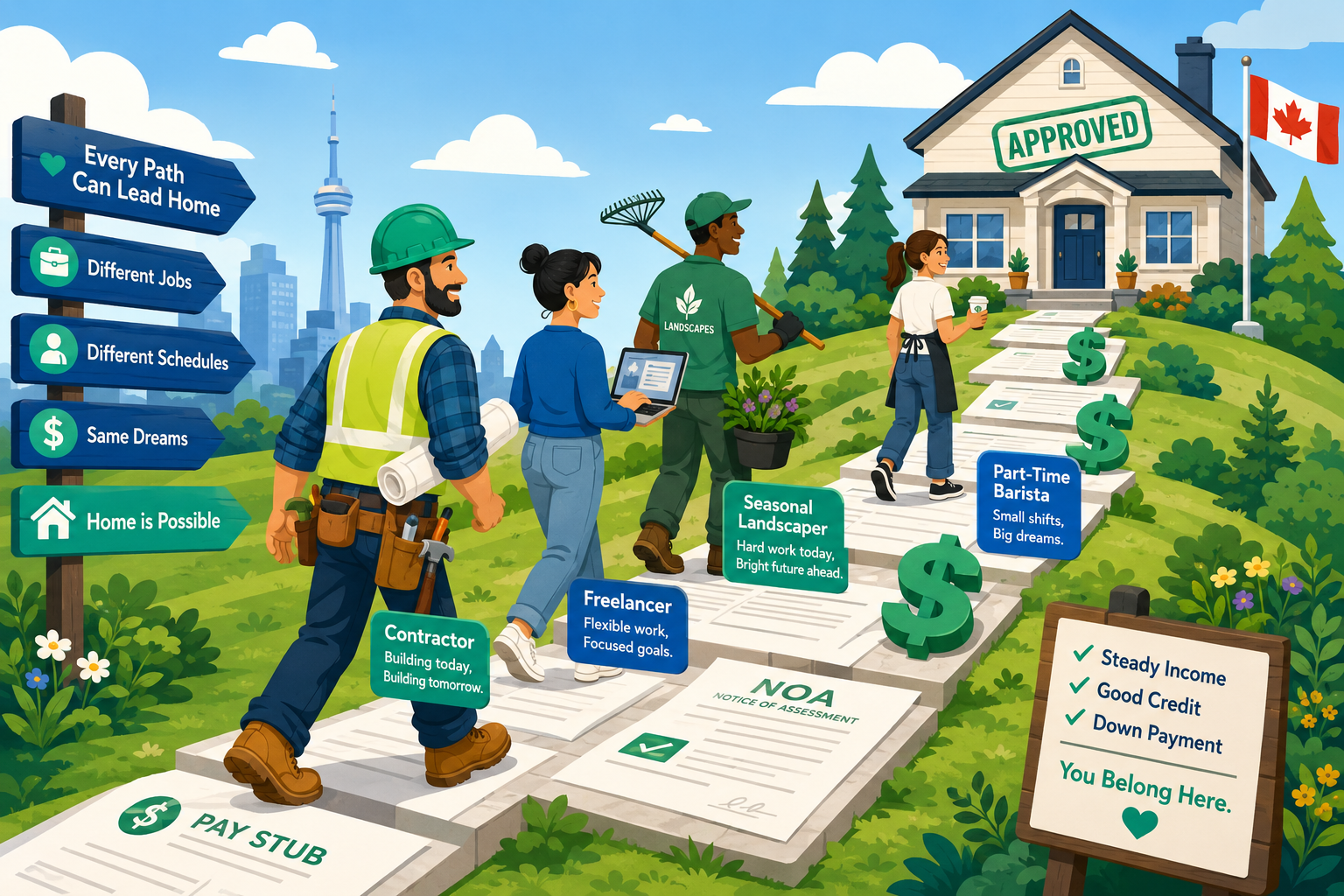
Non-traditional income includes earnings from self employed work, contract roles, seasonal jobs, hourly positions with variable shifts, part-time employment, commissions, tips, and households relying on several sources of income at once. Banks are built around T4 salaries, so anything outside that box gets extra scrutiny.
This guide explains what counts as non-traditional income, how debt service ratios like GDS and TDS affect qualification, what documentation lenders expect, and which mortgage options are available when the bank says no.
Table of Contents
ToggleWhat Counts as Non-Traditional Income in Canada?
Non-traditional income is any income that does not arrive as a fixed salary on a predictable schedule. It is not a lesser income. It is simply income that requires more proof.
A growing share of Canadians earn this way. Statistics Canada labour force data consistently show millions of self-employed Canadians, and that figure does not capture the gig workers, contractors, and multi-job households layered on top.
Common Types of Non-Traditional Income
- Self employed and business-for-self income
- Contract income, including fixed-term and renewable contracts
- Seasonal income from construction, landscaping, tourism, or agriculture
- Hourly income with fluctuating shifts or overtime
- Part-time income, often combined with other work
- Commission and bonus income
- Gig economy and freelance earnings
- Tips and gratuities
- Rental income, investment income, pensions, and support payments
- Several sources of income are combined into one household total
Important to note: many borrowers have a hybrid situation. A part-time T4 job plus self employed income on the side is one of the most common profiles we see, and it is also one of the most commonly mishandled at the bank level.
Why Traditional Banks Struggle With Non-Traditional Income
Banks are not punishing you for how you earn. Their underwriting systems are simply calibrated for predictability, and non-traditional income is harder to predict on paper.
How Lenders Verify Income
A salaried borrower hands over a letter of employment and two pay stubs. Done. A borrower with non-traditional income is asked for two years of T1 Generals, Notices of Assessment, T4As, business financial statements, invoices, and sometimes 6 to 12 months of bank statements.
The lender is trying to answer one question: will this income still be here in year three of the mortgage?
The Two-Year Average Rule
Most traditional lenders average your last two years of declared income. If you earned $90,000 last year but $60,000 the year before, the bank often qualifies you at $75,000. If income declined year over year, many banks use the lower figure outright.
Common myth: “If my deposits show strong cash flow, the bank will use that number.” Not at an A lender. Banks qualify on declared, taxable income. Self employed borrowers who write down expenses aggressively to reduce tax often discover their qualifying income on paper is a fraction of what they actually take home.
Understanding Debt Service Ratios: GDS and TDS
Debt service ratios are the math behind every mortgage approval in Canada. If your ratios are offside, the file does not move, no matter how strong the rest of your application looks.
Gross Debt Service Ratio (GDS)
Your gross debt service ratio measures housing costs against gross income. It includes the mortgage payment, property taxes, heat, and half of condo fees where applicable. CMHC guidelines cap GDS at 39 percent for insured mortgages.
Total Debt Service Ratio (TDS)
Your total debt service ratio takes GDS and adds all other debt payments: car loans, credit cards, lines of credit, student loans, and support obligations. CMHC caps TDS at 44 percent for insured files.
| Ratio | What It Includes | Typical Insured Limit |
|---|---|---|
| GDS | Mortgage payment, property taxes, heat, 50% of condo fees | 39% |
| TDS | Everything in GDS plus all other monthly debt payments | 44% |
Here is where non-traditional income borrowers get squeezed twice. First, the two-year average shrinks the income side of the ratio. Second, the federal stress test forces lenders to calculate your ratios at a qualifying rate higher than your actual contract rate.
Key takeaway: debt service ratios are a fraction. You can fix them by raising provable income, lowering monthly debt, or working with a lender that calculates income differently. Most declined borrowers only ever try the first option.
What Lenders Actually Want to See From Non-Traditional Income Borrowers
Strip away the jargon and lenders want three things: proof the income is real, proof it is stable, and proof you manage debt responsibly.
Documentation Checklist
Have these ready before you apply:
- Last 2 years of T1 General tax returns
- Last 2 years of Notices of Assessment, showing no taxes owing
- T4, T4A, and T5 slips for all income sources
- Business financial statements or a statement of business activities, if self employed
- Articles of incorporation or business licence, if applicable
- 6 to 12 months of business and personal bank statements
- Current contracts or signed agreements for contract workers
- Record of Employment history for seasonal workers showing repeat rehiring
- Recent pay stubs and a letter of employment for hourly and part-time roles
- Lease agreements for any rental income
Stability and Consistency Signals
Beyond paperwork, underwriters look for patterns. Two or more years in the same industry. Seasonal income that repeats reliably each year. Hourly earnings backed by consistent average hours. Several sources of income that have coexisted for a sustained period rather than appearing last month.
Common mistake: changing how you are paid right before applying. Switching from salaried to self employed, or incorporating, resets the two-year clock at most traditional lenders. If a move like that is coming, talk to a broker about sequencing it around your mortgage.
Mortgage Options When Your Income Does Not Fit the Bank’s Box
A bank decline is not the end of the road. Canada has a layered lending market built precisely for non-traditional income.
B Lenders and Alternative Lenders
B lenders use more flexible income calculations. Many accept 6 to 12 months of bank statements as proof of self employed income instead of relying purely on taxable income, and many allow higher debt service ratios than the big banks. Rates run somewhat higher and a larger down payment, often 20 percent or more, is typically required.
Private Mortgage Lenders
Private lenders focus on the property and your equity rather than rigid income formulas. For borrowers with strong equity but income that is hard to document, a private mortgage can provide financing quickly while you build the paper trail an A or B lender wants. These are usually shorter term solutions, often one to two years, used as a bridge.
Using Home Equity Instead of Income
If you already own your home, your equity can do work your pay structure cannot. A home equity loan or second mortgage qualifies primarily on the value of the property and the equity in it. Homeowners with non-traditional income often use this route for debt consolidation, which lowers monthly payments, improves TDS, and makes a future bank refinance achievable.
Important to note: alternative and private lending is best treated as a strategy with an exit plan, not a permanent home. The goal is to stabilize, document, and graduate back to lower cost financing.
How to Strengthen Your Application Before You Apply
You have more control over qualifying than you might think. A few months of preparation can move a file from declined to approved.
- Pay down high-interest balances first. Reducing credit card and line of credit payments directly improves your total debt service ratio.
- Stop writing everything off, temporarily. For self employed borrowers, two years of higher declared income raises your qualifying number.
- Save a larger down payment. More equity widens your lender options and offsets income risk in the lender’s eyes.
- Keep income streams documented. Invoices, contracts, deposit records, and clean bank statements all matter.
- Consider a co-applicant. A partner with T4 income can anchor the file while your non-traditional income supplements it.
- File taxes on time and clear any CRA balance. Taxes owing is a frequent and avoidable decline reason.
Key takeaway: lenders reward preparation. The borrower who shows up organized with two clean years of records gets treated very differently than the borrower scrambling for documents mid-application.
Frequently Asked Questions
Q: Can I get a mortgage in Canada if I am self employed with low declared income?
A: Yes, but likely not at a major bank. Banks qualify on taxable income, so heavy write-offs work against you. B lenders that accept bank statement programs, or equity-based private lenders, are the usual path. A mortgage broker can match your declared income, deposits, and equity to the right lender.
Q: How long do I need to be at my job with hourly or part-time income?
A: Most lenders want to see at least two years of consistent hourly or part-time history, ideally in the same field. If hours fluctuate, lenders average them. Guaranteed-hour positions are easier to qualify with than purely variable shifts.
Q: Does seasonal income count toward qualifying for a mortgage?
A: Yes. Lenders typically want two or more years of seasonal income history showing a repeating pattern, plus evidence like Records of Employment showing you are rehired each season. EI received during the off-season is sometimes included by certain lenders when it is part of a regular seasonal cycle.
Q: Can I combine several sources of income to qualify?
A: Yes, and many households do. A lender can stack part-time income, self employed earnings, rental income, and support payments, provided each source is documented and has history. Each lender treats each source differently, which is exactly why lender selection matters for multi-income files.
Q: What credit score do I need with non-traditional income?
A: At a traditional bank, roughly 680 or higher gives you the best shot, especially with variable income. B lenders work with scores in the 500s and 600s. Private lenders focus on equity and may approve borrowers with bruised credit. Stronger credit always means better pricing, regardless of income type.
Final Thoughts on Qualifying With Non-Traditional Income
Non-traditional income does not disqualify you from homeownership or from accessing the equity you have built. It changes the route. Know your GDS and TDS numbers, build two clean years of documentation, and work with professionals who deal with self employed, seasonal, contract, hourly, and multi-income borrowers every day.
If a bank has already said no, that is feedback on their formula, not on your finances. LendToday.ca works with Ontario homeowners and buyers whose income does not fit the standard mould. Reach out and find out what your income actually qualifies for.
Apply for a Non-Traditional Income Mortgage