A foreclosed home purchase in Ontario seldom involves an actual foreclosure. The overwhelming majority of distressed properties here are sold through power of sale, a faster process governed by the Mortgages Act. These properties sell as-is with no seller disclosure; the discounts are usually smaller than buyers expect because lenders have a legal duty to seek fair market value, and financing needs to be fully arranged before you write an offer. The buyers who succeed treat a foreclosed home purchase as a due diligence exercise, not a bargain hunt.
If you have been searching for foreclosure listings in Ontario, you have probably noticed something odd. There are far fewer of them than the term suggests, and the ones you find rarely look like the deep discounts you were promised.
That is because the thing most Canadians call foreclosure is not what actually happens in this province. Understanding the difference is the single most useful thing you can learn before you make an offer.
Table of Contents
ToggleWhat a Foreclosed Home Purchase Actually Means in Ontario
When buyers talk about a foreclosed home purchase, they usually mean any property being sold because the owner stopped paying the mortgage. That is a reasonable everyday definition, and it is how most people search.
Legally, though, the property is being sold by a lender enforcing its security. It is not being sold by an owner who chose to list it. That distinction drives everything that follows.
An ordinary seller has lived in the home. They know the furnace is temperamental and the basement took water in 2019, and Ontario law requires a degree of honesty about what they know. A lender knows almost nothing about the property. In many cases, nobody from the lender has ever set foot inside.
Key takeaway: In a foreclosed home purchase, the seller cannot tell you what is wrong with the house because the seller genuinely does not know. That is why these properties sell as-is, and why your due diligence has to be more thorough, not less.
This also changes the negotiation. A lender is not emotionally attached to the property and is not going to be talked down by a sympathetic story. They are working from a legal obligation and a number.
Power of Sale vs Foreclosure: The Distinction Most Buyers Miss
Ontario lenders have two enforcement routes available. They almost always choose one of them.
How Power of Sale Works in Ontario
Power of sale is the standard remedy in Ontario. The lender sells the property to recover what it is owed, but the borrower keeps title until the sale closes.
The process is set out in the Mortgages Act. A lender can send a Notice of Sale at least 15 days after the default occurs, and this document is the first formal step in the power of sale process. Once the Notice of Sale is mailed, the lender must wait 35 days, or 40 days if the property is occupied by a married couple, before taking further steps. That waiting window is the redemption period, and during it the borrower can pay the arrears and stop the sale entirely.
Here is the part that matters most to you as a buyer. Under the Act, lenders must ensure the property is sold for market value, and borrowers retain the right to redeem by paying arrears and associated costs before a sale. Any money left over after the debt and costs are paid goes back to the borrower.
That legal duty to pursue market value is precisely why the fire-sale prices buyers imagine do not materialize.
How Judicial Foreclosure Works
True foreclosure is a court process. The lender applies to the court, the borrower is given a chance to redeem, and if they cannot, the lender takes title to the property outright.
The catch for lenders is that foreclosure is slow, expensive, and all-or-nothing. If the lender takes title and the property is worth more than the debt, the lender keeps the difference, but it also absorbs the full risk if the property is worth less. Power of sale is faster and cleaner, so it dominates in Ontario.
| Power of Sale | Judicial Foreclosure | |
|---|---|---|
| Governed by | Mortgages Act | Court process |
| Who holds title before sale | Borrower | Borrower, until court order |
| Typical speed | Faster | Slower |
| Court involvement | Limited | Required throughout |
| Surplus proceeds | Returned to borrower | Retained by lender |
| How common in Ontario | The standard remedy | Uncommon |
| What buyers see | An MLS listing with lender clauses | Rarely encountered |
Common myth: That Ontario is full of bank foreclosures sitting empty and waiting to be scooped up cheaply. In practice, you are looking at power of sale listings on the open market, priced to reflect market value, competing against other buyers.
Where to Find Foreclosed Properties in Ontario
Most distressed properties in Ontario are sold the same way any other home is sold, through a listing on MLS handled by a real estate brokerage.
They are not always labelled clearly. The tell is usually in the listing remarks or the schedules: language about the seller being a mortgagee, references to as-is condition, or a note that the seller has never occupied the property.
Your realistic sources are:
- MLS listings through a licensed realtor. This is where the large majority of power of sale properties appear.
- Court-ordered sales and estate sales. Less common, sometimes handled through specific legal channels.
- Brokerages and agents who handle these files regularly. Experience matters here more than in a conventional purchase.
Important to note: Paid websites promising exclusive foreclosure lists frequently repackage the same public MLS data you can access through any realtor at no cost. Before paying a subscription fee, ask what you are getting that a good agent cannot pull for you.
Are Foreclosed Homes Actually Cheaper?
Sometimes, but rarely by the margin buyers expect.
The reason traces directly back to that duty to seek fair market value. A lender that dumps a property well below market opens itself to a claim from the borrower, whose equity was reduced by the shortfall. Lenders and their lawyers are careful about this.
So where does genuine value come from in a foreclosed home purchase?
- Condition. The price often reflects real deferred maintenance. That is not a discount; it is a repair bill you are agreeing to inherit.
- Reduced competition. Properties that will not pass a lender’s appraisal scare off buyers who need conventional financing, which thins the field for those who can move.
- Timing and certainty. A lender may favour a clean, firm offer over a higher one loaded with conditions.
Common mistake: Budgeting for the purchase price and treating repairs as a problem for later. Buyers who get burned on a foreclosed home purchase are almost always the ones who spent their entire cushion on the down payment and had nothing left when the furnace failed in November.
Build a contingency into your numbers from the beginning. On a property you cannot fully inspect, that cushion is not optional.
The Risks Buyers Take On in a Foreclosed Home Purchase
This is where a foreclosed home purchase separates from a conventional one. The risks are manageable, but only if you know they exist before you sign.
Property Condition and No Seller Disclosure
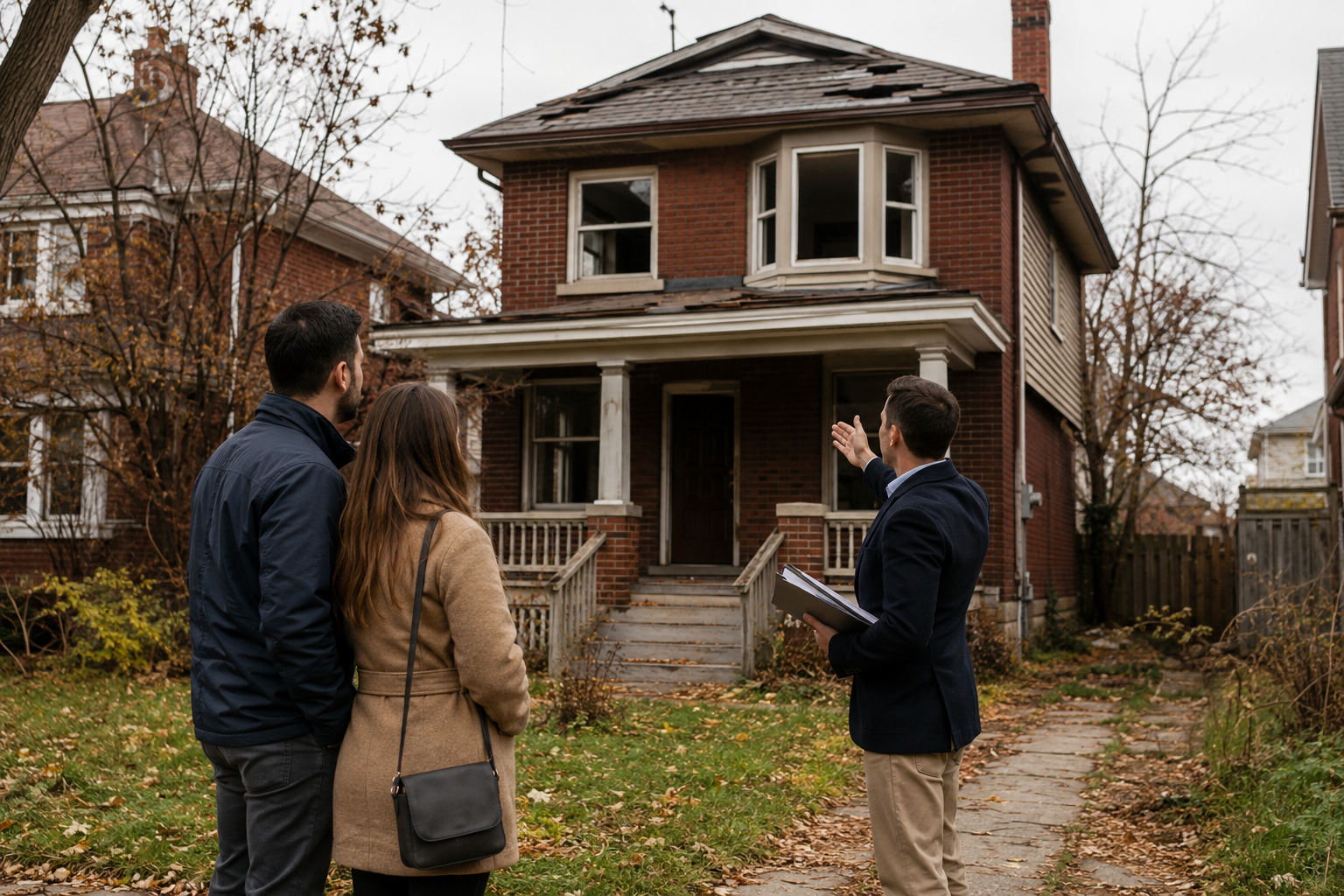
The property is sold as-is, where-is. The lender makes no representations about the roof, the wiring, the plumbing, or anything else.
Watch for:
- Fixtures and appliances removed by the departing owner
- Deferred maintenance from months or years of financial strain
- Damage from vacancy, including frozen pipes in an unheated home
- Renovations completed without permits
- Utilities disconnected, making inspection difficult
A home inspection is more valuable here than anywhere else, not less. If access is restricted, that restriction itself is information about your risk.
Title, Liens, and Arrears
Power of sale generally clears subsequent mortgages, but other claims can survive or complicate closing. Construction liens, property tax arrears, and unpaid utility accounts all need to be searched carefully by your lawyer.
Title insurance carries real weight in a foreclosed home purchase because the transaction has more moving parts than a standard sale. Talk to your lawyer about coverage specific to this type of transaction.
Occupancy and Possession
The home may still be occupied on closing day. That could be the former owner, or it could be tenants with rights under the Residential Tenancies Act.
Vacant possession is not automatic. Confirm the occupancy status in writing before your offer goes firm, and make sure your lawyer knows what you are dealing with.
The Schedule B Problem
This is the risk most first-time buyers of distressed property never see coming.
Lenders attach their own schedule to the Agreement of Purchase and Sale, and it typically overrides significant portions of the standard OREA form. Common provisions remove warranties, disclaim responsibility for the condition of the property and its chattels, limit the buyer’s remedies if closing does not happen, and sometimes shorten the time you have to satisfy conditions.
Key takeaway: Have a real estate lawyer read the lender’s schedule before your offer becomes firm, not after. The standard agreement you may have signed on a previous purchase is not the agreement you are signing here.
Financing a Foreclosed Home Purchase
Financing is where most foreclosed home purchase attempts fall apart, and it is the part buyers prepare for least.
Lender-sold properties tend to move quickly. When a property is finally listed, the selling lender wants a clean close, which means offers with fewer conditions and shorter timelines have a real advantage.
That creates genuine tension. A firm offer with no financing condition is more attractive to the seller, but it is a serious risk if your financing is not truly locked down. If the deal collapses, your deposit and potentially more is on the line.
The way through is preparation. A rate hold is not approval. Being fully underwritten before you start shopping, with income and down payment documentation already reviewed, is what lets you write a competitive offer without gambling.
There is a second complication specific to distressed properties. Your approval depends on the property as much as on you. A conventional lender orders an appraisal, and if the home has significant deficiencies, that appraisal can come back short or with conditions attached. A buyer who was approved on paper suddenly is not approved for this particular house.
When Traditional Financing Does Not Fit
Bank financing works well when the buyer is straightforward and the property is in good shape. A foreclosed home purchase frequently fails one of those tests.
Situations where conventional financing commonly stalls:
- The property’s condition will not support a clean appraisal
- The closing timeline is shorter than a bank can accommodate
- The buyer is self-employed, and income documentation is not standard
- Credit has been affected by a past event
- The buyer is carrying an existing property while purchasing
In these cases, alternative and private mortgage options sometimes serve as a bridge. These are equity-focused solutions with a defined exit, typically refinancing to a conventional lender once the property has been repaired and stabilized, or once the buyer’s file is easier to place. They are not permanent financing, and they should be entered into with a clear plan for that exit.
Buyers whose credit has taken a hit sometimes assume they are shut out entirely. Options exist for those working through a bad credit mortgage situation, though the structure looks different from a bank product and the exit plan matters more.
Key takeaway: In a foreclosed home purchase, financing certainty is your competitive advantage. The buyer who can close reliably often beats the buyer who bid more but might not close at all.
Step by Step: How to Approach a Foreclosed Home Purchase
- Confirm your financing first. Full underwriting, not a rate hold. Know your true ceiling before you look.
- Assemble your team. A realtor with power of sale experience and a real estate lawyer who has closed these transactions.
- Set a repair budget separate from your purchase budget. Assume you will need it.
- View the property and get an inspection. If a full inspection is not possible, price the unknown into your offer.
- Have your lawyer review the lender’s schedule before the offer goes firm.
- Order title and arrears searches early.
- Confirm occupancy status in writing.
- Arrange insurance before closing, including vacant property coverage if the home is unoccupied.
- Close, then complete urgent repairs, particularly anything affecting safety, heat, or water.
Buyer Due Diligence Checklist
- Financing fully underwritten, not just pre-qualified
- Lawyer has reviewed Schedule B and lender-specific clauses
- Title search completed
- Property tax and utility arrears searched
- Home inspection completed, or budget adjusted for unknown condition
- Occupancy status confirmed in writing
- Vacant property insurance arranged if applicable
- Contingency fund set aside beyond the down payment and closing costs
- Condo status certificate reviewed if applicable
- Exit plan confirmed if using short-term financing
Who a Foreclosed Home Purchase Suits, and Who It Does Not
Being honest about fit will save you far more than a bargain price ever will.
A foreclosed home purchase tends to work for:
- Buyers with financing fully arranged and flexibility on structure
- Buyers with renovation experience or trades they trust
- Investors who price condition risk deliberately
- Buyers with cash reserves beyond the down payment
It tends not to work for:
- Buyers stretched to the absolute top of their budget
- Buyers who need a move-in-ready home on a fixed date
- Buyers relying on warranties or seller disclosure for peace of mind
- Buyers who cannot absorb a five-figure surprise
There is no shame in the second list. Buying a conventional home from a conventional seller is a perfectly good decision, and for many buyers it is the better one.
Frequently Asked Questions
Q: What is the difference between power of sale and foreclosure in Ontario?
A: In a power of sale, the lender sells the property to recover the debt owed, and the borrower holds title until the sale closes. Any surplus after the debt and costs are paid goes back to the borrower. The process is governed by the Mortgages Act, which sets out notice requirements and a redemption period.
In a foreclosure, the lender applies to the court to take title to the property itself. If it succeeds, the lender owns the home and keeps any surplus value. Because foreclosure is slower and more expensive, power of sale is the standard route in Ontario. Almost every property marketed as a foreclosure here is actually a power of sale.
Q: Are foreclosed homes in Ontario cheaper than regular listings?
A: Usually less than buyers expect. Lenders have an obligation to seek fair market value, which limits how far below market a property can be sold without exposing the lender to a claim from the borrower.
Where you may find value is in properties needing significant work, or in homes that conventional buyers avoid because financing is difficult. That value is real, but it comes attached to repair costs and risk. Compare the total cost of purchase plus repairs against a comparable move-in-ready home before deciding you found a deal.
Q: Can I inspect a property before a foreclosed home purchase?
A: Often yes, though access can be inconsistent. If the property is vacant and utilities are disconnected, a full inspection may not be possible because systems cannot be tested.
An inspection matters more here than in a conventional purchase, since there is no seller disclosure to fall back on. If you cannot get a proper inspection, treat that as a reason to build a larger contingency into your budget or to reconsider the property.
Q: Can the former owner reclaim the property after I buy it?
A: Once a power of sale closes properly, the sale is final and your title is protected. The borrower’s right to redeem exists during the redemption period before the sale, not after closing.
That said, procedural correctness on the lender’s side is what protects you. This is exactly why a real estate lawyer experienced with power of sale transactions is worth engaging early rather than at the last minute.
Q: Is it harder to get a mortgage for a foreclosed home?
A: It can be, and the reason is usually the property rather than the buyer. Conventional lenders assess the home through an appraisal, and significant deficiencies can result in a reduced value or conditions that must be met before funding.
Short closing timelines can also create difficulty, since banks need a certain amount of runway. Buyers in this position sometimes use alternative or private financing as a bridge, then refinance to a conventional lender once repairs are complete. If you are going that route, have the exit plan defined before you commit.
Q: Can I buy a foreclosed property while I still own my current home?
A: Yes, though it adds complexity because you are carrying two properties at least temporarily. Lenders will assess whether you can service both, and bridge financing or accessing equity in your existing home are common approaches.
The timing risk is worth thinking through carefully. If your purchase closes before your sale, you need a plan that does not depend on your current home selling by a specific date.
Getting Your Financing Sorted Before You Bid
A foreclosed home purchase in Ontario is not a shortcut to cheap real estate. It is a different kind of transaction with different rules, less information, and more responsibility on the buyer.
The buyers who do well are not the ones who found the biggest discount. They are the ones who understood they were buying from a lender enforcing a debt, budgeted for what they could not see, had their lawyer read the fine print, and had their financing genuinely locked down before they made an offer.
If your situation is not straightforward, whether that is self-employment, credit history, a property that will not appraise cleanly, or a tight closing date, it is worth having that conversation before you start writing offers rather than after one falls apart.
Speak with a licensed mortgage agent operating as part of a licensed Ontario mortgage brokerage about what financing structure fits your purchase. The consultation is free and comes with no obligation.
Call 1-855-242-7732 toll-free across Canada, email info@lendtoday.ca, or book a consultation online.