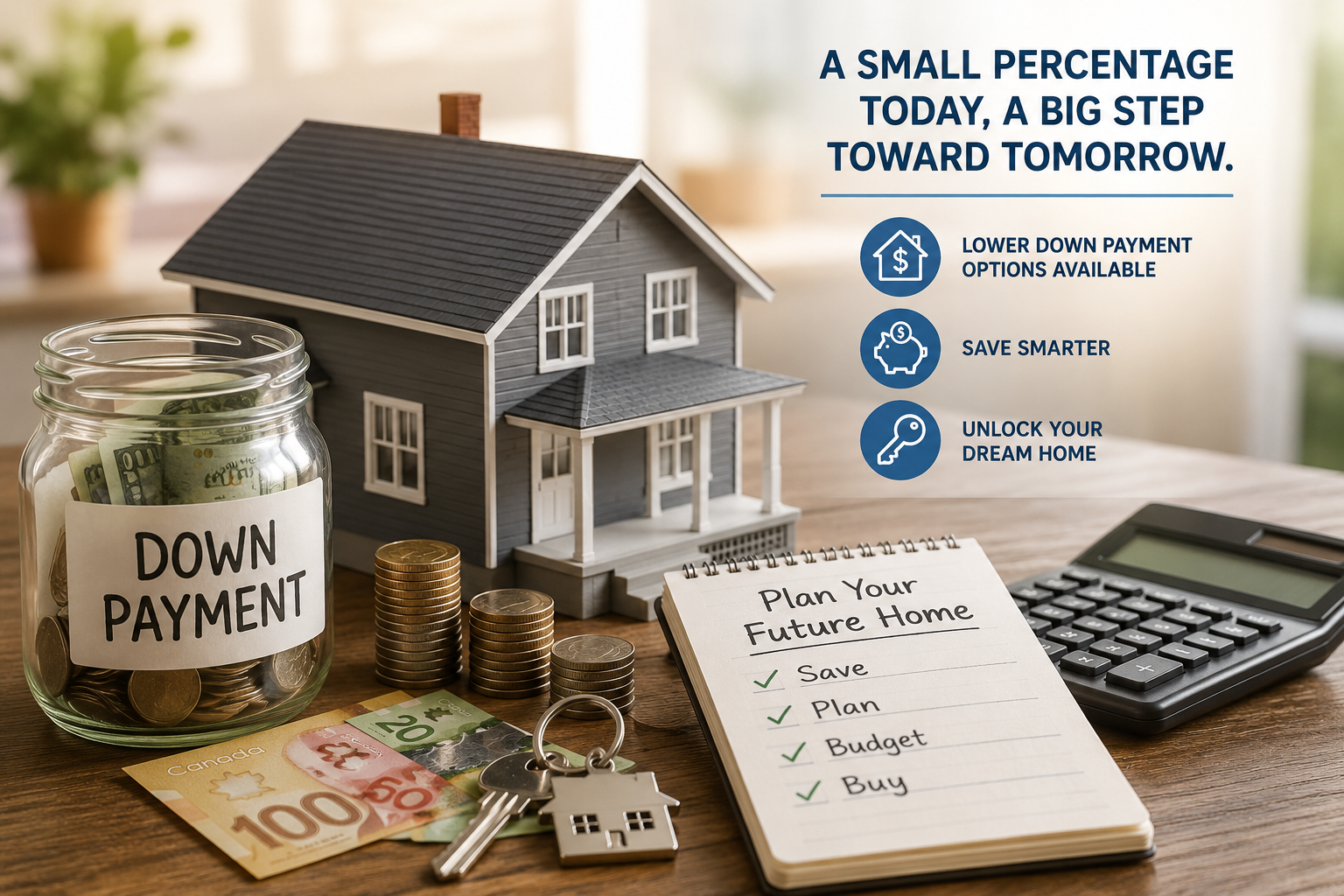
Saving a down payment is one of the biggest financial hurdles most Canadians face on the path to homeownership. What many first-time buyers do not realize is that the money for a down payment does not have to come from a single place. Canadian lenders accept a wide range of sources, from personal savings and registered accounts to gifted funds, sold investments, and even borrowed money in the right circumstances. Understanding which sources qualify, which come with strings attached, and how to document each one properly can be the difference between a smooth approval and a frustrating decline.
In Canada, the minimum down payment for a home purchase is 5 percent on the first $500,000, 10 percent on the portion between $500,000 and $1.5 million , and 20 percent on any purchase price above $1.5 million. That money can come from personal savings, the RRSP Home Buyers Plan, the First Home Savings Account, a family gift, the sale of another property, the sale of investments, a HELOC or line of credit, a gift of equity, or sweat equity in a new build. Every source must be documented for at least 90 days before closing, and lenders will trace the money trail carefully. This article walks through each of the nine main down payment sources, how much you can actually get from each one, and what documentation you need to make it work.
Table of Contents
ToggleWhat Counts as a Down Payment in Canada?
A down payment is the portion of the home’s purchase price that the buyer pays out of their own resources at closing, with the remainder financed by the mortgage. The down payment does more than reduce the size of the loan. It also determines whether the mortgage is insured or conventional, affects the interest rate available, and shapes the qualification process.
Canadian lenders require every dollar of the down payment to be traced to a legitimate, documented source. This is not just a bank policy. It is a legal requirement under Canada’s anti-money laundering rules, which apply to every regulated financial institution in the country.
Minimum Down Payment Requirements
The minimum down payment in Canada is set by federal rule. For purchase prices up to $500,000, the minimum is 5 percent. For purchase prices between $500,000 and $1.5 million , the minimum is 5 percent on the first $500,000 plus 10 percent on the portion above. For purchase prices above $1.5 million, the minimum is 20 percent, because insured mortgages are not available above the $1.5 million cap that took effect in December 2024.
For a $700,000 home, that works out to $25,000 (5 percent of the first $500,000) plus $20,000 (10 percent of the remaining $200,000) for a total minimum down payment of $45,000.
The 90 Day Sourcing Rule
Canadian lenders require at least 90 days of history on all down payment funds. This means every dollar going toward the down payment needs to be traceable through bank statements, transfer records, or other documentation for at least 90 days before closing.
Key takeaway: Money that appears in your account 45 days before closing without a documented source will delay or derail your mortgage approval. Plan your down payment consolidation at least three months before you expect to buy.
1. Personal Savings: The Traditional Foundation
Personal savings are the most straightforward down payment source. Money in chequing accounts, savings accounts, tax-free savings accounts (TFSAs), and other non-registered accounts can all be used without restriction, provided the funds have been in your name for at least 90 days.
What Counts as Personal Savings
Chequing and savings accounts, TFSA balances, GIC redemptions, and money market funds all count as personal savings. Cash held outside a bank account (physical cash, safety deposit box cash) does not count unless it can be traced back to a documented source such as employment income or a family gift.
How Lenders Verify Personal Savings
Lenders require 90 days of statements for every account contributing to the down payment. Large deposits during that window need to be explained and documented. A 20,000 dollar transfer from your parents that shows up 60 days before closing needs a gift letter and evidence of the parents’ source of funds.
Common mistake: Consolidating savings from multiple accounts into one at the last minute. This creates unexplained deposits in the receiving account and can complicate the paper trail. If consolidation is needed, do it more than 90 days before applying.
2. RRSP Home Buyers Plan (HBP)
The Home Buyers Plan lets first-time home buyers withdraw funds from their RRSP for a down payment on a first home without triggering tax. The 2024 federal budget increased the withdrawal limit significantly, and the current higher limit remains in effect in 2026.
How Much You Can Withdraw in 2026
As of 2024 and continuing into 2026, an eligible first-time buyer can withdraw up to $60,000 from their RRSP under the HBP. For a couple where both spouses qualify, the combined withdrawal can reach $120,000.
To qualify, the funds must have been in the RRSP for at least 90 days before withdrawal, and the buyer must not have owned a home they lived in during the previous four years.
The Repayment Requirement
HBP withdrawals are not free money. They must be repaid to the RRSP over 15 years, starting the second year after withdrawal. If a scheduled repayment is missed, the missed amount is added to that year’s taxable income.
Important to note: The HBP is not a gift from the government. It is a temporary self-loan from your own retirement savings. Missing repayments increase your tax bill and reduce your future retirement funds.
3. First Home Savings Account (FHSA)
The FHSA is a newer registered account, introduced in 2023, designed specifically to help Canadians save for a first home. It combines the best features of an RRSP (tax-deductible contributions) and a TFSA (tax-free withdrawals for qualifying home purchases).
Contribution Limits and Tax Benefits
Eligible Canadians can contribute up to 8,000 dollars per year to an FHSA, to a lifetime maximum of 40,000 dollars. Contributions are tax deductible in the year they are made, similar to an RRSP contribution. Withdrawals for a qualifying first home purchase are completely tax-free, similar to a TFSA withdrawal.
For a couple where both spouses maximize their FHSA contributions, the combined tax-free down payment potential reaches 80,000 dollars, plus investment growth inside the accounts.
How the FHSA Compares to the HBP
The FHSA and HBP can be used together. A first-time buyer who maxes both can access 100,000 dollars in tax-advantaged down payment funds (40,000 from FHSA plus 60,000 from HBP). For a couple, the combined potential reaches 200,000 dollars.
The FHSA is generally the more powerful tool because it does not require repayment. HBP withdrawals must be repaid over 15 years. FHSA withdrawals do not.
Common misconception: That the FHSA and HBP are alternatives to choose between. In fact, they are designed to be used together, and most financial advisors recommend maximizing both for eligible first-time buyers.
4. Gifted Down Payment From Family
A gifted down payment is one of the most common sources for first-time buyers in Canada, particularly in high-cost markets. Canadian lenders accept gifts as a down payment source, but only when the gift is documented properly and comes from an eligible family member.
Who Can Legally Provide a Gift
Lenders accept gifts from immediate family members, including parents, grandparents, spouses, and in some cases siblings. Gifts from friends, distant relatives, employers, or business partners are generally not accepted, because they can suggest hidden loans rather than true gifts.
The Gift Letter Requirement
Every gifted down payment requires a signed gift letter from the family member providing the funds. The letter must state that the money is a genuine gift with no expectation of repayment, that no interest is being charged, and that the funds are not being provided in exchange for any obligation. Lenders provide their own gift letter templates.
The lender will also require proof that the family member had the funds to give, typically through a bank statement showing the funds available before the transfer.
Important to note: If the money is actually a loan disguised as a gift, the lender will treat it as a loan once discovered. This affects the borrower’s debt service ratios and can cause the file to be declined. Honesty on the gift letter matters.
5. Sale of Another Property
Proceeds from the sale of another property, whether a primary residence, an investment property, or a vacation home, can be used as a down payment on a new purchase. This is the most common source for repeat buyers who are moving up, moving down, or relocating.
Bridge Financing Between Sale and Purchase
Timing rarely lines up perfectly between a sale and a purchase. When the closing date of the new purchase falls before the closing date of the sale, bridge financing can provide short-term funds to cover the gap. Most A lenders offer bridge financing to their mortgage clients for periods of up to 90 days.
The lender will require a firm sale agreement on the existing property before approving bridge financing. Longer bridge periods, or bridges tied to unsold properties, typically require private lender solutions.
6. Sale of Investments and Non-Registered Assets
Non-registered investments, including stocks, mutual funds, ETFs, and bonds, can be sold and used as a down payment. The proceeds need to be documented from the sale through to the deposit in your account.
Cryptocurrency has become a more common down payment source in recent years, but lender acceptance varies significantly. Some lenders accept documented cryptocurrency sales that clear into a Canadian bank account, while others do not. The paper trail from wallet to exchange to bank account must be complete.
Common mistake: Selling investments and holding the proceeds in cash for months without documenting the sale. Lenders can see the deposit but cannot verify the source without the original brokerage statements showing the sale.
7. Borrowed Funds: HELOC and Lines of Credit
Borrowed funds can be used as a down payment in Canada, but they come with important qualifications. The most common borrowed sources are a HELOC on another property (often a parent’s home) or an unsecured line of credit.
How Borrowed Down Payment Affects Qualification
Borrowed down payment funds carry a payment obligation, and that obligation must be factored into the borrower’s debt service ratios when the lender assesses the new mortgage. This can reduce the borrower’s borrowing capacity significantly.
The math looks like this. A $50,000 HELOC drawn for a down payment might carry a monthly interest-only payment of 300 to 400 dollars at current rates. That 300 to 400 dollars per month gets added to the borrower’s total debt service calculation, which lowers the maximum mortgage amount the same borrower can qualify for.
Borrowed down payment is a legitimate strategy, but it works best when the borrower has significant income, and the borrowed portion is a smaller share of the total down payment.
8. Gift of Equity for Family Home Transfers
A gift of equity is a specialized structure used when a family member sells a home to another family member at below market value. The difference between the fair market value and the sale price is treated as the buyer’s down payment.
For example, if parents sell a home worth $800,000 to their child for $640,000, the $160,000 difference becomes the child’s 20 percent down payment. The child obtains a mortgage for the $640,000 sale price with no cash needed at closing.
The structure requires an independent appraisal to establish fair market value, a signed agreement of purchase and sale reflecting the discounted price, and a gift of equity letter documenting the transaction. Legal advice is essential because tax implications for the seller vary based on whether the property was their principal residence.
9. Sweat Equity and Builder Programs for New Builds
For new build purchases, some builders allow buyers to contribute labour or materials in place of a portion of the cash down payment. This is called sweat equity, and it is most common in custom builds and some semi-custom builder programs.
Land already owned by the buyer can also count as down payment on a new build. If the buyer owns a lot worth $200,000 and builds a $600,000 home on it, the land value counts toward the down payment on the construction financing.
Sweat equity and land as down payment require careful documentation through the builder’s contract, appraisals, and often legal review. Lender appetite varies, and construction financing typically requires more specialized underwriting than a resale purchase.
Down Payment Sources That Do Not Count
Not every source of funds qualifies as an acceptable down payment. Understanding what does not count prevents wasted time and last-minute complications.
Undocumented Cash
Physical cash without a documented source cannot be used, regardless of how legitimately it was earned. Cash tips, side income paid in cash, or family cash gifts that were never deposited need to be traced to a documented origin.
Sale of Personal Items Without Records
Proceeds from the sale of jewelry, cars, collectibles, or other personal items can be used, but only with proper documentation. Bills of sale, receipts from buyers, and clear deposits into a bank account are required.
Common mistake: Selling a car privately for cash 60 days before closing and depositing the cash into your account. Without a proper bill of sale and evidence of the buyer, the deposit will be flagged as unexplained.
Unverified Foreign Transfers
Wire transfers from foreign accounts need to be documented from the originating account, through any intermediate accounts, and into the Canadian bank account. Foreign transfers without complete documentation are one of the leading causes of mortgage approval delays for newcomer buyers and buyers with international family.
Documentation Requirements for Every Source
Every down payment source shares one universal requirement: proof of where the money came from. The specific documents vary by source, but the underlying test is always the same.
For personal savings, 90 days of account statements. For registered account withdrawals (HBP and FHSA), withdrawal confirmations and account history. For gifted funds, a signed gift letter and proof of the donor’s ability to give. For property sales, the sale agreement and lawyer’s trust statement. For investment sales, brokerage statements showing the sale and settlement. For borrowed funds, the loan or credit agreement showing the source. For gift of equity transactions, the appraisal, agreement, and equity letter.
Important to note: Lenders can and will request additional documentation at any stage of the application. Keeping organized records of every source from the beginning saves significant stress later.
How to Choose the Right Down Payment Mix
Most Canadian buyers use more than one down payment source. The right mix depends on the buyer’s situation, tax picture, and eligibility for programs like the FHSA and HBP.
For first-time buyers, maximizing the FHSA first is usually the smartest starting point because the tax deduction on contributions creates an immediate benefit and the withdrawals are permanently tax-free. Layering the HBP on top adds another 60,000 dollars per buyer without immediate tax cost, provided the buyer can commit to the repayment schedule.
For buyers with family support, a gifted down payment combined with personal savings often produces the strongest application because the gift does not create any repayment obligation that would affect debt service ratios.
For move-up buyers, the sale of the existing home is typically the primary source, with bridge financing or a HELOC covering any timing gap between sale and purchase.
Borrowed down payment is generally the last option to consider, because the payment obligation reduces the buyer’s total borrowing capacity.
Down Payment Sources in Canada: Side by Side
| Source | Maximum Amount | Repayment Required | Affects Debt Ratios | Documentation Needed |
|---|---|---|---|---|
| Personal savings | No limit | No | No | 90 days of statements |
| RRSP HBP | 60,000 per person | Yes, over 15 years | No | Withdrawal confirmation |
| FHSA | 40,000 per person | No | No | Withdrawal confirmation |
| Gifted funds | No limit | No | No | Gift letter, donor proof |
| Sale of property | No limit | No | No | Sale agreement, trust statement |
| Sale of investments | No limit | No | No | Brokerage statements |
| Borrowed funds (HELOC, LOC) | No formal limit | Yes | Yes | Loan agreement |
| Gift of equity | No limit | No | No | Appraisal, equity letter |
| Sweat equity or land | Varies by builder | No | No | Builder contract, appraisal |
Frequently Asked Questions
Q: What is the minimum down payment in Canada in 2026? A: The minimum down payment is 5 percent on purchase prices up to $500,000, 5 percent on the first $500,000 plus 10 percent on the portion between $500,000 and $1.5 million, and 20 percent on any purchase price above $1.5 million. For a $700,000 home, the minimum works out to $45,000.
Q: How much can I withdraw from my RRSP for a down payment? A: Under the Home Buyers Plan (HBP), an eligible first-time buyer can withdraw up to $60,000 from their RRSP tax-free for a down payment on a first home. A couple where both spouses qualify can withdraw a combined $120,000. The funds must have been in the RRSP for at least 90 days before withdrawal and must be repaid to the RRSP over 15 years.
Q: How does the First Home Savings Account (FHSA) work for a down payment? A: The FHSA allows eligible Canadians to contribute up to $8,000 per year, to a lifetime maximum of $40,000. Contributions are tax-deductible, and withdrawals for a qualifying first home purchase are completely tax-free. Unlike the HBP, FHSA withdrawals do not need to be repaid. The FHSA and HBP can be used together for a combined $100,000 per buyer.
Q: Can I use a gifted down payment in Canada? A: Yes. Canadian lenders accept gifts from immediate family members, including parents, grandparents, spouses, and in some cases siblings. The gift must be documented through a signed gift letter confirming that the funds are a true gift with no expectation of repayment, and the donor must show proof of having the funds available.
Q: Can I borrow my down payment in Canada? A: Yes, but the borrowed funds carry a payment obligation that reduces your total debt service capacity, which can lower the maximum mortgage you qualify for. Borrowed down payment is a legitimate strategy but works best when the borrower has significant income, and the borrowed portion is a smaller share of the total down payment.
Q: What is the 90 day rule for down payment funds? A: Canadian lenders require every dollar of the down payment to be documented for at least 90 days before closing. This means bank statements, transfer records, and source documentation must show where the funds came from and where they have been for the past three months. Money that appears in your account without a documented source will delay or derail your mortgage approval.
Q: Can I use cryptocurrency as a down payment in Canada? A: Some lenders accept cryptocurrency proceeds that have been documented from wallet, through exchange, to a Canadian bank account. Others do not. The paper trail must be complete, and the funds must clear into a traceable Canadian account well before closing. Lender acceptance varies significantly, so confirm with your broker before relying on crypto as a primary source.
Q: What down payment sources do lenders not accept? A: Lenders do not accept undocumented cash, funds without a clear 90-day paper trail, unverified foreign transfers, or gifts from non-family members like friends or business partners. Cash advances from credit cards and payday loans are also generally rejected as down payment sources because of the high cost and short-term repayment obligations.
Conclusion
The down payment is often the biggest single financial hurdle to homeownership in Canada, but it is also one of the most flexible pieces of the mortgage puzzle. Between personal savings, registered accounts like the FHSA and HBP, family gifts, sold assets, and borrowed funds when appropriate, Canadian buyers have more options than most first time buyers realize. The key is understanding which sources fit your situation, planning the paper trail early, and documenting every dollar with the care that Canadian lenders expect.
The buyers who navigate this process most smoothly are the ones who start planning at least six months before they want to close. That timeline allows the FHSA to be opened and contributed to, the HBP funds to season for the required 90 days, gifted funds to be documented and deposited properly, and every source to be organized in a way that speeds the mortgage approval rather than slowing it down.
If you are planning a home purchase and want a clear read on which down payment sources fit your situation and how to structure the funding, contact LendToday at 1-855-242-7732 or visit lendtoday.ca to speak with a mortgage broker who can review your file and help you build a down payment strategy that will actually get approved.