Table of Contents
ToggleWhat happens if I can’t exit at the end of my term?
You can usually renew with the private lender, but you’ll pay new fees and possibly a higher rate. Starting your refinance 90 days early and working with a broker reduces this risk.
Is there a penalty for paying off a private mortgage early?
It depends on the lender. Some private mortgages are fully open, while others charge a few months’ interest. Always confirm prepayment terms before you sign.Why Every Private Mortgage Needs an Exit Plan
A private mortgage can be a lifeline. When the bank says no because of bruised credit, self employed income, a consumer proposal, or a property that doesn’t fit the box, a private lender can fund the deal in days instead of weeks.
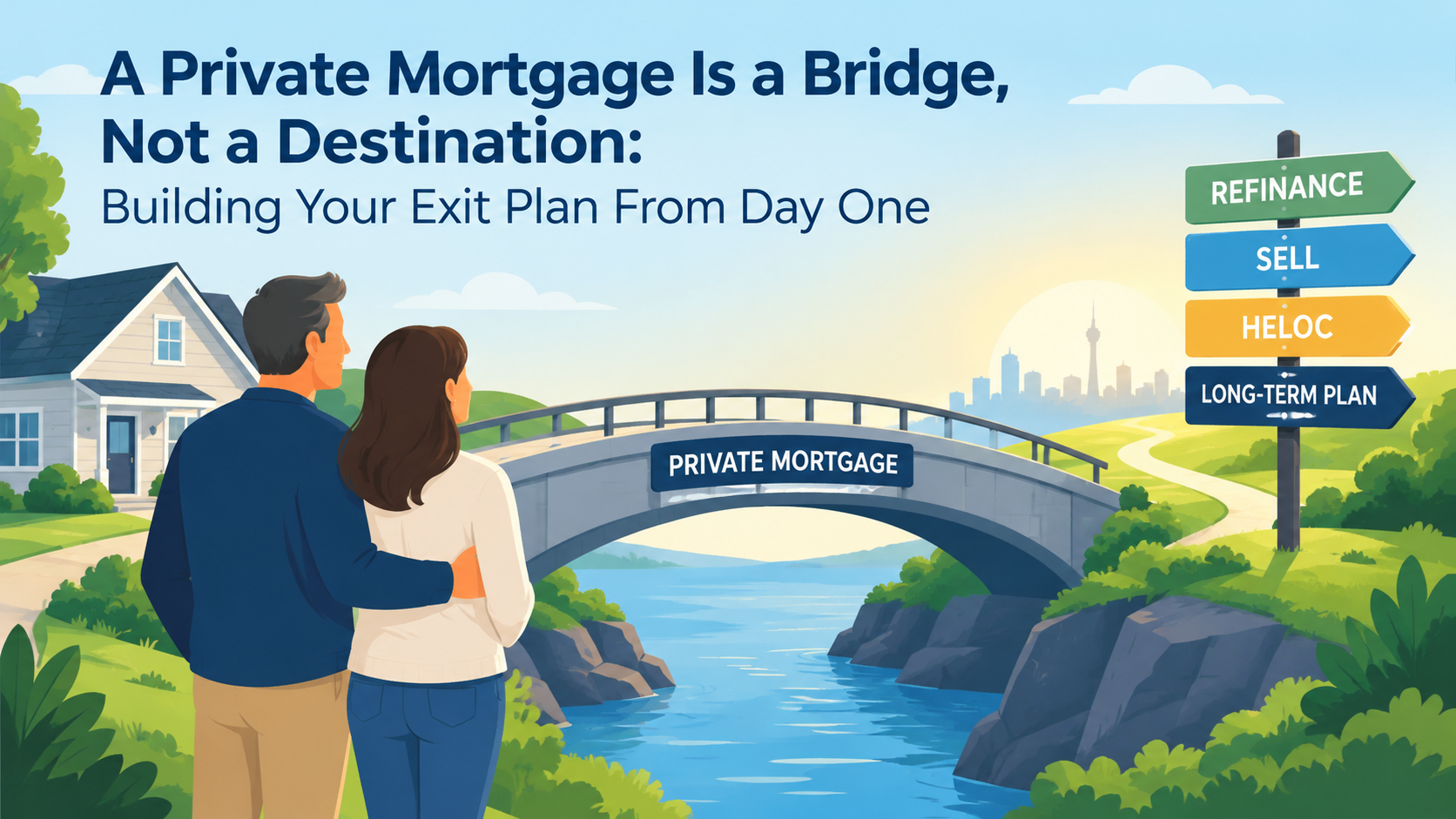
But a private mortgage was never meant to be permanent. Think of it as a bridge: it gets you safely from where you are today to where you need to be. The trouble starts when borrowers treat that bridge like a place to live.
The smartest time to plan your way out of a private mortgage is before you sign. In this guide, we’ll walk through what a private mortgage exit strategy looks like, the most common exit routes, the mistakes that keep Ontario homeowners stuck, and the exact steps you can take from day one to move back to a bank or B lender at the lowest possible cost.
At LendToday, a licensed Ontario mortgage brokerage (FSRA #13691), we build the exit into every private mortgage we arrange. It’s the single biggest factor in whether a private loan saves you money or quietly costs you thousands.
Why Private Mortgages Are Built to Be Temporary
Private lenders price their loans for speed and flexibility, not for the long haul. That shows up in three places.
Higher interest rates. Private mortgage rates in Ontario typically run well above bank rates, often in the high single digits to low double digits depending on your equity, location, and file strength. Most are interest only, so your payments don’t reduce the balance.
Upfront fees. Expect a lender fee and a broker fee on most private files, each commonly in the range of 1% to 3% of the loan amount, plus legal and appraisal costs. These fees come due again at every renewal.
Short terms. Most private mortgages run for 6 to 24 months, with 12 months the most common. When the term ends, you either renew (and pay fees again), refinance, or pay out the loan.
All three point to the same conclusion: every month you stay in a private mortgage longer than necessary costs real money. A clear exit strategy turns that cost into a short, planned investment in getting your finances back on track.
What Is a Private Mortgage Exit Strategy?
An exit strategy is your written plan for paying out the private mortgage before or at the end of its term. It answers three questions: where you’re going next, what has to change to get there, and how long that will realistically take.
Most Ontario borrowers leave a private mortgage through one of these routes.
| Exit route | Best for | What usually needs to change |
|---|---|---|
| Refinance to a bank (A lender) | Borrowers whose credit and income can be rebuilt within a year or two | Credit score recovery, clean payment history, provable income |
| Refinance to a B lender | Self employed borrowers, recent consumer proposals, credit in the mid range | Some credit repair, two years of tax filings or business statements |
| Sell the property | Downsizing, estate situations, or when carrying costs no longer make sense | A realistic sale price and timeline |
| Pay out from a lump sum | Inheritance, business sale, legal settlement, or bonus | Confirmed timing of the funds |
| Bank renewal after a second mortgage | Homeowners who kept their first mortgage and used private money as a second | The first mortgage renews normally while the second is paid down or refinanced |
Many borrowers use a two step exit: private lender to B lender, then B lender to a bank once their credit is fully restored. That’s perfectly normal, and often the fastest way to cut your rate.
How to Build Your Exit Plan From Day One
The best exit plans start at the application, not three weeks before maturity. Here’s the process we follow with every private mortgage client.
- Name the reason you need private money. Be specific. Is it a credit score of 540? A consumer proposal that isn’t discharged yet? Income that doesn’t show on your tax returns? The reason the bank declined you is exactly what your exit plan has to fix.
- Pick your target lender before you sign. Decide whether you’re aiming for a bank or a B lender, and learn what that lender will need to see. A broker with access to over 50 lenders can tell you the exact credit score, income documents, and loan-to-value limits you’ll need to meet.
- Match the term to the timeline. If your credit needs 18 months to recover, a 6-month term guarantees at least two rounds of renewal fees. If you’ll be ready in 9 months, a 12-month term with an open prepayment option gives you room to leave early.
- Check the prepayment terms. Some private mortgages are open after a few months; others charge a penalty of several months’ interest. Ask before you sign, because this decides how cheaply you can leave once you qualify.
- Protect your equity. Your exit depends on having enough equity to refinance. Avoid borrowing more than you need, and know your loan to value ratio. Our Equity Check tool can give you a quick estimate.
- Set milestones and dates. Write down where your credit score, debts, and income documents need to be at 3, 6, and 9 months. Put the dates in your calendar.
- Start the refinance 90 days before maturity. Appraisals, credit checks, and lender approvals take time. Starting early means you never get forced into a renewal by the calendar.
Using Your Private Mortgage Term to Rebuild Credit and Income
Your private mortgage term is a window of opportunity. Used well, it puts you in a far stronger position when maturity arrives.
Repair your credit on purpose
- Pay every bill on time. Payment history is the biggest factor in your score. Set up automatic payments on your mortgage, cards, and loans.
- Bring credit card balances down. Keeping balances under 30% of your limit can lift your score noticeably within a few months.
- Keep old accounts open. Closing cards shortens your credit history and raises your utilization.
- Add a secured card if your file is thin. A small secured card used lightly and paid in full builds positive history.
- Check both credit bureaus. Pull your Equifax and TransUnion reports and dispute any errors early, since corrections can take weeks.
- Get your discharge paperwork. If you’ve completed a consumer proposal or bankruptcy, keep your certificate handy. Lenders will ask for it.
Get your income documents in order
If your income was the issue, use the term to make it provable. For self-employed borrowers, that means filing taxes on time, paying any CRA balance, and keeping clean business bank statements. Salaried borrowers who were on probation or recently changed jobs simply need time on the job and recent pay stubs.
Don’t take on new debt
A new car loan or line of credit during your term can undo months of progress. If a major purchase can wait until after your refinance, let it wait.
5 Costly Mistakes That Trap Borrowers in Private Lending
1. Signing without an exit plan. If nobody asks how you’ll get out, you probably won’t. A responsible broker should talk about the exit before the rate.
2. Renewing on autopilot. Each renewal brings new fees. Two or three automatic renewals can cost more than the original problem the private mortgage solved.
3. Borrowing to the maximum. Taking every dollar of available equity leaves no room to refinance. If your home’s value dips, you may not qualify anywhere else.
4. Ignoring the root cause. If the private mortgage paid off debt but spending habits didn’t change, the balances often come back, and so does the decline.
5. Waiting until the last month. Lenders need time for appraisals and approvals. Starting late leaves you with no choice but to renew at whatever terms the private lender offers.
Real Numbers: What a Planned Exit Can Save
Here’s an illustrative example. Rates and fees are sample figures for comparison only; your numbers will depend on your file.
Sarah owns a home in Durham Region worth $750,000. After a consumer proposal, her bank declined her refinance, so she took a $450,000 private first mortgage at 9.99% interest only, with a 12-month term. Her monthly payment is about $3,746.
From day one, her plan was to move to a B lender at the end of the term. She paid every bill on time, received her proposal discharge certificate in month 5, and started her refinance in month 9.
| Year two outcome | Interest cost for the year | Renewal fees | Total |
|---|---|---|---|
| Exits to a B lender at about 6% | About $27,000 | $0 | About $27,000 |
| Renews with the private lender at 9.99% | About $44,955 | About $13,500 (3%) | About $58,455 |
By planning her exit, Sarah saves roughly $31,000 in year two alone, and she’s one step closer to qualifying with a bank at even better rates.
How LendToday Plans Your Exit With You
At LendToday, we don’t just arrange private mortgages. We arrange the way out of them. Every private file we place comes with a clear plan for where you’re heading next.
- An exit plan in writing. We identify the target lender, the requirements you’ll need to meet, and a realistic timeline before you sign.
- The right term and prepayment options. We match the term to your recovery timeline and look for terms that let you leave early without heavy penalties.
- Access to over 50 lenders. Banks, B lenders, credit unions, and private lenders all sit within our network, so we can map a path from private to prime.
- Check-ins during your term. We review your credit and documents at key milestones so there are no surprises at maturity.
- A head start on renewal. We begin your refinance well before your term ends, so you’re never forced into an automatic renewal.
We’ve helped homeowners across the province use private lending the way it was meant to be used: as a short, strategic step back to better rates.
Ready to build your exit plan? Call us at 1-855-242-7732 or try our Equity Check tool to see where you stand today.
Frequently Asked Questions
How long should I stay in a private mortgage?
Most borrowers aim to exit within 12 to 24 months. The right timeline depends on what needs to be fixed, such as rebuilding credit, documenting income, or getting a consumer proposal discharged.
Can I refinance a private mortgage with a bank?
Yes. Once your credit score, income documents, and equity meet the bank’s requirements, you can refinance and pay out the private lender. Many borrowers move to a B lender first, then to a bank.
What happens if I can’t exit at the end of my term?
You can usually renew with the private lender, but you’ll pay new fees and possibly a higher rate. Starting your refinance 90 days early and working with a broker reduces this risk.
Is there a penalty for paying off a private mortgage early?
It depends on the lender. Some private mortgages are fully open, while others charge a few months’ interest. Always confirm prepayment terms before you sign.
What credit score do I need to leave a private mortgage?
B lenders often work with scores in the 550 to 650 range, while banks typically look for 680 or higher. Requirements vary by lender and by the rest of your file.
Does a second private mortgage need an exit plan too?
Yes. Even if your first mortgage stays with the bank, a private second mortgage carries
What credit score do I need to leave a private mortgage?
B lenders often work with scores in the 550 to 650 range, while banks typically look for 680 or higher. Requirements vary by lender and by the rest of your file.
Does a second private mortgage need an exit plan too?
Yes. Even if your first mortgage stays with the bank, a private second mortgage carries high costs. Plan to pay it down, roll it into a refinance, or pay it out from a sale or lump sum.