If you are dealing with property tax arrears in Pickering, you are not alone. Many homeowners fall behind due to inflation, job changes, unexpected expenses, or simply missing instalments.
Here is the quick truth about property tax arrears in Pickering. The balance does not just sit there. Interest and penalty charges can compound quickly, your ability to borrow against the home can shrink, and your mortgage lender may step in to protect their position.
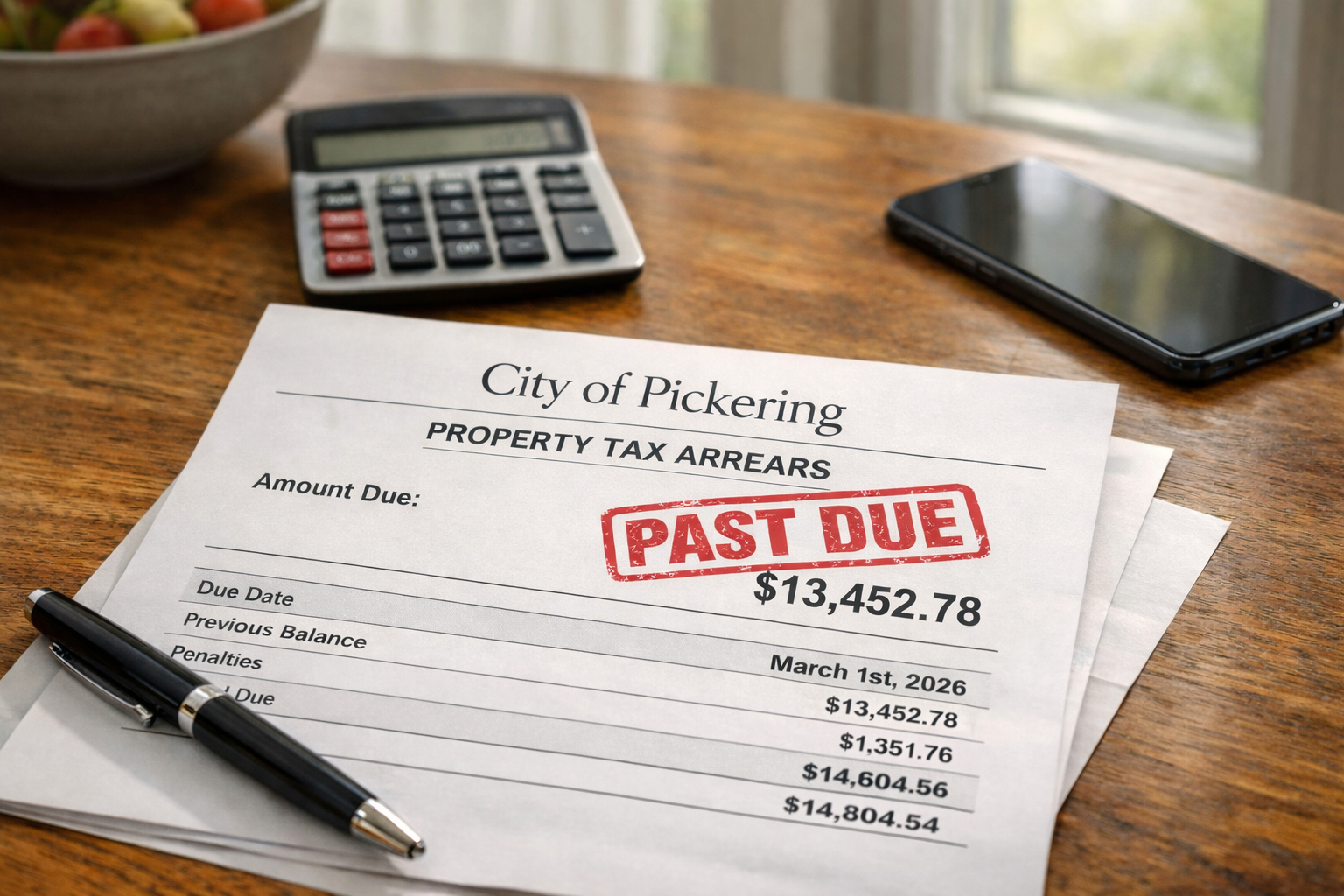
In Pickering, late payment penalties are typically 1.25% applied on the first day of default, plus another 1.25% on the first day of each month until paid. If arrears go unresolved long enough, Ontario municipalities can register a tax arrears certificate and eventually sell the property if the cancellation price is not paid within the required period.
Key early takeaway: the earlier you act, the more solutions exist.
Table of Contents
ToggleWhat Property Tax Arrears Pickering Means and How It Starts
Property tax arrears in Pickering simply means your property taxes are past due. This can happen after a missed instalment, a short payment, an NSF payment, or a bill that was not received or opened in time.
How property taxes are billed in Pickering
Pickering property taxes are normally due in scheduled instalments, and the City publishes tax due dates each year. For example, Pickering’s final bills have had due dates such as July 29 and October 29 for a given year.
If you miss a due date, the account becomes past due and begins accumulating charges. This is where property tax arrears in Pickering can become a problem that grows month by month.
What happens the moment taxes become past due
Pickering’s policy states that a late payment penalty of 1.25% is applied on the first day of default, and a further 1.25% is added on the first day of each calendar month while unpaid.
Important to note: That monthly 1.25% pattern is common in Ontario municipalities and is often described as effectively up to around 15% per year if left unresolved.
Worst Case Scenarios If Property Tax Arrears in Pickering Is Ignored
When property tax arrears in Pickering is ignored, the path usually gets worse in predictable steps. The exact timeline depends on the balance, how long it has been past due, and whether your mortgage lender intervenes early.
1) High interest and fees accumulate on the past due balance
The first worst-case scenario is cost escalation. With Pickering applying 1.25% at default and 1.25% monthly after, balances can snowball faster than homeowners expect.
Even if your original missed instalment was manageable, several months of penalties can turn it into a more stressful number. This is why property tax arrears in Pickering becomes harder to fix the longer it sits.
Common mistake: paying “something” but not catching up fully. Partial payments may not stop monthly penalties if the account remains past due, and municipalities often apply payments to the oldest amounts first.
Key takeaway: you do not want to carry property tax arrears through multiple billing cycles.
2) Tax lien reduces or blocks your ability to borrow against the property
The second worst-case scenario is losing access to financing. Once a municipality registers enforcement on title, most lenders treat it as a major red flag.
In Ontario, municipalities can register a tax arrears certificate on title as part of the tax sale framework once conditions are met, and the certificate and related process can block refinancing until resolved.
This is why timing matters. Homeowners often start looking for a home equity line of credit only after the situation feels urgent. By then, the ability to borrow can already be restricted.
Important to note: property taxes generally rank ahead of mortgages in priority, which is why lenders react quickly when taxes go unpaid.
3) Mortgage lender threatens power of sale if arrears are not brought into good standing
Mortgage lenders do not like surprises, and they do not like municipal arrears even more. If property tax arrears in Pickering remains unresolved, lenders may issue warnings, demand proof of payment, or take action under the mortgage terms.
Many mortgage agreements allow the lender to “advance” funds to pay taxes if the borrower fails to pay. That protects the lender’s security, but it can also create a new repayment problem for the homeowner.
If you cannot repay or resolve it, lender enforcement escalates. Depending on your situation, power of sale can become a real risk.
Key takeaway: your mortgage lender’s risk tolerance drops quickly when taxes are in arrears.
4) Tax sale by the City to recover past due balance
The final worst-case scenario is a tax sale process. Ontario provides a framework that allows municipalities to proceed with selling a property after taxes have been in arrears for a sufficient period and required notices and steps have been taken.
Ontario’s municipal tax sale procedures outline the process of registering a tax arrears certificate and the one-year period during which the amount required to cancel must be paid.
This is not meant to scare homeowners. It is meant to emphasize that property tax arrears in Pickering are time sensitive, and waiting too long removes control.
How Property Tax Arrears in Pickering Impacts Your Mortgage and Future Financing
This is where most homeowners feel the pinch. Even if you have good credit, property tax arrears in Pickering can derail standard approvals.
Why lenders care so much about property tax arrears
Property taxes are a first-priority risk. If the municipality has a mechanism to enforce and potentially sell the property, that threat sits above the mortgage lender’s position. That is why lenders monitor for arrears and respond aggressively.
How arrears affect renewals and refinancing
If you try to renew, refinance, or switch lenders while you have property tax arrears in Pickering, most lenders require the arrears to be paid in full at closing. The lender needs a clean tax status, and the lawyer will typically confirm tax balances as part of closing.
So, even if refinancing is your best solution, you may need a plan to clear taxes at the same time. Be it from the refinance proceeds or alternate methods available to you.
How arrears affect HELOC and home equity loan approvals
A home equity line of credit and a home equity loan are both commonly used to fix property tax arrears in Pickering, but approval depends on:
-
Loan-to-value
-
Property type and location
-
Credit history
-
Income and existing debts
-
Whether any tax enforcement has been registered
Important to note: the earlier you apply, the cleaner the file is. That typically means better pricing and more lender options.
Best Case Solutions for Property Tax Arrears in Pickering
If you act early, property tax arrears in Pickering can often be resolved with one of three realistic paths. The “best” option depends on your timeline and whether the arrears balance is small, medium, or large.
Solution 1) Mortgage lender repays the past due balance and sets a payment plan
This happens most often when the arrears are small. Pickering’s monthly penalty system means small balances can become medium balances surprisingly fast, so speed matters.
If your lender advances the taxes, you typically repay it either:
-
As a lump sum
-
Through increased monthly payments
-
Through an added amount to your mortgage balance (varies by lender and product)
Key takeaway: lender advances are more common for small balances because the lender wants the issue resolved without a full refinance.
Solution 2) Refinance your mortgage to include tax arrears and other debts
Refinancing can consolidate:
-
Property tax arrears
-
High interest credit cards
-
Personal loans
-
Collections-related debts (case dependent)
This can reduce stress by replacing multiple payments with one structured mortgage payment.
Refinancing is especially helpful when the homeowner has other debts, because it can fix property tax arrears in Pickering and stabilize cash flow at the same time.
Common mistake: waiting until the last minute and hoping a refinance will be simple. If your taxes are in arrears, the file becomes more time sensitive and documentation heavy.
Solution 3) Use a home equity loan or home equity line of credit to pay arrears
A home equity loan is a lump-sum, fixed-payment product. A home equity line of credit is revolving, like a secured line.
Both can be effective for property tax arrears in Pickering when:
-
The arrears are not too far gone
-
There is enough equity
-
The lender is comfortable with the borrower’s profile
In many real-world cases, homeowners prefer a home equity solution because it is faster than a full refinance and can be targeted only to the arrears and immediate needs.
Comparison Table of the Main Fixes
| Option | Best for | Speed | Main downside | Typical requirement |
|---|---|---|---|---|
| Lender advance + repayment plan | Small arrears | Fast | Not always offered | Lender approval |
| Mortgage refinance | Medium to large arrears + other debts | Medium | More paperwork and qualification | Income and credit review |
| Home equity loan | Lump sum catch-up | Fast | Payment is fixed | Enough equity |
| Home equity line of credit | Ongoing flexibility | Fast to medium | Can be harder with weaker credit | Equity + lender criteria |
Key takeaway: the right option depends on urgency and how far the arrears have progressed.
When Time Is Critical for Property Tax Arrears in Pickering
If you want the widest set of lender options, treat property tax arrears in Pickering like a deadline problem, not a paperwork problem.
First steps checklist
Use this checklist immediately:
Immediate Action Checklist
-
Confirm the exact past due balance with the City of Pickering
-
Ask for the breakdown of penalty and interest and the date it will increase again
-
Check if any enforcement step has been initiated (ask directly)
-
Notify your mortgage lender if you have received arrears notices
-
Review your home equity position and mortgage balance
-
Start a financing application early if you may need refinancing or equity financing
Documents lenders often request
To fix property tax arrears in Pickering through financing, lenders commonly request:
-
Mortgage statement
-
Property tax statement
-
Proof of income or bank statements, depending on lender type
-
Credit review
-
Property details and sometimes an appraisal
Important to note: you usually want the tax statement early because it confirms the true arrears balance and helps structure the payout properly.
Common Myth About Property Tax Arrears Pickering
Common myth: “If I owe property tax arrears, I will automatically lose my home.”
This is not automatically true. Many homeowners resolve property tax arrears in Pickering well before any enforcement reaches a critical stage.
The real risk is delay. The longer the balance stays past due, the more expensive it gets and the more it limits borrowing options.
Key takeaway: early action is the difference between a controlled solution and an emergency.
Conclusion: Fixing Property Tax Arrears in Pickering Before It Escalates
Property tax arrears in Pickering is solvable, but it is time sensitive. Monthly penalty charges can add up quickly, and once enforcement steps affect title, borrowing options narrow fast.
The best outcomes usually come from one of three paths: a lender repayment plan for small balances, refinancing to consolidate arrears and debts, or using a home equity loan or home equity line of credit before the situation hardens. If you address property tax arrears in Pickering early, you stay in control of the solution instead of reacting to worst case timelines.
Key takeaway: deal with it early, while you still have options.
FAQ: Property Tax Arrears Pickering
Q: How quickly do penalties add up in Pickering once I miss a due date?
A: Pickering applies a 1.25% penalty on the first day of default and adds another 1.25% on the first day of each month while unpaid. This means balances can grow quickly, especially if missed instalments continue.
Q: Can my mortgage lender pay my Pickering property tax arrears for me?
A: Sometimes, especially when the balance is small, medium or large. The lender may advance funds to pay the taxes to protect the property and then require repayment. If the amount is larger, the lender may require refinancing instead.
Q: Can I refinance if I have property tax arrears in Pickering?
A: Often yes, but the arrears must be cleared as part of closing. Most lenders and lawyers require taxes to be brought into good standing when the mortgage is being registered or replaced.
Q: What is a tax arrears certificate, and why does it matter?
A: In Ontario’s tax sale framework, municipalities can register a tax arrears certificate on title when eligibility conditions are met. The process includes a period where the cancellation amount must be paid, and if not paid, the municipality can proceed toward sale under the rules. This matters because it can restrict financing and escalate urgency.
Q: Should I use a HELOC or a home equity loan to pay property tax arrears in Pickering?
A: A home equity loan can be better when you need a fixed lump sum and predictable payments. A home equity line of credit can be better if you need flexibility. The best choice depends on equity, credit, income, and timing.
Q: If I cannot qualify right now, what is the most important thing to do?
A: Stop the problem from growing. Confirm your balance, understand when the next penalty is applied, and explore a structured plan. Pickering’s monthly penalty schedule is a major reason early action matters.
Apply now: Clear Property Tax Arrears