A private mortgage lender in Alberta can approve you when a bank or credit union won’t. Private lenders, also called hard money lenders, focus on the equity in your property rather than your credit score or income. That makes them a practical option for bruised credit, self employed income, urgent timelines, or stopping a foreclosure.
The trade-off is cost and time. Private mortgages carry higher rates and fees, terms are short, and you need a clear plan to pay the loan off. This guide covers how private lending works in Alberta, who qualifies, estimated rates and fees, Alberta’s foreclosure rules, and how to choose the right lender.
LendToday is an Ontario mortgage brokerage. Mortgages on Alberta properties are arranged through our licensed Alberta partner.
Table of Contents
ToggleWhat Is a Private Mortgage Lender?
A private mortgage lender is an individual, a group of investors, or a company that lends money secured against real estate, outside the banking system. In Alberta, private lenders include:
- Mortgage investment corporations (MICs): pooled investor funds that lend on real estate
- Private lending companies: firms that fund and manage private mortgages
- Individual private lenders: investors who lend their own money, usually through a broker or lawyer
Hard Money vs Private Mortgage: Is There a Difference?
Not really. “Hard money” is another name for private, asset-based lending. The loan is approved mainly on the value of the “hard” asset, your property. In Alberta, the terms are used interchangeably.
How Private Mortgages Work in Alberta
Banks focus on your income, debt ratios, credit score and the stress test. Private lenders put the property first. Approval depends on four things:
- Your property’s current market value
- What you already owe on it
- The resulting loan-to-value (LTV) ratio
- How easily the property could be sold
Example: your home is worth $600,000 and you owe $300,000. At an 80% LTV limit, total mortgages on the property can reach $480,000, so you could borrow up to about $180,000 on top of your existing mortgage, before fees.
Most private mortgages are interest only. Your monthly payment covers the interest, and the full balance is due at the end of the term. That keeps payments lower, but it means you must have a plan to repay the principal.
Who Qualifies With a Private Lender in Alberta?
Credit
Most private lenders will look at any credit score. Collections, missed payments, a consumer proposal or even a recent bankruptcy may be acceptable when there’s enough equity. Very weak credit can still affect your rate or how much you can borrow.
Loan-to-Value
Most Alberta private lenders lend up to 75% to 80% of the property’s value, including any existing mortgage. Homes in smaller towns, rural properties and slower markets may be capped lower, sometimes around 65%, because they’re harder to sell.
Income and Documents
Income checks are lighter than at a bank, but not skipped. Lenders want to know you can make the interest payments. Expect to provide:
- Government-issued ID
- Your current mortgage statement
- Your property tax bill
- Proof of home insurance
- Proof of income, even if it’s irregular
- An appraisal ordered or approved by the lender
- Purchase documents, if you’re buying
A lawyer is required to register the mortgage on title and close the loan.
When Alberta Homeowners Use a Private Mortgage
Stopping a foreclosure. If you’ve fallen behind on your mortgage or property taxes, a private loan can pay out the arrears and buy you time. Acting early matters, because legal costs and interest reduce your equity every month. See our guide on how private lenders can help with foreclosure in Alberta.
Consolidating debt. Paying off high-interest debt with a private second mortgage in Alberta can lower your monthly payments while you rebuild your credit.
Accessing home equity. When a bank won’t approve a home equity loan in Alberta, a private lender often can.
Bridge financing. Buy your next home before your current one sells, then repay the private loan from the sale.
Self employed or irregular income. Alberta’s energy, agriculture and trades sectors mean many workers have seasonal or commission income that banks struggle to assess.
Fix and flip, land and construction. Investors use private loans for fast purchases, renovations, vacant land and early-stage builds that banks avoid. A private lender can often close in 7 to 14 days, compared to 30 to 45 days at a bank.
Estimated Private Mortgage Rates and Fees in Alberta
Estimates only, subject to change. Your actual rate and fees depend on your application, documents, property and the final approval.
| Cost | Estimated range |
|---|---|
| Interest rate | 9% to 14% per year, usually interest only |
| Lender fee | 1% to 4% of the loan, paid at closing |
| Broker fee | May apply when a broker arranges the loan, disclosed upfront |
| Legal fees | About $1,500 to $3,000 or more |
| Appraisal | About $300 to $600 for a home, more for complex properties |
| Typical term | 6 to 12 months |
Example payment: a $100,000 private mortgage at 11% interest only is about $917 a month, plus the fees above. Always compare the full cost of the loan, not just the rate.
Your Exit Strategy
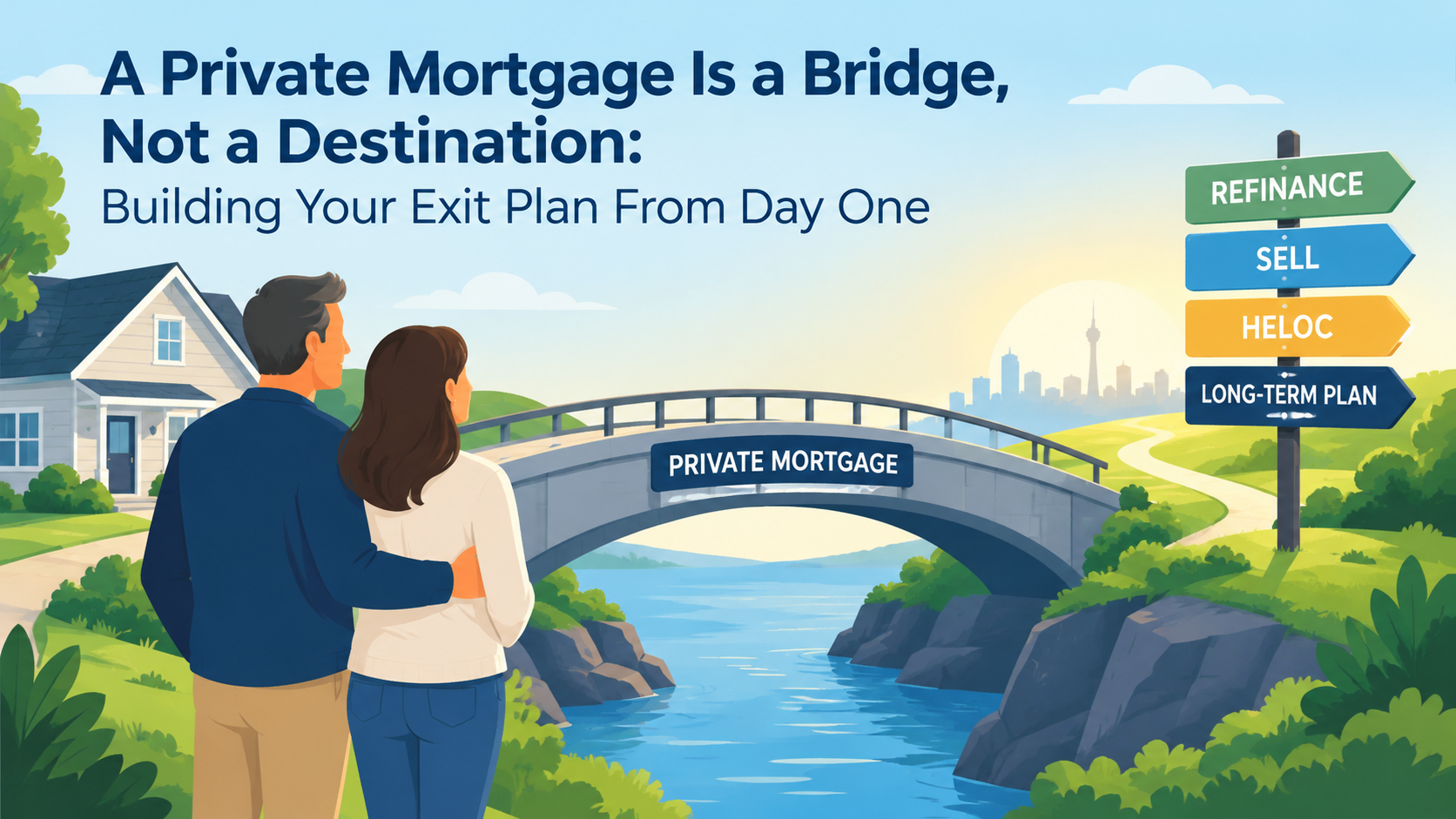
This is the most important part of any private mortgage. Renewal isn’t guaranteed, so you need a realistic way to repay the loan before you sign:
- Refinance with a bank or credit union. Use the term to improve your credit, pay down debt or settle your income, then move to a lower-rate lender.
- Sell the property. Price realistically, and don’t plan around a best-case sale price.
- Add a co-borrower or guarantor. This can help you qualify for a refinance sooner.
If none of these will work within the term, a private mortgage likely isn’t the right fit. Think about it carefully before borrowing.
Alberta Foreclosure Rules: What’s Different
Alberta doesn’t use Ontario-style “power of sale” for homes. Mortgage enforcement goes through the Court of King’s Bench, and a judge oversees each step.
- Redemption period: for residential (non-farm) property, the Law of Property Act generally sets a six-month redemption period. During this time you can catch up on payments, refinance or sell. A lender can ask the court to shorten it, and the court considers factors like your equity and ability to pay.
- Shortfalls: whether a lender can come after you for money still owed after the property is sold depends on your mortgage type, for example a high-ratio insured mortgage versus a conventional one.
Because these rules depend on your exact situation, speak with an Alberta real estate lawyer if you’ve received a demand letter or a statement of claim. The sooner you act, the more options you have.
How to Choose the Best Private Mortgage Lender in Alberta
- Get every cost in writing. Ask for the rate, lender fee, broker fee, legal, appraisal and any renewal or discharge fee, each listed separately.
- Check the term and renewal terms. Ask what happens at maturity and what a renewal would cost.
- Check prepayment terms. Can you pay the loan off early without a penalty? Many private loans have a minimum interest period.
- Confirm licensing. Mortgage brokers and lenders in Alberta must be licensed with the Real Estate Council of Alberta (RECA).
- Compare several lenders. Private lenders’ funds and appetite change week to week. A broker can show you the lenders actively funding right now.
- Plan your exit first. A good lender or broker will ask about your exit plan before approving you. Be wary of one who doesn’t.
Who Is the Largest Private Mortgage Lender in Alberta?
There’s no single “largest” lender that’s right for everyone. Private and MIC lenders’ available funds change constantly, and each has its own rules on property types, locations and loan sizes. The best lender is the one with funds available, a fit for your property, and the lowest total cost for your situation.
Risks to Weigh
- Higher cost: a 12-month private loan at 10% to 12% plus fees is expensive. The numbers must work for you.
- No guaranteed renewal: if your exit plan falls through, the lender can demand repayment.
- Losing equity: borrowing to cover ongoing expenses without fixing the underlying problem can leave you worse off.
- Enforcement: if you default, the lender can start foreclosure.
Frequently Asked Questions
How fast can a private lender in Alberta fund a mortgage?
Most straightforward files fund in 10 to 21 days, and some close in as little as 7 to 14 days. Appraisal and title issues are the most common delays.
How much can I borrow from a private lender in Alberta?
Usually up to 75% to 80% of your property’s value, minus what you already owe. Rural and slower markets may be capped lower.
Can I get a private mortgage in Alberta with bad credit?
Yes. Equity matters more than credit, although very poor credit may affect the rate or the amount you can borrow.
Is a hard money lender the same as a private lender?
Yes. Hard money lenders are private lenders that approve loans based mainly on the property’s value. The terms are used interchangeably in Alberta.
Are private lenders regulated in Alberta?
Mortgage brokers and lenders are licensed through the Real Estate Council of Alberta (RECA). Every mortgage must be registered on title, and a lawyer is required to close.
What happens if I can’t repay at the end of the term?
The lender may demand repayment and start enforcement. That’s why you should plan your exit before you sign.
Talk to a Private Mortgage Specialist
If a bank has said no, we can review your equity, compare private lenders that are actively funding in Alberta, and show you the full cost before you commit.
LendToday is an Ontario mortgage brokerage. Mortgages on Alberta properties are arranged through our licensed Alberta partner. Rates and fees are estimates only, subject to change, and depend on your application, documents and property.