Table of Contents
ToggleOpen vs. Closed Mortgages: The Critical Difference Most Canadians Overlook
When Canadians go mortgage shopping, most of the conversation centres around interest rates — fixed or variable, 5-year or 3-year, and what the Bank of Canada might do next. But there’s another choice that often gets glossed over, one that can cost you thousands of dollars if you get it wrong: open vs. closed mortgages.
Most borrowers pick a closed mortgage without fully understanding what that means for their flexibility — and then get blindsided when life doesn’t go according to plan. Let’s break down exactly what these two mortgage types mean, who should consider each one, and the mistakes we see far too often.
What Is a Closed Mortgage?
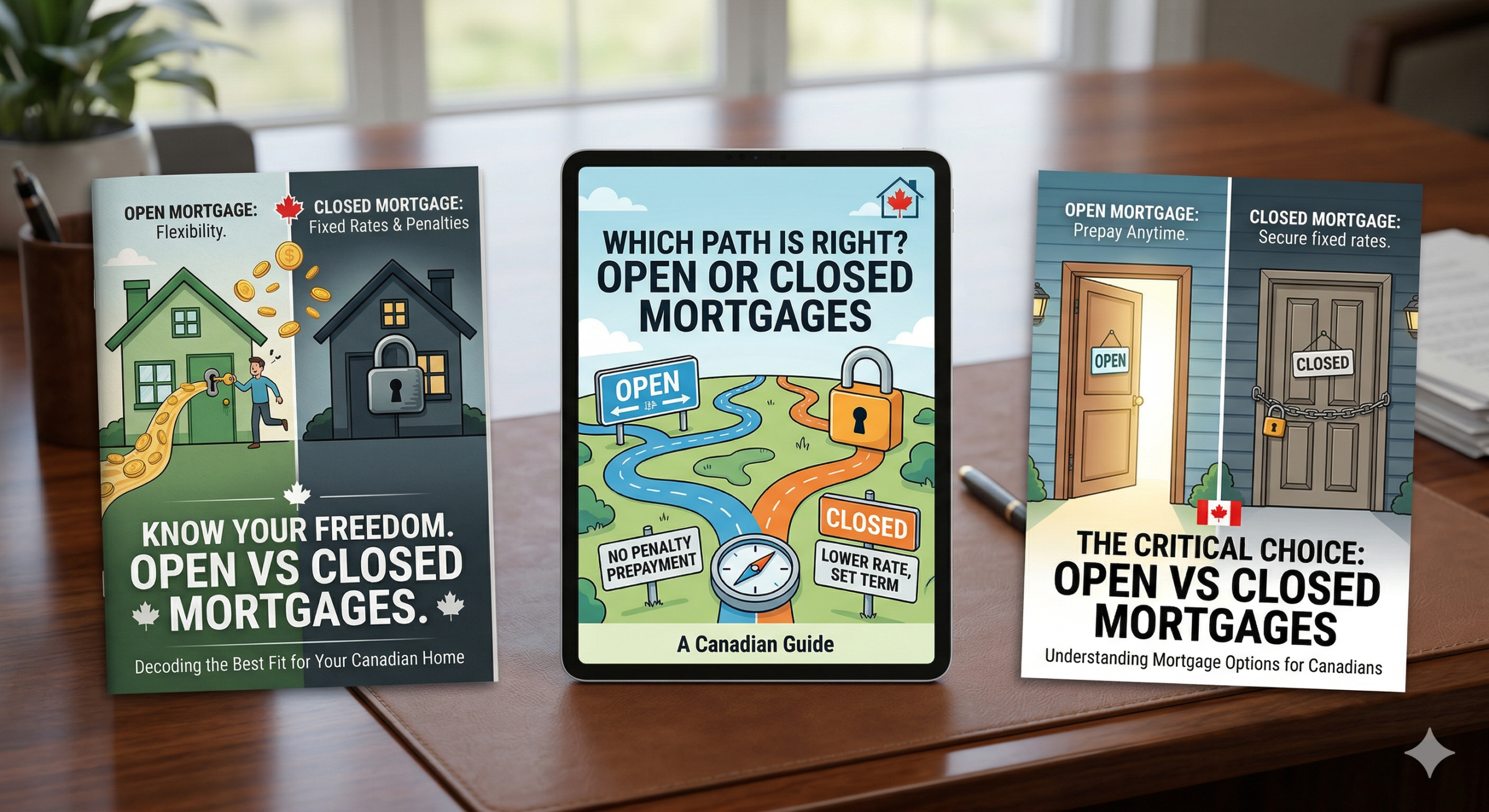
A closed mortgage is the most common type in Canada. It comes with a fixed term, typically 1 to 5 years, during which your prepayment options are limited. You can usually make lump-sum payments or increase your regular payments up to a certain percentage per year (often 10–20% of the original principal), but beyond that, breaking the mortgage early will trigger a prepayment penalty.
The trade-off? Closed mortgages typically come with lower interest rates than open mortgages. For borrowers who plan to stay put and don’t expect major financial changes, that lower rate is the reward for committing to the term.
What Is an Open Mortgage?
An open mortgage gives you the freedom to pay off your mortgage partially or in full at any time, without penalty. You can also break the mortgage and refinance whenever it makes sense, without facing any financial consequences.
That flexibility comes at a cost: open mortgages carry higher interest rates, sometimes 1% or more above comparable closed rates. That gap can add up quickly on a large mortgage balance.
The Penalty Problem: Where Canadians Get Caught
Here’s where it gets expensive. Most Canadians who choose a closed mortgage assume they’ll simply ride out the term without issue. But life has other plans.
The most common reasons people break a closed mortgage early include:
- Selling the home before the term ends (job relocation, upsizing, divorce, estate situations)
- Refinancing to access home equity or consolidate debt at a better rate
- Taking advantage of a significant rate drop mid-term
When you break a closed mortgage, lenders charge a prepayment penalty. For fixed-rate mortgages, this is typically calculated using the Interest Rate Differential (IRD), and it can be shockingly large. In some cases, Canadian homeowners have faced penalties of $10,000, $20,000, or more.
Variable-rate closed mortgages are generally less brutal; the penalty is usually just three months’ interest, but it’s still a real cost.
A common scenario: A homeowner locks into a 5-year fixed closed mortgage, then needs to sell two years in due to a job change. They’re hit with an IRD penalty of $14,000 — money they didn’t budget for and didn’t expect.
So Should You Ever Choose an Open Mortgage?
Yes — in the right circumstances, an open mortgage makes a lot of sense. Consider it if:
- You’re expecting a large windfall — an inheritance, business sale, or property sale — and want to pay down your mortgage aggressively without restriction
- You’re in a transitional period — recently separated, planning to sell, or between properties — and need short-term flexibility
- You believe rates will drop significantly and want to be able to refinance without penalty when they do
- Your income is highly variable, and you want the ability to make large, unpredictable lump-sum payments
Open mortgages are also commonly used as a short-term bridge — borrowers take one for 6 months to a year while they figure out their longer-term strategy, then transition into a closed product once their situation stabilizes.
The Hybrid Option: Convertible Mortgages
Worth mentioning is the convertible mortgage — a middle-ground product offered by many Canadian lenders. It typically starts as an open or short-term closed mortgage but can be converted into a longer-term closed mortgage at any point without penalty.
This can be a smart option for buyers who want some flexibility upfront but expect to commit to a longer term once their situation clarifies.
Key Questions to Ask Yourself Before Choosing
Before signing, ask yourself the following:
- How certain am I that I’ll stay in this home for the full term?
- Is there any chance I’ll need to refinance — for renovations, debt consolidation, or a major life change?
- How is my income likely to change? Could I want to pay off more aggressively later?
- What is the actual penalty calculation method my lender uses? (IRD vs. three months’ interest matters enormously)
- What prepayment privileges does the closed mortgage include? (Some lenders allow up to 20% annually — not nothing)
FAQ
What is the main difference between an open and a closed mortgage in Canada? An open mortgage lets you pay off or break your mortgage at any time without penalty, while a closed mortgage restricts how much you can prepay and charges a penalty if you break it early. Closed mortgages come with lower interest rates; open mortgages offer more flexibility at a higher rate.
How much is the penalty for breaking a closed mortgage early? It depends on your lender and mortgage type. Variable-rate closed mortgages typically charge three months’ interest. Fixed-rate closed mortgages use an Interest Rate Differential (IRD) calculation, which can result in penalties of several thousand dollars — sometimes $10,000 or more, depending on your balance and remaining term.
Is an open mortgage ever worth the higher interest rate? Yes — if you’re expecting a large lump-sum payment, planning to sell your home soon, or want the freedom to refinance without penalty, the higher rate can be worth it. It’s also useful during transitional life stages like separation, estate situations, or waiting to finalize a longer-term mortgage strategy.
Can I make extra payments on a closed mortgage? Most closed mortgages in Canada do include prepayment privileges — typically allowing you to increase your regular payments or make a lump-sum payment of up to 10–20% of the original principal per year without penalty. Always confirm the specific terms with your lender or broker before signing.
What is a convertible mortgage, and how does it differ from open and closed options? A convertible mortgage starts with the flexibility of an open or short-term product, but can be switched into a longer-term closed mortgage at any point without penalty. It’s a good middle-ground option for borrowers who want short-term flexibility but expect to commit to a fixed term once their situation becomes clearer.
What to Watch Out for With Lender Penalty Calculations
Not all closed mortgages are created equal. The penalty for breaking a mortgage varies dramatically depending on the lender and how they calculate the IRD. Big banks often use posted rates in their IRD formula, which inflates the penalty significantly compared to monoline lenders or credit unions, who use discounted rates.
Before committing to any closed mortgage, ask your broker to walk you through the worst-case penalty scenario. If the lender can’t give you a clear answer, that’s a red flag.
The Bottom Line
Closed mortgages are the right call for most Canadians most of the time — the lower rate is a genuine advantage for borrowers who stay the course. But the keyword is most. If there’s any meaningful chance your circumstances will change before the term ends, the lower rate on a closed mortgage can quickly be erased by a hefty prepayment penalty.
An experienced mortgage broker can help you model both scenarios using your actual numbers — not just the headline rate. At LendToday.ca, we work with over 50 lenders across Canada to find the right mortgage structure for your specific situation, not just the lowest number on paper.
Have questions about your mortgage options? Contact our team today for a free consultation.