If you want to raise your credit score in 2026, focus on three fundamentals. Pay every bill on time. Keep credit card balances below 50 percent of their limits. Avoid unnecessary credit applications.
Your credit score in Canada affects your borrowing power, your ability to qualify for a mortgage, the interest rates you receive, and even whether you may need alternative financing such as a stated income mortgage. A strong credit profile lowers borrowing costs and increases financial flexibility. A weak credit profile can limit your options and drive up what you pay to borrow.
This guide explains what a credit score is, what is considered bad credit in Canada, how to raise your credit score, and how lenders view credit when reviewing a mortgage application.
What Is a Credit Score in Canada
A credit score is a three-digit number that represents how likely you are to repay borrowed money. It is calculated using information contained in your credit report, which is maintained by a credit bureau that tracks your borrowing history and payment behaviour over time.
Who Calculates Your Credit Score
In Canada, the two primary credit bureau agencies are Equifax and TransUnion. These companies collect information from lenders and generate a FICO score or proprietary credit score model.
Lenders reviewing a mortgage application typically evaluate:
- Payment history
- Credit utilization
- Length of credit history
- Types of credit accounts
- Recent credit applications
Important to note: lenders do not rely only on the number itself. They also review the full credit report and the financial story behind the application.
What Impacts Your Credit Score
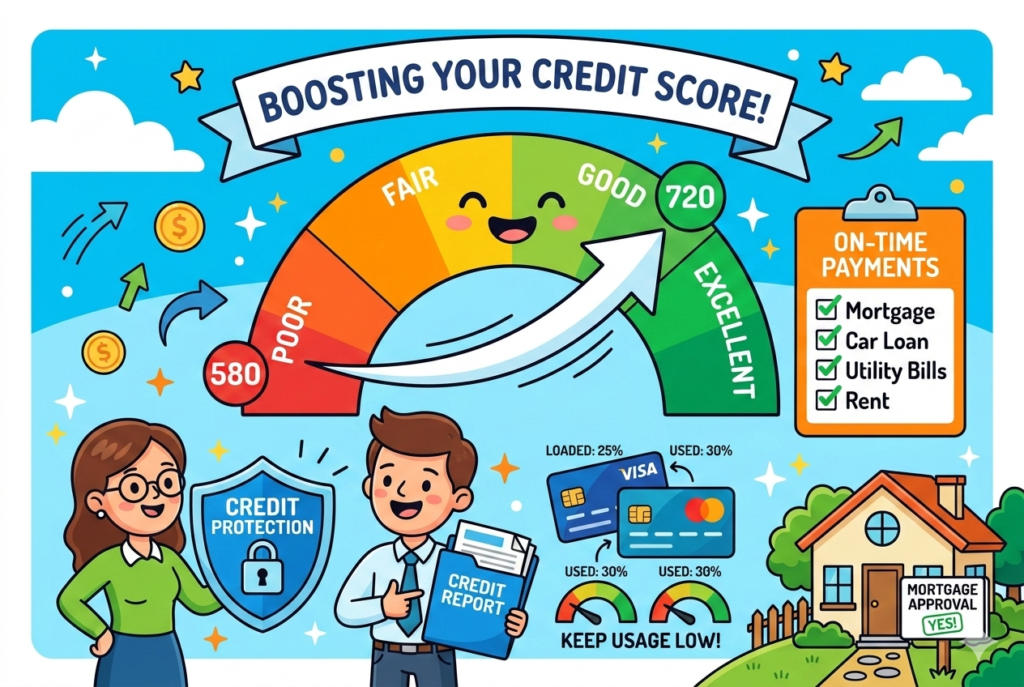
Payment history has the largest impact on your credit score. Missing even a single payment can significantly lower your score and take months to recover.
Credit utilization also plays a significant role. Experts generally recommend maintaining balances below 50 percent of your credit limit, and ideally below 30 percent.
Common mistake: maxing out a credit card and making only minimum payments. This single habit is one of the fastest ways to damage your credit score and one of the most important things to correct when working to raise it.
How Your Credit Score Impacts You Financially
Your credit score directly affects how easily you can access borrowing and what interest rate you receive. Understanding this connection is one of the strongest reasons to raise your credit score as early as possible.
Borrowing Costs
Borrowers with stronger credit scores typically receive:
- Lower interest rates
- Higher borrowing limits
- More flexible repayment terms
Borrowers with weaker credit scores may experience:
- Higher interest rates
- Lower approval amounts
- Stricter lending criteria
For example, someone applying for home equity loans with a 760 score will usually qualify for significantly better rates than someone with a 620 score.
Mortgage Approval and Stated Income Mortgage Options
Credit scores play a major role when qualifying for a mortgage. If a borrower has strong credit and a stable income, banks and credit unions usually offer the most competitive mortgage rates.
However, borrowers with weaker credit may need alternative financing solutions such as a stated income mortgage. A stated income mortgage often relies more heavily on equity and bank statement income verification rather than traditional documentation. These solutions can help borrowers access financing when conventional approval is difficult.
Key takeaway: working to raise your credit score expands your lending options and reduces reliance on higher-cost financing, such as a stated income mortgage.
Credit Score Requirements by Lender Type in Canada
When working to raise your credit score in 2026, it helps to understand how different lenders evaluate credit. Banks, credit unions, B lenders, and private lenders all have different credit requirements.
Important to note: your credit score is only one piece of the mortgage application. Income stability, debt repayment history, and property equity also influence qualifying decisions.
| Lender Type | Typical Credit Score Range | Exceptions | Income Requirements |
|---|---|---|---|
| A Lenders (Banks/Monolines) | 675 or higher | Some lenders use internal credit scoring models. Exceptions may occur depending on the borrower’s story and overall risk profile. | Self employed accepted. Hourly accepted with a two year average and no probation. Salary accepted with no probation. Contract and multiple income sources accepted with explanation. |
| Credit Unions | 675 or higher | Some credit unions use internal credit scoring systems. Exceptions may be considered depending on the borrower’s story and relationship history. | Self employed accepted. Hourly accepted with a two year average and no probation. Salary accepted with no probation. Contract and multiple income sources accepted with explanation. |
| B Lenders | 500 or higher | Lower credit scores can sometimes be considered, depending on the borrower’s story and property equity. | Self employed accepted. Hourly accepted with a two year average and no probation. Salary accepted with no probation. Contract and multiple income sources accepted with explanation. |
| Private Lenders | No specific score required | Private lenders focus less on the credit score and more on the story behind the application. The key focus is often the exit strategy. | All income types accepted with explanation. |
Key Takeaway
Your credit score matters, but lenders often evaluate the overall financial story behind a borrower. Examples where exceptions may be considered include:
- Temporary credit issues
- Debt consolidation plans
- Strong property equity
- A clear exit strategy from short-term financing
Continuing to raise your credit score in 2026 remains one of the most important steps toward better mortgage options, regardless of which lender type you are targeting.
What Is Considered a Bad Credit Score in Canada
Credit scores in Canada typically range between 300 and 900. The table below outlines how lenders generally categorize these ranges.
| Credit Score | Category |
|---|---|
| 760 to 900 | Excellent |
| 660 to 759 | Good |
| 600 to 659 | Fair |
| 300 to 599 | Poor |
A score below 600 is generally considered bad credit. However, a common myth is that borrowers with bad credit cannot qualify for financing. In reality, many borrowers with lower scores still obtain financing, though they may need solutions such as a stated income mortgage or alternative lending programs. This is exactly why it pays to raise your credit score before applying.
Why Maintaining a Good Credit Score Matters
Maintaining a strong credit score creates long term financial advantages. The effort to raise your credit score and protect it over time pays dividends across many areas of your financial life.
Benefits include:
- Easier mortgage approvals
- Lower borrowing costs
- Greater access to home equity loans
- Increased flexibility for debt consolidation
Important to note: credit scores change regularly based on financial behaviour. Maintaining positive habits ensures long term credit stability.
Credit Health Checklist
Use the following checklist to protect and raise your credit score consistently:
- Pay every account before the due date
- Keep credit card balances below 50 percent utilization
- Avoid opening unnecessary credit accounts
- Review your credit report annually
- Avoid collections whenever possible
- Keep older credit accounts open
Key takeaway: Small financial habits performed consistently can significantly improve long-term credit health and help you raise your credit score faster than most people expect.
Practical Steps to Raise Your Credit Score
Improving a bad credit score requires a clear financial strategy. Here are the most effective practical steps to raise your credit score in Canada.
Debt Repayment Strategy
Focus on paying down high-interest debt first. Lower balances reduce credit utilization and positively impact your credit report. In some situations, debt consolidation or home equity loans can simplify multiple payments into one manageable payment, which also supports your effort to raise your credit score.
Credit Utilization Strategy
Credit utilization is a major factor in scoring models. If your credit card limit is $10,000, try to keep your balance below $5,000. Ideally, keep it below $3,000. Reducing utilization is often the fastest single action borrowers can take to raise their credit score within 30 to 90 days.
Avoiding Collections
Collections can significantly damage your credit score and set back your progress by months or years. If you are struggling to make payments, communicate with lenders early. Many lenders prefer working out payment arrangements rather than sending accounts to collections.
Important to note: even after paying collections, rebuilding your credit score may take time. Prevention is far more effective than recovery.
Credit Products That Help Raise Your Credit Score
Strategic borrowing can help improve your credit profile when managed responsibly. The table below outlines products that can support your goal to raise your credit score.
| Credit Product | Credit Impact | Reason |
|---|---|---|
| Secured credit card | Positive | Builds payment history |
| Credit builder loan | Positive | Adds installment credit |
| Small personal loan | Positive | Diversifies credit mix |
| Stated income mortgage | Neutral to positive | Adds mortgage history if payments are consistent |
A stated income mortgage can support long term credit rebuilding if payments are made consistently and on time.
How Multiple Applications Affect Your Credit Score
Each credit application typically results in a hard inquiry on your credit report. Understanding this is important when you are trying to raise your credit score, since unnecessary applications can work against your progress.
Hard vs Soft Credit Inquiries
A soft inquiry does not impact your credit score. A hard inquiry may temporarily lower your credit score, and submitting several applications within a short period can signal higher financial risk to lenders.
Smart Application Strategy
When planning a mortgage application or borrowing request, speak with a mortgage broker before applying. This helps prevent unnecessary credit bureau inquiries and protects the progress you have made to raise your credit score.
Important to note: when shopping for mortgage rates within a short period, credit scoring models may treat multiple inquiries as a single inquiry.
Key Takeaways to Raise Your Credit Score in 2026
Working to raise your credit score in 2026 requires discipline and consistency.
Focus on these fundamentals:
- Make every payment on time
- Maintain credit utilization below 50 percent
- Avoid unnecessary credit applications
- Monitor your credit report regularly
- Maintain responsible borrowing habits
A stronger credit score can reduce borrowing costs and increase the number of lenders willing to work with you. Over time, the work you put into raising your credit score allows you to move away from higher-cost financing solutions, such as a stated income mortgage and into better terms with mainstream lenders.
Frequently Asked Questions
How long does it take to raise your credit score in Canada?
Minor improvements may appear within 30 to 90 days if balances are reduced. Major credit rebuilding after collections or missed payments may take 12 to 24 months. Starting now is always the best strategy.
Does checking my own credit report lower my credit score?
No. Checking your credit report through Equifax or TransUnion is considered a soft inquiry and does not affect your credit score. You should review your report at least once a year.
Can I qualify for a mortgage with bad credit?
Yes. Borrowers with weaker credit scores may still qualify for financing through alternative lenders or programs such as a stated income mortgage. That said, working to raise your credit score before applying will always improve your options and reduce your costs.
Should I close old credit cards?
Generally no. Keeping older credit accounts open helps increase the length of credit history, which benefits your credit score. Closing them can shorten your credit history and lower your score.
Is debt consolidation good for your credit score?
Debt consolidation can help if it reduces credit utilization and supports consistent debt repayment. It is one of the tools available to borrowers who want to raise their credit score while managing multiple debts.