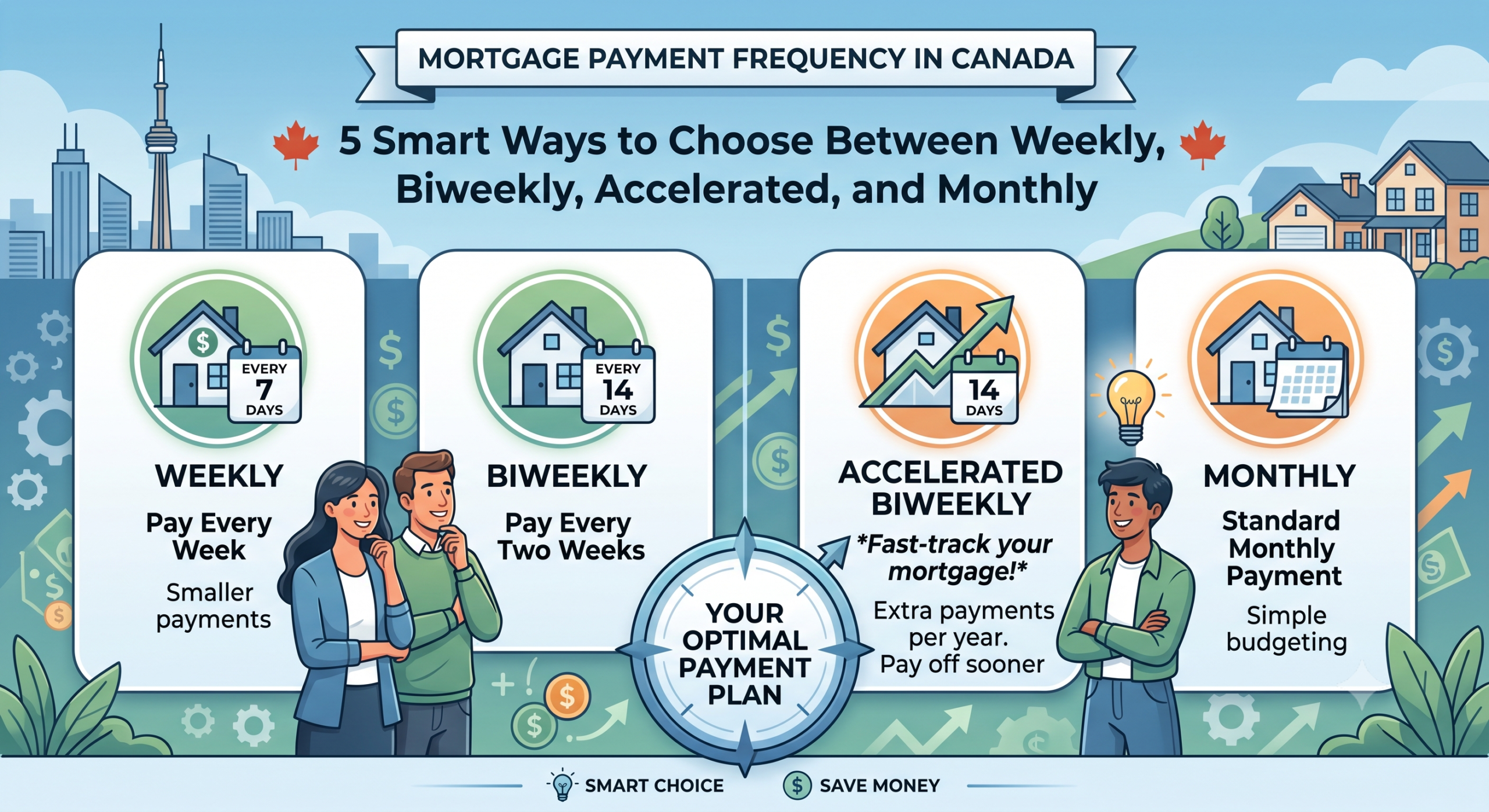
Most Canadian homeowners sign their mortgage, set up their payments, and never think about payment frequency again. The default at most lenders is monthly, so monthly is what most borrowers end up with. The conversation about whether weekly, biweekly, or accelerated payments would actually save money rarely happens at the closing table, which means a significant opportunity to shave years off the mortgage and tens of thousands of dollars in interest often goes unexplored.
The choice between monthly, semi-monthly, biweekly, weekly, accelerated biweekly, and accelerated weekly payments is not just a matter of timing. Two of these options, accelerated biweekly and accelerated weekly, structurally pay the mortgage off faster by sneaking in extra principal each year without dramatically changing the per payment cost. The non-accelerated options simply rearrange the same annual payment total into different intervals. Understanding the difference can be worth tens of thousands of dollars over the life of a mortgage. This article walks through how each payment frequency works in Canada, how much each one actually saves, and how to choose the right one for your cash flow and financial goals.
Table of Contents
ToggleWhat Is Mortgage Payment Frequency?
Mortgage payment frequency is how often you make a payment to your lender over the course of a year. In Canada, lenders typically offer six options: monthly, semi-monthly, biweekly, weekly, accelerated biweekly, and accelerated weekly. The frequency you choose affects how quickly your principal is paid down, how much interest you pay over the life of the mortgage, and how the payment fits into your household cash flow.
The number of payments per year varies significantly across these options, from 12 payments under monthly to 52 payments under weekly. The total annual payment amount, however, is identical for the non-accelerated options and slightly higher for the accelerated options. That small difference in annual total is where the long-term savings come from.
How Payment Frequency Affects Your Mortgage
Two things happen when you make a mortgage payment. A portion goes toward interest, calculated based on the outstanding principal. The remainder reduces the principal. The faster you reduce the principal, the less interest accrues on subsequent payments. More frequent payments mean the principal is paid down a little sooner each cycle, which compounds in your favour over the life of the mortgage.
Key takeaway: Payment frequency is not just about cash flow timing. It directly affects how much total interest you pay and how quickly the mortgage is paid off.
The Difference Between Accelerated and Non-Accelerated
This is the single most important concept in mortgage payment frequency, and it is also the most poorly understood.
A non-accelerated biweekly payment takes your monthly payment, multiplies it by 12 to get an annual total, then divides by 26 to get a biweekly amount. The annual total is the same as paying monthly. Twenty-six biweekly payments equal twelve monthly payments.
An accelerated biweekly payment takes your monthly payment, divides it by 2, and pays that amount every two weeks. Because there are 26 biweekly periods in a year but only 24 semi-monthly periods (which match the monthly schedule), accelerated biweekly results in 26 half payments per year, which equals 13 monthly payments instead of 12.
The same logic applies to accelerated weekly. Your monthly payment is divided by 4 and paid each week. Over 52 weeks, that equals 13 monthly payments per year instead of 12.
Important to note: The word “accelerated” is the only thing that matters. Without it, you are simply rearranging the same annual payment total. With it, you are quietly making one extra monthly payment per year toward your principal.
The Six Mortgage Payment Frequencies Available in Canada
Here is how each option breaks down for a borrower with a $600 weekly equivalent mortgage payment, which corresponds to a roughly $2,600 monthly payment.
Monthly Payments
Twelve payments per year, one per month. This is the default option at most Canadian lenders. The payment amount equals the calculated monthly amount based on the interest rate and amortization. Annual total: 12 times the monthly payment.
Semi-Monthly Payments
Twenty four payments per year, two per month, typically on the 1st and 15th. Each payment is the monthly payment divided by 2. Annual total: same as monthly.
Biweekly Payments
Twenty six payments per year, one every two weeks. Each payment is the annual monthly total divided by 26. Annual total: same as monthly.
Weekly Payments
Fifty two payments per year, one per week. Each payment is the annual monthly total divided by 52. Annual total: same as monthly.
Accelerated Biweekly Payments
Twenty six payments per year, one every two weeks. Each payment is the monthly payment divided by 2. Annual total: 13 monthly payments instead of 12.
Accelerated Weekly Payments
Fifty two payments per year, one per week. Each payment is the monthly payment divided by 4. Annual total: 13 monthly payments instead of 12.
Common misconception: That biweekly payments alone save you money. They do not, unless they are accelerated biweekly. A non accelerated biweekly payment is just a monthly payment chopped into smaller pieces with no additional principal reduction.
How Accelerated Payments Actually Save You Money
The mechanism behind accelerated payments is simple, but the impact over a 25 year amortization is significant.
The Extra Monthly Payment Hidden in the Math
Take a 500,000 dollar mortgage at 5 percent interest amortized over 25 years. The monthly payment is roughly 2,908 dollars. The annual total under monthly payments is 34,896 dollars.
Under accelerated biweekly, the payment is 1,454 dollars every two weeks. Over 26 biweekly periods, the annual total is 37,808 dollars. That is 2,912 dollars more than the monthly schedule, which is essentially one extra monthly payment per year, applied directly to principal.
That single extra payment per year, multiplied across the life of the mortgage and compounded by reduced interest accumulation, is what saves the homeowner real money.
Real Savings Over a 25 Year Amortization
On the same $500,000 mortgage at 5 percent, here is how the options compare over the full amortization:
- Monthly payments: paid off in 25 years, total interest paid approximately 372,400 dollars
- Accelerated biweekly: paid off in approximately 22 years and 2 months, total interest paid approximately 325,800 dollars, savings of approximately 46,600 dollars
- Accelerated weekly: paid off in approximately 22 years and 1 month, total interest paid approximately 325,200 dollars, savings of approximately 47,200 dollars
Key takeaway: Accelerated biweekly captures the vast majority of the available savings. Accelerated weekly adds only marginal additional benefit over accelerated biweekly.
For most borrowers, accelerated biweekly is the highest impact, lowest friction option available.
The Pros and Cons of Each Payment Frequency
Each option has its place. The right choice depends on cash flow, pay schedule, and financial goals.
Pros of Monthly Payments
Simple, predictable, and easy to budget around. Lines up with most fixed monthly expenses like utility bills, insurance, and subscription services. The default option for most lenders.
Pros of Accelerated Biweekly Payments
The most popular choice among financially focused borrowers. Lines up well with biweekly pay schedules. Cuts roughly two and a half to three years off a 25-year amortization. Saves tens of thousands of dollars in interest with minimal per payment increase.
Pros of Accelerated Weekly Payments
Marginally better than accelerated biweekly. Useful for borrowers with weekly pay schedules who want the smallest per payment amount. Provides slightly faster principal reduction.
The Cons to Watch For
For non-accelerated frequencies, the only benefit is the timing of the payments relative to your pay cheques. There is no interest savings versus monthly. Borrowers who choose non-accelerated biweekly or non-accelerated weekly thinking they are saving money are mistaken.
For accelerated frequencies, the higher annual total payment can pressure cash flow for borrowers operating with tight budgets. The “extra payment” sneaks in via the structure of the math, but it is still a real outflow that needs to be accommodated.
Common mistake: Switching from monthly to non-accelerated biweekly and assuming it will pay off the mortgage faster. The annual total is identical. Only the accelerated options change the math.
How to Choose the Right Payment Frequency for Your Situation
The right choice is rarely the most aggressive option. It is the option that fits your life and your budget while moving you toward your financial goals.
Match the Frequency to Your Pay Schedule
If you are paid every two weeks, accelerated biweekly is a natural fit. The payment lines up with your pay deposits, which reduces the risk of cash flow timing problems and overdraft fees. If you are paid weekly, accelerated weekly is similarly natural. If you are paid monthly, monthly or semi-monthly payments may be easier to manage even if accelerated biweekly would save more.
Consider Your Cash Flow Tolerance
Accelerated payments mean roughly 8 percent more flowing out to your mortgage each year compared to monthly. For most households, this is absorbable, but for borrowers with tight cash flow or variable income, it is worth checking the budget impact carefully before committing.
The hidden risk is that an aggressive payment frequency can force borrowers to rely on credit cards or lines of credit to smooth out the rest of their budget, which can ultimately cost more than the mortgage savings.
Factor in Your Long-Term Goals
If your goal is to be mortgage free as quickly as possible, accelerated biweekly is the most efficient default. If you are also using prepayment privileges, like lump sum payments or annual payment increases, the accelerated frequency stacks on top of those for even faster payoff.
If your goal is more balanced, perhaps investing surplus cash in registered accounts rather than paying down the mortgage, monthly payments combined with regular investment contributions may be a smarter overall use of the money. Speak with a financial advisor about which approach fits your tax bracket and retirement plan.
Can You Change Your Payment Frequency Mid Term?
Most Canadian lenders allow borrowers to change payment frequency without penalty, although the rules vary.
Lender Policies on Payment Changes
Most A lenders allow payment frequency changes once per term, with some allowing changes at any time. The process is usually a simple form or phone call. There is no penalty for the change, although some lenders impose a small administrative fee.
Switching from monthly to accelerated biweekly is the most common change borrowers make mid term, particularly after a salary increase or a budget review that identifies room for the additional payment.
Other Prepayment Privileges to Consider
Payment frequency is just one of several prepayment privileges available in most Canadian mortgages. Others include lump sum prepayments, typically 10 to 20 percent of the original mortgage balance per year, and annual payment increases, typically 10 to 20 percent of the current payment per year.
These three tools, accelerated payments, lump sum prepayments, and payment increases, stack together to produce significant amortization reductions when used in combination.
Important to note: Prepayment privileges vary by lender and by mortgage product. Always confirm what your specific mortgage allows before counting on a particular feature.
Mortgage Payment Frequencies in Canada: Side by Side
The following table illustrates how each option compares on a $500,000 mortgage at 5 percent interest with a 25-year amortization.
| Frequency | Payments Per Year | Approximate Payment Amount | Annual Total | Years to Pay Off | Total Interest Paid |
|---|---|---|---|---|---|
| Monthly | 12 | $2,908 | $34,896 | 25 years | $372,400 |
| Semi monthly | 24 | $1,454 | $34,896 | 25 years | $372,400 |
| Biweekly | 26 | $1,342 | $34,896 | 25 years | $372,400 |
| Weekly | 52 | $671 | $34,896 | 25 years | $372,400 |
| Accelerated biweekly | 26 | $1,454 | $37,808 | 22 years 2 months | $325,800 |
| Accelerated weekly | 52 | $727 | $37,808 | 22 years 1 month | $325,200 |
Figures are illustrative. Actual amounts depend on the specific mortgage, interest rate, and amortization.
Frequently Asked Questions
Q: What is the difference between accelerated biweekly and biweekly mortgage payments in Canada? A: A biweekly payment takes your annual monthly payment total and divides it by 26, so the yearly total is identical to monthly payments. An accelerated biweekly payment takes your monthly payment, divides it by 2, and pays that amount every two weeks. Because there are 26 biweekly periods in a year, this results in 13 monthly payments per year instead of 12, which is what creates the long term interest savings.
Q: How much can I save with accelerated biweekly payments? A: On a $500,000 mortgage at 5 percent interest amortized over 25 years, accelerated biweekly payments save approximately $46,600 in interest and pay the mortgage off about two years and ten months sooner than monthly payments. Actual savings depend on your specific mortgage balance, interest rate, and remaining amortization.
Q: Is accelerated weekly better than accelerated biweekly? A: Marginally. The savings difference between accelerated biweekly and accelerated weekly is usually small, often only a few hundred dollars over a full amortization. For most borrowers, accelerated biweekly captures the vast majority of the available savings without the added complexity of weekly payments.
Q: Can I change my mortgage payment frequency in the middle of my term? A: Most Canadian lenders allow borrowers to change payment frequency at least once per term, and many allow changes at any time. There is usually no penalty, although some lenders charge a small administrative fee. Contact your lender directly to confirm their specific policy and process.
Q: Does payment frequency affect my interest rate? A: No. The interest rate on your mortgage is set by the contract and does not change based on how often you make payments. Payment frequency affects the total interest paid over the life of the mortgage through the timing of principal reduction, not through the rate itself.
Q: What is the best mortgage payment frequency in Canada? A: For most borrowers, accelerated biweekly is the best balance of savings and convenience. It cuts roughly two and a half to three years off a 25-year amortization, saves tens of thousands of dollars in interest, lines up well with biweekly pay schedules, and only requires a marginal increase in annual cash flow versus monthly payments.
Q: Should I make accelerated payments or invest the extra money instead? A: It depends on your tax bracket, expected investment returns, and overall financial plan. Accelerated payments produce a guaranteed return equal to your mortgage interest rate, which is typically tax-neutral. Investments in registered accounts like RRSPs and TFSAs may produce higher returns but with more risk. Speak with a financial advisor to decide which approach fits your situation.
Q: Are non-accelerated weekly or biweekly payments ever worth it? A: Only as a cash flow management tool. Non-accelerated weekly and biweekly payments do not save any interest over monthly payments because the annual total is identical. They can be useful if your pay schedule makes smaller, more frequent payments easier to budget around, but they will not pay off the mortgage faster.
Conclusion
The choice of mortgage payment frequency is one of the simplest, lowest-friction ways to save money on a Canadian mortgage. Switching from monthly to accelerated biweekly takes a single conversation with your lender and can save tens of thousands of dollars in interest over a 25-year amortization, all without dramatically changing your monthly cash flow.
The key is understanding the difference between accelerated and non-accelerated options. The word “accelerated” is what makes the savings possible. Without it, you are simply rearranging the same annual payment total into different intervals.
If you are setting up a new mortgage, approaching renewal, or already in a mortgage and want to review whether your current payment frequency is the most efficient choice for your goals, contact LendToday at 1-855-242-7732 or visit lendtoday.ca to speak with a mortgage broker who can review your file and help you optimize the structure for your situation.