Table of Contents
ToggleHow to Get Money From Your House: 7 Smart Options for Canadian Homeowners
If you’ve owned your home for a few years, there’s a good chance you’re sitting on more wealth than you realize. Canadian home values have climbed steadily over the past decade, and that built-up equity doesn’t have to stay locked in your walls. Whether you need cash for a renovation, debt consolidation, tuition, or an investment opportunity, you have real options to get money from your house without selling it.
This guide walks through seven proven ways Canadian homeowners can turn home equity into usable cash, including which option fits which situation, what each one costs, and what to watch out for.
What Does “Getting Money From Your House” Actually Mean?
When people talk about getting money from their house, they’re usually referring to home equity the difference between what your home is worth and what you still owe on your mortgage.
For example: if your home is worth $750,000 and your remaining mortgage balance is $400,000, you have $350,000 in equity. Most lenders in Canada will let you borrow against up to 80% of your home’s appraised value (minus what you owe), which in this example would give you access to roughly $200,000.
The trick is choosing the right way to access it.
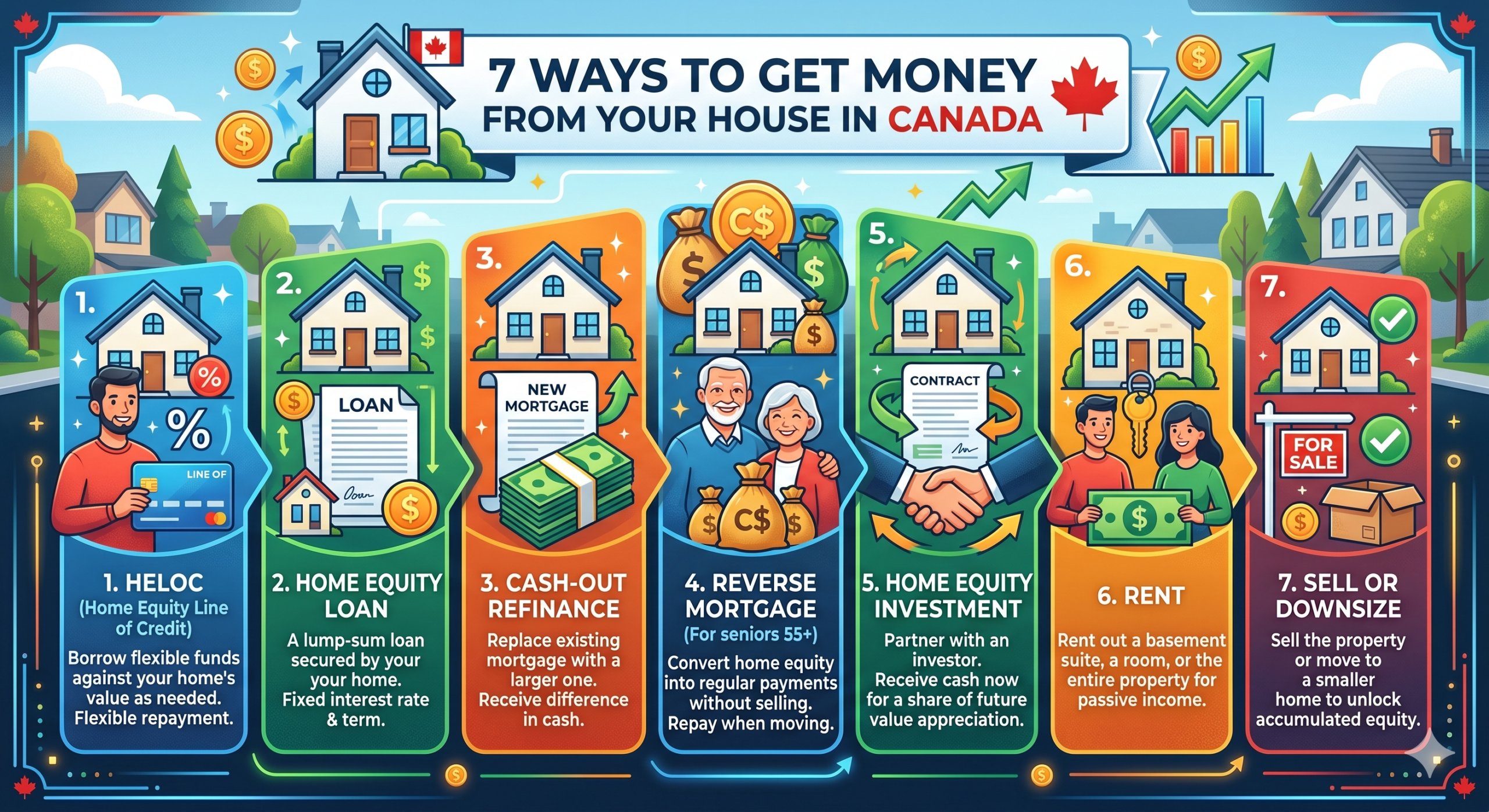
7 Ways to Get Money From Your House in Canada
1. Home Equity Line of Credit (HELOC)
A HELOC is one of the most flexible ways to get money from your house. It works like a credit card secured against your home you’re approved for a maximum limit, but you only pay interest on what you actually use.
Best for: Ongoing or unpredictable expenses (renovations done in phases, tuition over several years, emergency buffers).
Pros:
- Pay interest only on the amount you draw
- Reuse the credit as you pay it down
- Lower interest rates than credit cards or unsecured loans
Cons:
- Variable interest rate — payments can rise
- Easy access can lead to overspending
- The lender can reduce or freeze your limit
Most Canadian HELOCs let you borrow up to 65% of your home’s value as a standalone product, or up to 80% when combined with your mortgage.
2. Home Equity Loan (Second Mortgage)
A home equity loan — often called a second mortgage — gives you a one-time lump sum at a fixed interest rate, paid back over a set term.
Best for: A specific, known expense like a major renovation, debt consolidation, or business investment.
Pros:
- Fixed payments make budgeting easier
- Often available even with bruised credit
- Faster approval than refinancing in many cases
Cons:
- You take on a second monthly payment
- Higher rates than a first mortgage
- Closing costs can apply
This is often the go-to option for homeowners who don’t qualify with traditional banks but have strong equity. Alternative and private lenders look at the property’s value first and the borrower’s credit profile second.
3. Cash-Out Refinance
A cash-out refinance replaces your existing mortgage with a new, larger one, and you pocket the difference in cash.
Best for: Homeowners whose current mortgage rate is higher than today’s rates, or who want to consolidate debt into one lower payment.
Pros:
- One single payment instead of two
- Often, the lowest interest rate of any equity product
- Can extend your amortization to lower monthly costs
Cons:
- You may pay a prepayment penalty to break your existing mortgage
- Resets your amortization clock
- Closing costs (legal, appraisal, possibly CMHC if applicable)
Refinancing makes the most sense when interest rates have dropped since you signed your current mortgage, or when the savings from consolidating high-interest debt outweigh the prepayment penalty.
4. Reverse Mortgage
If you’re 55 or older, a reverse mortgage lets you get money from your house without making any monthly payments. The loan plus interest is repaid when you sell the home, move out, or pass away.
Best for: Retired homeowners who are house-rich but cash-poor and want to age in place.
Pros:
- No monthly payments required
- You keep ownership of your home
- The funds are tax-free
Cons:
- Interest rates are higher than traditional mortgages
- Reduces the equity you’ll leave to heirs
- Strict age and equity requirements
Reverse mortgages have grown significantly in Canada, particularly among retirees who don’t want to downsize but need supplemental income.
5. Home Equity Investment (Equity Sharing)
A newer option in Canada, home equity investment lets you receive a lump sum in exchange for a share of your home’s future appreciation without taking on monthly debt payments.
Best for: Homeowners who can’t qualify for traditional debt, or who want cash without adding to their monthly obligations.
Pros:
- No monthly payments
- No interest charges
- Approval focused on equity, not income or credit
Cons:
- You give up a portion of future appreciation
- Total cost can be high if your home appreciates significantly
- Fewer providers in Canada than in the U.S.
This option is still emerging, so it pays to compare carefully and read the fine print on the buyout terms.
6. Rent Out Part of Your Home
You don’t have to borrow to get money from your house. If you have an unused basement, in-law suite, garage loft, or even a spare room, renting it out generates ongoing income from the asset you already own.
Best for: Homeowners with extra space who want recurring income rather than a lump sum.
Pros:
- Doesn’t add to your debt load
- Builds a steady monthly income stream
- May qualify you for rental income to support a future mortgage application
Cons:
- Comes with landlord responsibilities
- Local zoning rules may restrict secondary suites
- Tax implications on rental income
Many Ontario municipalities now actively encourage secondary suites and garden suites check your local rules before renovating.
7. Sell and Downsize
The most direct way to get money from your house is to sell it. Downsizing to a smaller home, a different city, or a condo can free up significant cash, eliminate your mortgage entirely, and reduce ongoing carrying costs.
Best for: Homeowners ready for a lifestyle change, or those who need to access a large amount of equity at once.
Pros:
- Unlocks 100% of your equity
- No new debt
- Simplifies finances
Cons:
- Selling and moving costs add up (commissions, legal fees, land transfer tax)
- Emotional and logistical effort
- Timing the market is unpredictable
How to Choose the Right Option
The best way to get money from your house depends on a few key factors:
- How much you need — A small renovation may only call for a HELOC; a major debt consolidation may justify a full refinance.
- How quickly you need it — Second mortgages and HELOCs typically close faster than refinances.
- Your credit and income situation — Bank-prime borrowers have the most options; self-employed, bruised credit, or non-traditional income borrowers may do better with alternative or private lenders.
- Your stage of life — Reverse mortgages are powerful for retirees but rarely the right fit for someone still earning.
- Your tolerance for monthly payments — If cash flow is tight, options that don’t add a monthly bill (reverse mortgage, equity investment, renting out space) may make more sense.
A mortgage broker who works with multiple lender types can usually map these factors to the right product faster than calling banks one by one.
What It Costs to Get Money From Your House
Most equity products in Canada come with similar cost categories:
- Appraisal fee: $300–$600 to confirm your home’s value
- Legal fees: $700–$1,500 depending on the product and province
- Lender fees: Vary by lender and product type, especially with alternative or private mortgages
- Prepayment penalties: Apply if you break an existing mortgage early
- Interest rate: Ranges widely — from prime-based rates on HELOCs to higher rates on second mortgages and reverse mortgages
Always ask for an APR (annual percentage rate) rather than just the posted rate. APR rolls in fees and gives you a clearer picture of the true cost.
Common Mistakes to Avoid
- Borrowing more than you need. Just because you qualify for $200,000 doesn’t mean you should take it.
- Using equity for depreciating purchases. Tapping home equity to pay for a vacation or a car often means you’re still paying for it years after the value is gone.
- Ignoring the exit plan. Especially with second mortgages and private lending know how and when you’ll refinance back to lower-cost debt.
- Going with the first lender who says yes. Rates, fees, and flexibility vary widely. Comparison saves real money.
Frequently Asked Questions
How much money can I get from my house in Canada? Most lenders allow you to borrow up to 80% of your home’s appraised value, minus your existing mortgage balance. So if your home is worth $700,000 and you owe $300,000, you could potentially access up to $260,000 in equity.
What’s the easiest way to get money from your house? A HELOC is often the fastest and most flexible option for homeowners with strong credit and steady income. For homeowners with credit challenges, a second mortgage through an alternative lender is usually quicker and easier to qualify for than refinancing with a bank.
Can I get money from my house with bad credit? Yes. Alternative and private lenders focus more on the equity in your home than on your credit score. Second mortgages, in particular, are designed for borrowers who have equity but don’t qualify with traditional banks.
Do I have to pay tax on money I take out of my home? No. Money borrowed against your home is debt, not income, so it isn’t taxable. However, if you use the funds to invest, the interest may be tax-deductible — and if you sell your principal residence, capital gains exemptions may apply.
How long does it take to get money from your house? HELOCs and refinances with major banks typically take 2–4 weeks. Second mortgages and private lender deals can sometimes close in as little as 5–10 business days.
Is it better to refinance or get a second mortgage? Refinancing generally offers a lower rate but resets your amortization and may trigger a prepayment penalty. A second mortgage avoids breaking your current mortgage and is usually faster to set up, but at a higher interest rate. The right choice depends on your existing rate, the size of any penalty, and how long you’ll need the money.
What happens if I can’t repay the loan? Any loan secured against your home, including HELOCs, second mortgages, refinances, and reverse mortgages, gives the lender the right to foreclose if payments aren’t made. That’s why it’s critical to borrow conservatively and have a clear repayment plan.
Ready to Find the Right Fit?
There’s no single best way to get money from your house only the option that matches your numbers, your goals, and your situation. At LendToday.ca, we work with borrowers across Ontario every day to map equity to the right product, whether that’s a HELOC, a second mortgage, a refinance, or something more creative.
If you’d like a no-pressure conversation about what’s possible with your home’s equity, get in touch with our team, and we’ll walk you through it.